
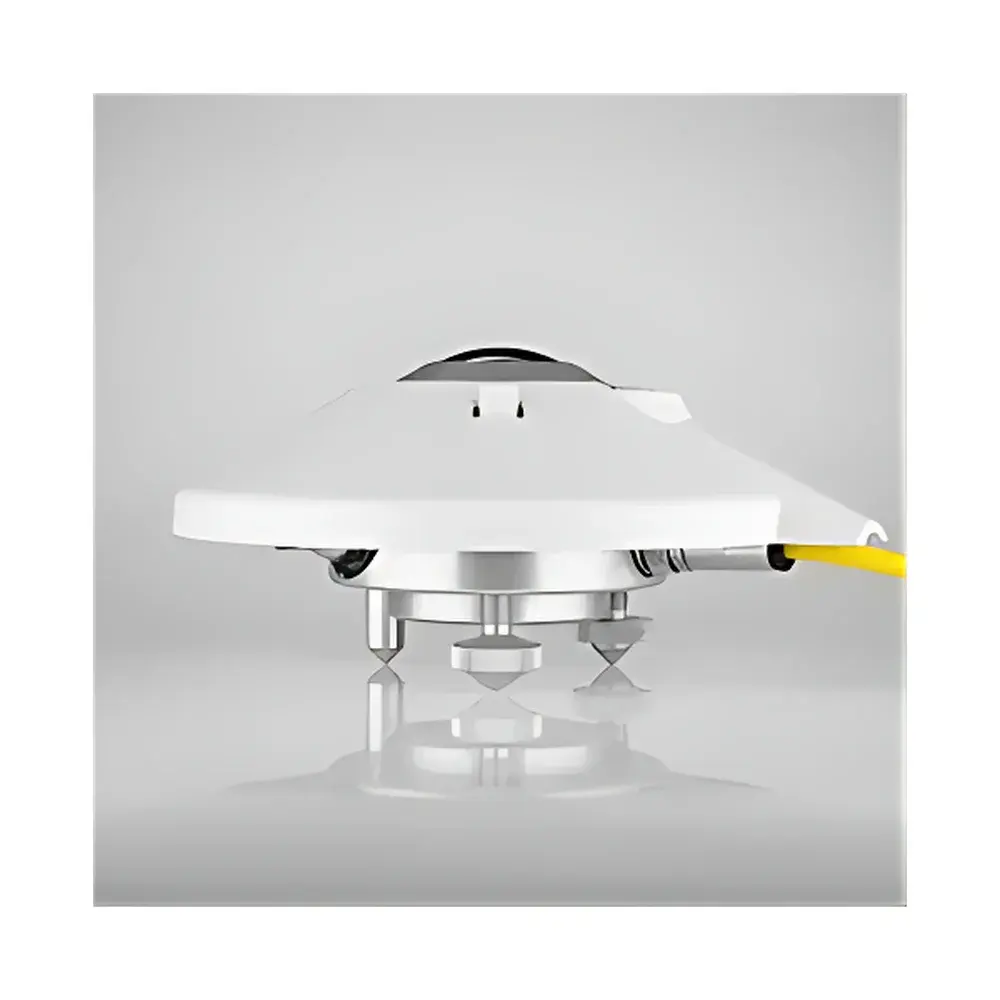
Kipp & Zonen CGR4 and SGR4 Longwave Infrared Radiometers
| Brand | Kipp & Zonen |
|---|---|
| Origin | Netherlands |
| Model | CGR4 / SGR4 |
| Spectral Range (CGR4) | 4500–42000 nm |
| Spectral Range (SGR4) | 4400–50000 nm |
| Sensitivity | 5–15 µV/W/m² |
| Response Time | 18 s |
| Window Heating Offset (CGR4) | < 4 W/m² |
| Zero Offset B | < 2 W/m² |
| Temperature Dependence of Sensitivity (−20 to +50 °C) | < 1 % |
| Operating Temperature Range | −40 to +80 °C |
| Net Irradiance Range | −250 to +250 W/m² |
| Field of View | 180° |
| Non-linearity Error | < 1 % |
| Analog Output (SGR4) | 4–20 mA / 0–1 V (mV/W·m²) |
| Digital Output (SGR4) | 2-wire RS-485 Modbus® |
| Power Supply (SGR4) | 5–30 VDC |
Overview
The Kipp & Zonen CGR4 and SGR4 longwave infrared radiometers are precision instruments engineered for continuous, high-fidelity measurement of terrestrial downward longwave radiation (DLR) and net longwave radiation (NLR) in atmospheric science, climatology, and surface energy balance studies. Both models operate on the thermopile detection principle: incident infrared radiation is absorbed by a blackened thermopile sensor, generating a voltage proportional to the irradiance (W/m²) across the instrument’s specified spectral band. The CGR4 employs passive thermal design with a meniscus-shaped silicon dome optimized for uniform angular response and minimal directional error (<0.5 % over 180° field of view). The SGR4 builds upon this architecture with integrated signal conditioning, temperature-compensated analog/digital outputs, and enhanced environmental resilience—making it suitable for unattended operation in remote or networked meteorological stations.
Key Features
- Meniscus-shaped silicon dome with hard carbon coating: ensures spectrally smooth transmission (4400–50000 nm for SGR4; 4500–42000 nm for CGR4), mechanical durability, and minimized spectral distortion.
- Thermally coupled dome-body design: eliminates need for separate dome temperature measurement or shading, improving thermal stability and reducing zero drift under diurnal thermal cycling.
- Integrated bubble level relocated to top of housing: enables real-time leveling verification without removing the redesigned snap-fit sun shield—critical for maintaining calibration integrity during field deployment.
- Gold-plated connectors and screw-in desiccant cartridge: support repeatable, low-contact-resistance connections and simplified moisture management; CGR4 includes replaceable desiccant; SGR4 features factory-sealed, 10-year service-life desiccant.
- Optional ventilation units: CVF 3 (for CGR4) and CVF 4 (for SGR4) reduce dew/frost accumulation, extend cleaning intervals, and suppress convective heat exchange errors—particularly valuable in high-humidity or sub-zero environments.
- SGR4-specific enhancements: Modbus® RTU over 2-wire RS-485, temperature-corrected 4–20 mA and 0–1 V analog outputs, wide-input DC power (5–30 V), and standardized mechanical/electrical interfaces enabling seamless instrument interchangeability and recalibration traceability.
Sample Compatibility & Compliance
Both CGR4 and SGR4 comply with ISO 9060:2018 classification as “Secondary Standard” pyrgeometers, meeting stringent requirements for directional response, temperature dependence, and non-linearity. They are routinely deployed in WMO GAW (Global Atmosphere Watch) stations, FLUXNET eddy covariance sites, and national climate monitoring networks. Their construction adheres to IEC 61215 and IEC 61724-1 for outdoor environmental robustness, including IP67-rated cable glands and UV-stabilized housings. Calibration certificates are traceable to the World Infrared Standard Group (WISG) maintained at PMOD/WRC (Davos, Switzerland). Data acquisition systems integrating these sensors may be configured to meet GLP audit requirements, including timestamped calibration logs and sensor identity tracking via Modbus® register mapping.
Software & Data Management
The SGR4 ships with SmartExplorer Windows™ software—a validated tool for configuration, real-time visualization, and data logging. Users can assign unique Modbus® addresses, define scaling factors, and activate built-in temperature compensation profiles. All output values (downward longwave, upward longwave, net radiation) are computed internally using factory-characterized coefficients; no post-processing is required for standard applications. Raw sensor voltage, dome temperature (if equipped with optional probe), and diagnostic flags are accessible via RS-485. Data streams integrate natively with Campbell Scientific CR-series loggers, Siemens Desigo, and open-source platforms (e.g., Python-based PyModbus) supporting MODBUS RTU over RS-485. Firmware updates are delivered via serial command protocol and logged with version stamping for compliance documentation.
Applications
- Surface energy balance modeling in micrometeorology and hydrology (e.g., evapotranspiration estimation using SEBAL or METRIC algorithms).
- Long-term climate trend analysis in polar, alpine, and desert environments where thermal stability and low-power operation are critical.
- Validation of satellite-derived LWR products (e.g., CERES, GERB) and reanalysis datasets (ERA5, MERRA-2).
- Performance monitoring of radiative cooling materials and building envelope thermal dynamics.
- Calibration transfer and intercomparison campaigns between ground-based networks and reference observatories.
FAQ
What is the primary difference between CGR4 and SGR4?
The CGR4 is a passive thermopile radiometer requiring external signal conditioning and data logging; the SGR4 integrates amplification, temperature compensation, analog/digital outputs, and Modbus® communication—reducing system integration complexity.
Can CGR4 and SGR4 be used interchangeably in an existing station?
Mechanically and optically yes—but electrical interface and power requirements differ; SGR4 replaces legacy analog-only installations with digital-readiness while maintaining identical mounting geometry and calibration traceability.
Is dome heating correction applied automatically in SGR4?
No—window heating offset (<4 W/m²) is a physical artifact mitigated by ventilation (CVF 4); the instrument does not apply algorithmic correction, preserving metrological transparency per ISO 9060.
How often does the SGR4 require recalibration?
Kipp & Zonen recommends recalibration every two years for research-grade applications; annual verification against a traveling reference is advised for GAW-tier deployments.
Does the Modbus® interface support reading calibration coefficients?
Yes—registers store sensitivity (µV/W·m²), zero offset B (W/m²), temperature coefficient (%/°C), and calibration date—enabling automated metadata embedding in time-series databases.
Related Products







