
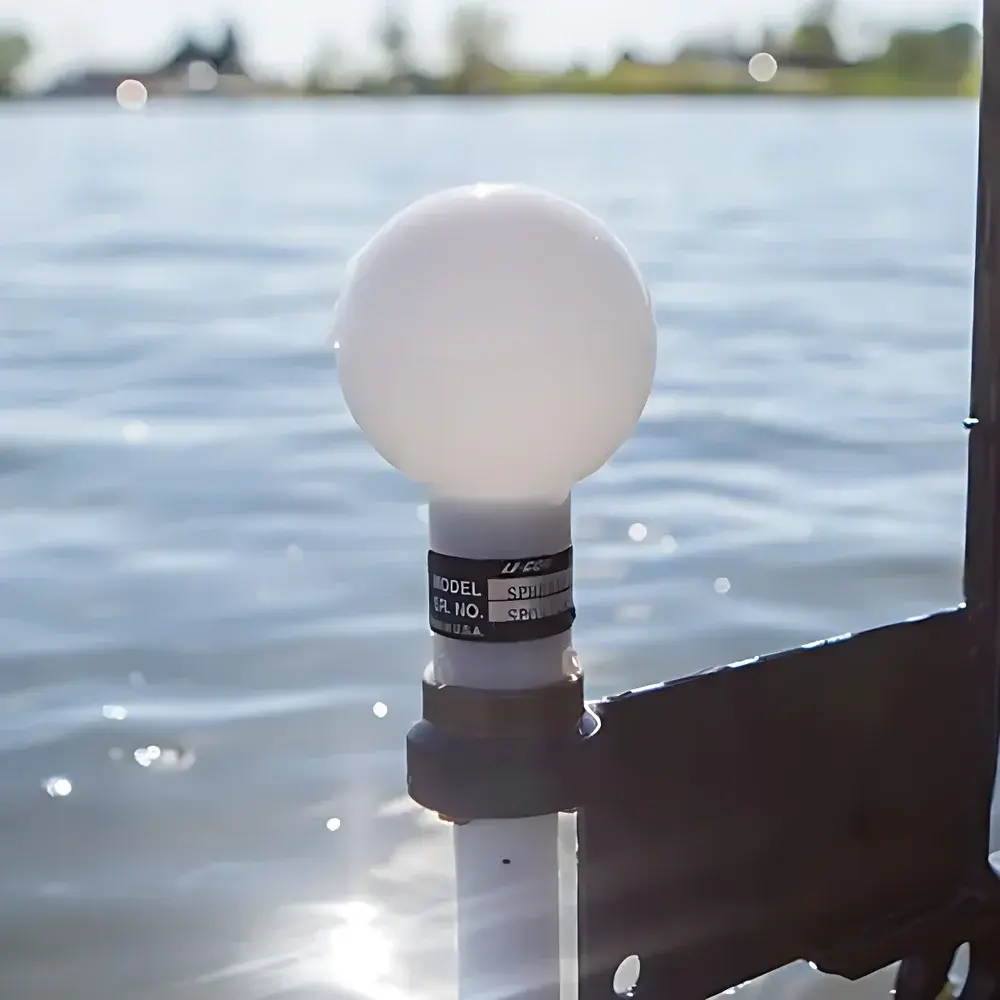
LI-COR LI-193 Spherical Underwater Photosynthetically Active Radiation (PAR) Sensor
| Brand | LI-COR |
|---|---|
| Origin | USA |
| Model | LI-193 Spherical Underwater PAR Sensor |
| Measurement Depth | Up to 350 m |
| Spectral Range | 400–700 nm |
| Calibration Uncertainty | ±5% |
| Sensitivity | 7 µA per 1000 µmol·s⁻¹·m⁻² (typ.) |
| Linearity | ±1% deviation up to 10,000 µmol·s⁻¹·m⁻² |
| Long-term Stability | <±2% per year |
| Response Time | 10 µs |
| Temperature Dependence | ≤±0.15%/°C |
| Angular Response Error | <±4% up to ±90° from vertical axis |
| Azimuthal Uniformity | <±3% over full 360° at 90° from vertical |
| Operating Temperature | −40 to +65 °C |
| Pressure Rating | 3400 kPa (equivalent to 350 m seawater depth) |
| Sensor Sphere Diameter | 6.1 cm |
| Base Diameter | 3.18 cm |
| Total Height | 10.7 cm |
| Mass | 142 g |
| Cable Options | Standard 3 m |
| optional lengths | 10, 30, 50, or 100 m (LI-2222UWB submersible cable) |
Overview
The LI-COR LI-193 Spherical Underwater Photosynthetically Active Radiation (PAR) Sensor is an optically engineered instrument designed for quantitative measurement of scalar irradiance across the photosynthetically active spectral region (400–700 nm) in aquatic environments. Unlike planar sensors that measure irradiance incident on a flat surface, the LI-193 employs a precision-ground spherical diffuser to collect photons isotropically—i.e., from all directions (2π steradians upward + 2π steradians downward = 4π total)—enabling accurate determination of quantum scalar irradiance (QSI), also reported as photosynthetic photon flux density (PPFD) in scalar mode. This capability is essential for modeling light availability to non-directional phototrophs such as phytoplankton, cyanobacteria, and suspended microalgae, whose photosynthetic response depends on integrated photon exposure rather than directional flux. The sensor’s optical architecture incorporates a spectrally selective interference filter matched to the quantum efficiency curve of chlorophyll-based photosynthesis, coupled with a blue-enhanced silicon photovoltaic detector optimized for high signal-to-noise ratio in low-light underwater conditions. Its pressure-rated housing (3400 kPa) ensures reliable operation down to 350 m in both freshwater and seawater, making it suitable for profiling in oceanographic moorings, limnological buoys, and benthic observatories.
Key Features
- Spherical cosine-corrected diffuser enabling true 4π solid angle collection for quantum scalar irradiance quantification
- Optimized spectral response (400–700 nm) aligned with CIE and ISO-defined PAR action spectrum, with <±5% absolute calibration traceable to NIST standards
- High-stability silicon photovoltaic detector with blue-enhanced responsivity, minimizing drift under prolonged immersion
- Corrosion-resistant metallic housing rated for continuous operation in saline and freshwater environments up to 350 m depth (3400 kPa)
- Fast temporal response (10 µs) supporting high-frequency profiling and synchronization with pulsed light sources or rapid-depth descent systems
- Minimal angular dependence: <±4% deviation across ±90° zenith angles and <±3% azimuthal variation over full 360° rotation at horizontal orientation
- Thermal stability of ≤±0.15%/°C enables deployment across broad thermal gradients without active temperature compensation
Sample Compatibility & Compliance
The LI-193 is compatible with a wide range of aquatic media, including turbid coastal waters, glacial runoff, eutrophic lakes, and oligotrophic open-ocean columns. Its compact form factor (6.1 cm sphere diameter) minimizes flow disturbance during towed or free-fall deployments. The sensor meets ISO 17025-accredited calibration protocols and complies with ASTM E2628–21 (Standard Practice for In Situ Measurement of Underwater Scalar Irradiance). It supports GLP-compliant data acquisition when paired with LI-COR’s LI-1500 datalogger or third-party systems equipped with 0–5 V analog input and timestamping capabilities. All calibration certificates include uncertainty budgets per GUM (Guide to the Expression of Uncertainty in Measurement) and are valid for 12 months under normal use conditions.
Software & Data Management
Raw output is a calibrated analog current signal (7 µA per 1000 µmol·s⁻¹·m⁻²), convertible to µmol·s⁻¹·m⁻² via user-defined scaling in any data acquisition platform. When used with LI-COR’s proprietary software (LI-1500 Firmware v3.2+, LI-COR Logger v5.1+), the sensor integrates seamlessly into automated profiling workflows, supporting real-time telemetry, automatic dark-offset correction, and metadata tagging (depth, temperature, GPS position). Export formats include CSV, NetCDF4, and CF-compliant files suitable for ingestion into Ocean Data View (ODV), MATLAB, Python (xarray/pandas), or ERDDAP servers. Audit trails and electronic signatures comply with FDA 21 CFR Part 11 requirements when configured with appropriate access controls and system validation documentation.
Applications
- Vertical profiling of scalar PAR in stratified water columns to parameterize primary production models (e.g., Platt et al. 1980, Morel & Smith 1974)
- Calibration and validation of ocean color satellite algorithms (e.g., MODIS, VIIRS, Sentinel-3 OLCI) through match-up in situ datasets
- Long-term mooring-based monitoring of light climate shifts associated with climate-driven changes in mixed-layer depth and particle load
- Experimental mesocosm studies evaluating phytoplankton photoacclimation under variable light quality and quantity regimes
- Benthic light assessment for coral reef resilience studies and seagrass habitat mapping
- Integration into autonomous platforms including AUVs, gliders, and profiling floats (e.g., Argo-BGC extensions)
FAQ
What does “quantum scalar irradiance” mean, and how is it different from planar PAR?
Quantum scalar irradiance (QSI) represents the total photon flux per unit area per unit time, integrated over all incident directions (4π steradians). It is expressed in µmol·s⁻¹·m⁻² and is the appropriate metric for organisms that absorb light omnidirectionally, such as planktonic algae. Planar PAR measures only downward-directed irradiance on a flat surface (2π steradians), which underestimates available light in scattering or reflective environments.
Can the LI-193 be deployed continuously for months on a mooring?
Yes—the sensor’s pressure-rated housing, corrosion-resistant materials, and long-term stability (<±2% per year) support multi-month unattended deployments. Biofouling mitigation (e.g., copper alloy housings or periodic cleaning protocols) is recommended for extended missions in productive waters.
Is factory recalibration required annually?
While not mandatory, LI-COR recommends annual recalibration against a reference standard traceable to NIST to maintain stated ±5% uncertainty. Field validation using a stable secondary standard or intercomparison with co-located sensors is advised before critical campaigns.
Does the LI-193 require temperature compensation during data processing?
The sensor’s intrinsic temperature coefficient is ≤±0.15%/°C. For applications requiring <1% total uncertainty, users may apply optional linear temperature correction using concurrent thermistor readings, though many operational oceanographic programs omit this step without measurable impact on trend analysis.
Which data loggers are natively compatible?
The LI-1500 Datalogger and LI-250A Meter provide plug-and-play support, including auto-ranging, dark-offset subtraction, and built-in PAR units. Third-party systems with 0–5 V analog input, 16-bit resolution, and sampling rates ≥1 Hz are also fully interoperable.




