
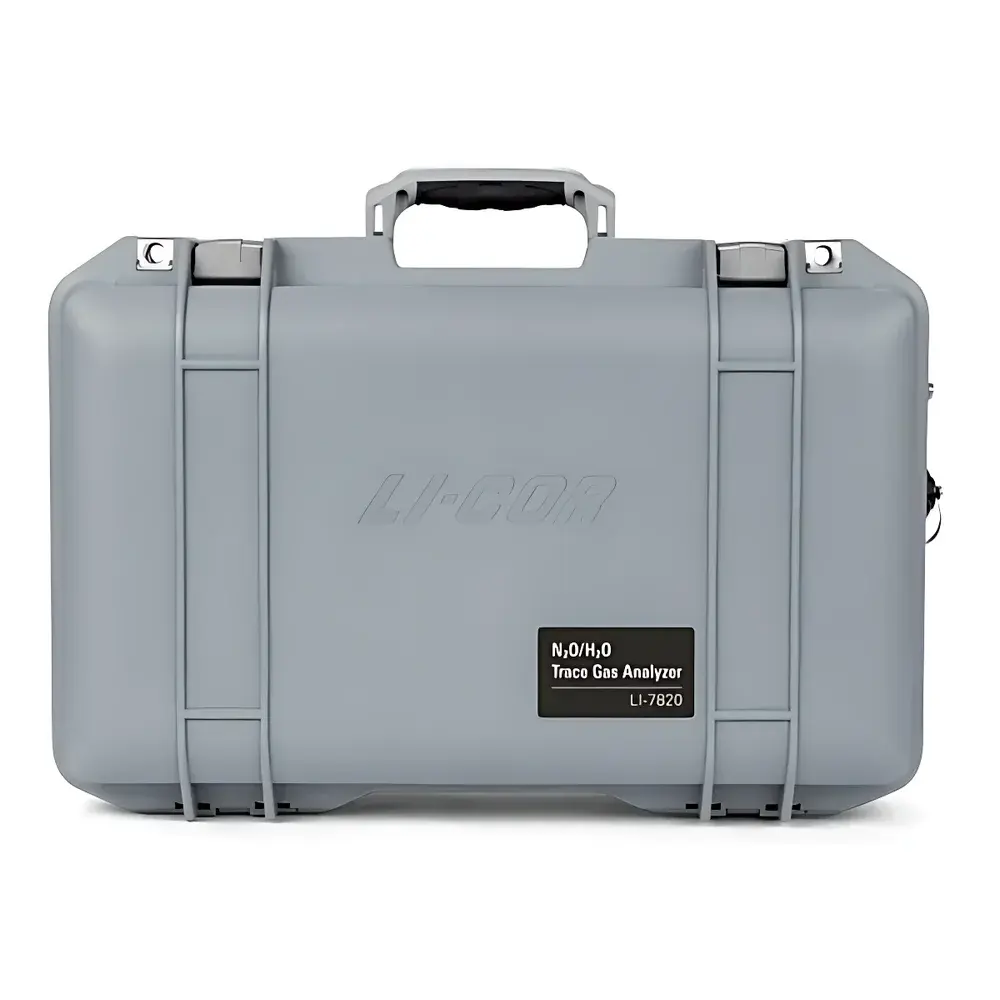
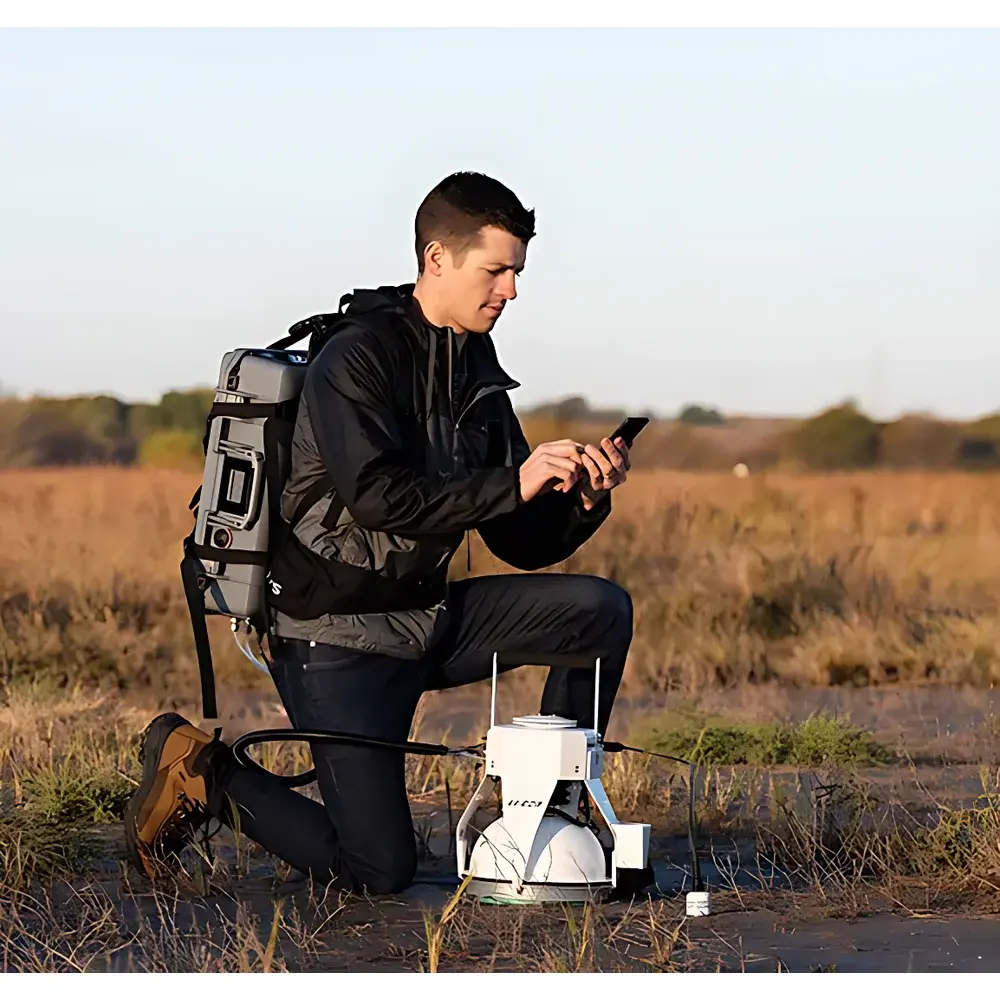
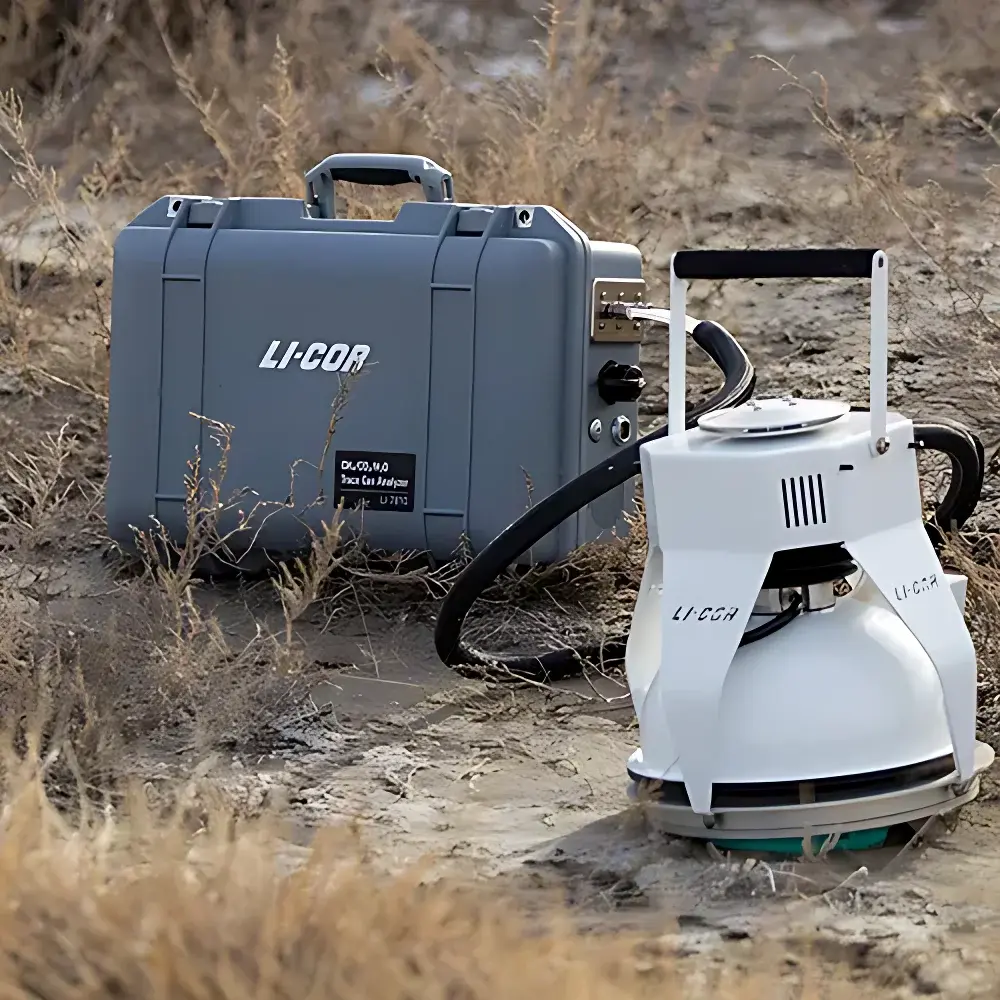
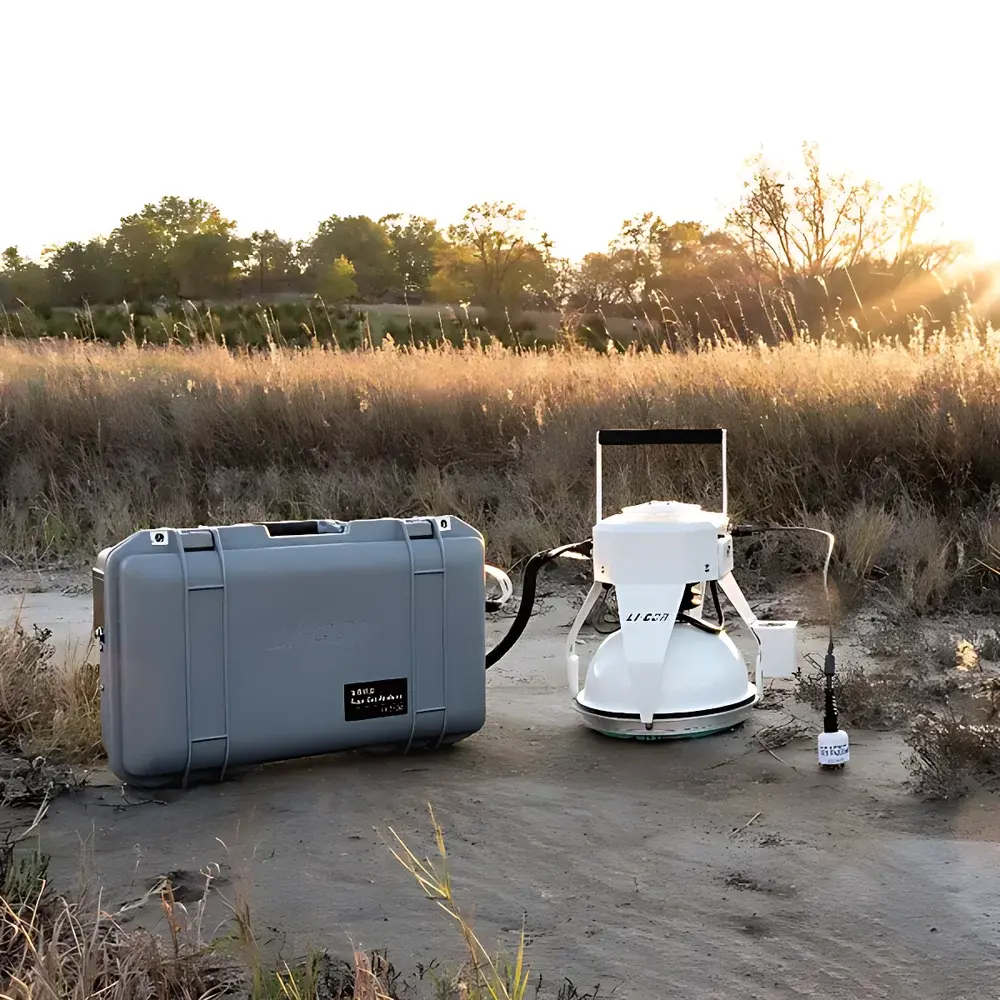
LI-COR LI-7820 Portable Soil N₂O/H₂O Flux Measurement System
| Brand | LI-COR |
|---|---|
| Origin | USA |
| Model | LI-7820 |
| Measurement Principle | Off-axis Cavity-Enhanced Absorption Spectroscopy (OF-CEAS) |
| N₂O Range | 0–100 ppm |
| N₂O Precision (1σ) | 0.05 ppb @ 330 ppb (60-s avg) |
| N₂O Response Time (T₁₀–T₉₀) | ≤2 s |
| H₂O Range | 0–60,000 ppm |
| H₂O Precision (1σ) | 5 ppm @ 10,000 ppm (60-s avg) |
| Measurement Frequency | 1 Hz |
| Optical Cavity Volume | 6.41 cm³ |
| Sample Flow Rate | 250 sccm (standard) |
| Operating Temperature | –25 to 45 °C |
| Operating Humidity | 0–85% RH (non-condensing, no direct solar exposure) |
| Sampling Line Humidity Tolerance | 0–99.9% RH (non-condensing) |
| Pressure Range | 70–110 kPa (extended mode: 50–110 kPa) |
| Power Consumption | 22 W (steady-state, 25 °C) |
| Battery Runtime | ~8 h (dual battery configuration) |
| Weight | 10.5 kg (incl. batteries) |
| Dimensions | 51 × 33 × 18 cm (L×W×H) |
| Connectivity | Ethernet, Wi-Fi (2.4 GHz, 802.11 a/b/g/n/ac) |
| Compliance | Designed for field-deployable GLP-aligned workflows |
Overview
The LI-COR LI-7820 Portable Soil N₂O/H₂O Flux Measurement System is an engineered field solution for high-temporal-resolution quantification of nitrous oxide (N₂O) and water vapor (H₂O) concentrations in soil-atmosphere exchange studies. Built upon off-axis cavity-enhanced absorption spectroscopy (OF-CEAS), the instrument delivers sub-part-per-trillion sensitivity and exceptional stability under variable ambient conditions. Unlike conventional tunable diode laser (TDL) or quantum cascade laser (QCL) platforms, OF-CEAS provides intrinsic immunity to optical misalignment and enhanced effective pathlength (>10 km) within a compact 6.41 cm³ optical cavity—enabling robust, drift-resistant measurements without active cavity length stabilization. The LI-7820 is explicitly designed for integration into eddy covariance towers, static chamber networks, and mobile survey platforms where low power draw, mechanical resilience, and real-time data accessibility are operational imperatives. Its native 1 Hz sampling rate, <2 s N₂O response time, and calibrated performance across pressure (50–110 kPa) and humidity (0–99.9% RH in sample line) gradients ensure metrological continuity from alpine tundra to tropical wetlands.
Key Features
- True portable architecture: 10.5 kg total mass with integrated rechargeable batteries enables single-operator deployment in remote terrain without external power infrastructure.
- Embedded web server with dual connectivity: Access live concentration traces, diagnostic logs, and calibration status via Ethernet or Wi-Fi (2.4 GHz, IEEE 802.11 a/b/g/n/ac)—no proprietary software required.
- Field-optimized user interface: High-contrast LCD display provides real-time N₂O/H₂O values, signal-to-noise metrics, cavity pressure/temperature diagnostics, and system health alerts—operation requires no internal hardware access.
- Interoperable chamber integration: Seamless synchronization with LI-COR’s 8200-01 Smart Chamber (GPS-enabled, self-regulating flow control, on-board flux computation) or multi-channel LI-8150/LI-8250 soil flux systems for automated, temperature- and moisture-compensated flux derivation.
- Low-maintenance optical design: OF-CEAS eliminates moving parts in the detection path; cavity mirrors are sealed and thermally stabilized to minimize thermal drift (<1 ppb/24 h baseline offset).
Sample Compatibility & Compliance
The LI-7820 accommodates unfiltered, humid gas streams directly from soil collars, root-zone probes, or atmospheric intakes—no external drying or conditioning is mandated prior to analysis. Its sample line accepts 0–99.9% RH input (non-condensing), while internal thermoelectric cooling maintains detector stability across –25 to 45 °C ambient ranges. The system complies with measurement traceability frameworks outlined in ISO 17025:2017 (clause 7.7) for field gas analyzers and aligns with US EPA Method TO-15 guidance for N₂O speciation in ambient air. When paired with 8200-01 chambers, raw concentration time series are processed using first-order linear regression (R² ≥ 0.95 threshold) per ASTM D6584-22 Annex A1, generating flux outputs compliant with IPCC Tier 2 reporting requirements. All data timestamps are synchronized to UTC via integrated NTP or GPS-derived time sources.
Software & Data Management
Data acquisition occurs natively in CSV and JSON formats via HTTP GET requests to the onboard web API. Each measurement packet includes: timestamp (UTC, microsecond precision), N₂O concentration (ppb), H₂O concentration (ppm), cavity pressure (kPa), cavity temperature (°C), laser current (mA), and signal variance (digital units). No local storage is required—the instrument streams continuously to networked servers or edge devices. For long-term monitoring deployments, LI-COR’s EddyPro® and FluxSuite™ software packages support automated ingestion, quality flagging (e.g., wind-speed-filtered chamber closures), and export to CF-compliant NetCDF files. Audit trails—including user login events, parameter changes, and firmware updates—are retained for ≥180 days and exportable for GLP/GMP validation documentation.
Applications
- Soil greenhouse gas flux characterization across agricultural, forest, and wetland ecosystems, including fertilizer-response trials and denitrification inhibition studies.
- Background atmospheric monitoring at remote stations (e.g., NOAA GML sites), where low-power, high-stability N₂O baselines inform global trend modeling.
- Mobile emissions mapping: mounted on all-terrain vehicles or UAV payloads for spatially resolved N₂O hot-spot identification near wastewater treatment plants or livestock facilities.
- Multi-sensor network deployments: synchronized operation with CO₂/H₂O analyzers (e.g., LI-7815), soil moisture/temperature probes, and meteorological stations for process-level biogeochemical modeling.
- Method development and intercomparison campaigns: serves as a reference-grade transfer standard in laboratory and field-based round-robin testing per ISO 5725-2:2019.
FAQ
Does the LI-7820 require zero/span calibration in the field?
No routine zero/span is required due to OF-CEAS inherent stability; however, periodic verification using certified N₂O standards (e.g., NOAA-certified cylinders) is recommended every 30–90 days depending on application criticality.
Can the LI-7820 operate at high altitude?
Yes—the extended pressure range (50–110 kPa) and automatic pressure compensation algorithm maintain accuracy up to ~5,500 m ASL.
Is the instrument compatible with third-party data loggers?
Yes—via Modbus TCP or ASCII-over-TCP protocols; full register map and command syntax are provided in the LI-7820 Communication Protocol Manual v3.2.
What is the minimum detectable flux when used with the 8200-01 chamber?
Under typical field conditions (20 cm diameter collar, 5-min closure), the system achieves a flux detection limit of 2.1 ng N m⁻² s⁻¹ (1σ, 60-s averaging) for N₂O.
How is moisture interference mitigated in N₂O quantification?
The OF-CEAS spectral fitting algorithm applies simultaneous multi-line H₂O absorption correction using >12 water vapor transitions within the same 2.9 µm band, eliminating cross-sensitivity without physical drying.
Related Products







