
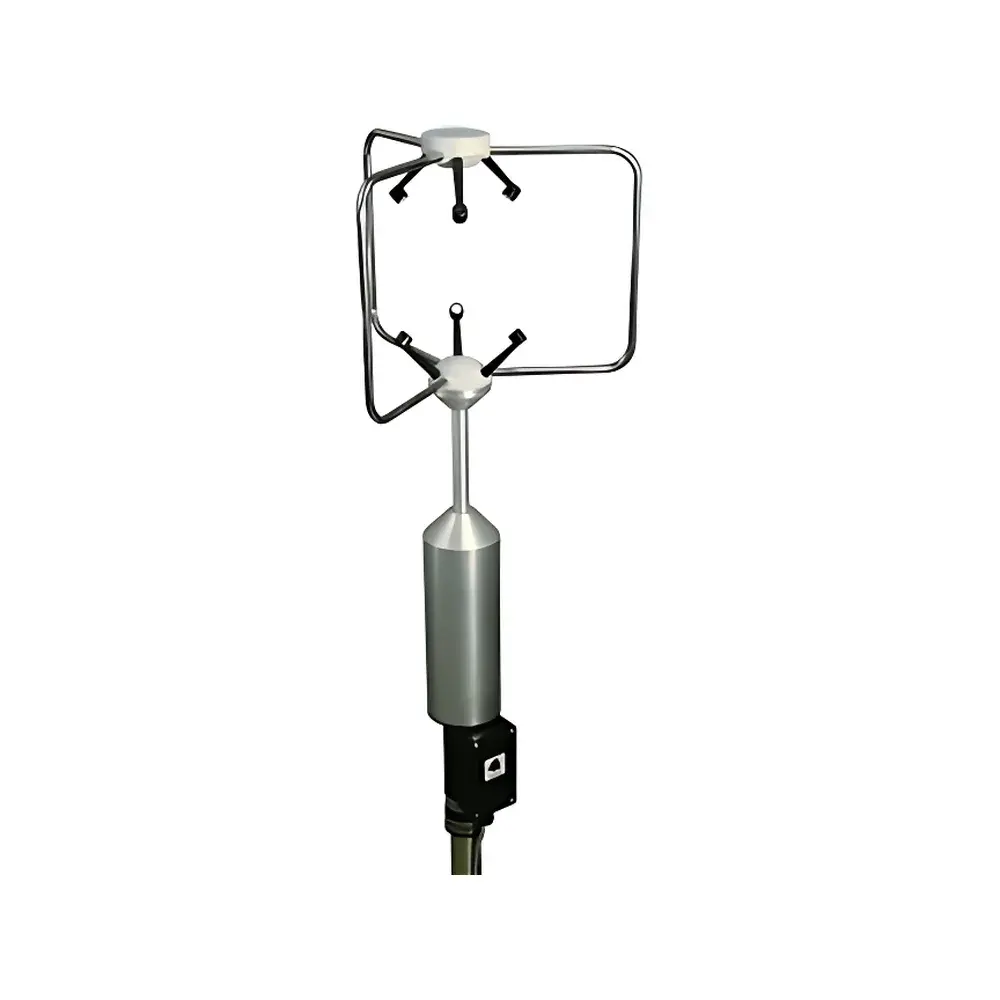
RM.YOUNG 81000RE Three-Dimensional Ultrasonic Anemometer
| Origin | USA |
|---|---|
| Manufacturer Type | Authorized Distributor |
| Origin Category | Imported |
| Model | RM.YOUNG 81000RE |
| Pricing | Available Upon Request |
Overview
The RM.YOUNG 81000RE Three-Dimensional Ultrasonic Anemometer is a precision meteorological sensor engineered for high-fidelity, real-time measurement of three-axis wind velocity (u, v, w), wind direction, vertical elevation angle, speed of sound, and sonic temperature in open-air environments. Operating on the principle of ultrasonic time-of-flight (TOF) transit-time differential measurement, the instrument calculates wind vector components by precisely timing the propagation of high-frequency acoustic pulses (≥200 kHz) between pairs of transducers arranged orthogonally in a tetrahedral configuration. This physics-based approach eliminates mechanical inertia and wear-related drift, enabling continuous, maintenance-free operation across extreme ambient conditions—from −50 °C to +50 °C—with no moving parts. Designed explicitly for long-term unattended deployment in eddy covariance (EC) flux towers, micrometeorological networks, boundary layer studies, and environmental monitoring stations, the 81000RE delivers traceable, NIST-referenced data compliant with international standards including ISO 7726 (Ergonomics of the thermal environment), ASTM D5142 (Standard Practice for Open-Path Atmospheric Monitoring), and WMO Guide to Meteorological Instruments and Methods of Observation (CIMO Guide, Chapter 8).
Key Features
- True 3D wind vector resolution: simultaneous measurement of u (east-west), v (north-south), and w (vertical) components at user-selectable output frequencies from 4 Hz to 32 Hz
- Integrated sonic temperature derivation via speed-of-sound calculation: eliminates need for separate thermistor-based air temperature sensors in turbulent heat flux computations
- Robust mechanical architecture: UV-stabilized thermoplastic housing, marine-grade 316 stainless steel mounting hardware, and anodized aluminum transducer arms ensure structural integrity under prolonged exposure to solar radiation, salt spray, and freeze-thaw cycling
- Dual serial interface support: RS-232 (default: 38400 baud, ASCII format) and RS-485 (multi-drop capability up to 1200 m) for flexible integration into SCADA, CR1000X/CR6 datalogger ecosystems, or custom telemetry platforms
- Four isolated analog voltage outputs (0–5000 mV, 12-bit resolution): independently scalable to represent 3D wind speed (0–50 m/s), compass-direction (0–540°), elevation angle (−60° to +60°), and sonic temperature (220 K to 320 K)
- Factory-calibrated linear response with documented uncertainty budgets: ±1% RMS accuracy for wind speed (0–30 m/s), ±2° directional accuracy (1–30 m/s), and ±0.1% speed-of-sound accuracy referenced to dry air at standard pressure
Sample Compatibility & Compliance
The RM.YOUNG 81000RE samples atmospheric air within a defined volumetric domain (10 cm height × 10 cm diameter cylinder) and optical path length (15 cm inter-transducer baseline). Its non-intrusive ultrasonic sensing mechanism ensures zero airflow disturbance—critical for turbulence spectral analysis and Reynolds stress estimation. The device meets IEC 61326-1 (EMC requirements for measurement and testing equipment) and UL 61010-1 (safety requirements for electrical equipment for measurement, control, and laboratory use). Data integrity protocols align with GLP/GMP-aligned field deployments: all firmware versions, calibration coefficients, and factory default settings are permanently stored in non-volatile memory and accessible via serial command set. While not inherently FDA 21 CFR Part 11 compliant, audit-trail-capable data acquisition systems (e.g., Campbell Scientific LoggerNet with security-enabled logging) may be configured to satisfy regulated environmental monitoring requirements.
Software & Data Management
Configuration and diagnostics are performed using standard terminal emulation software (e.g., PuTTY, Tera Term, or HyperTerminal) over RS-232. The embedded command interpreter supports parameter modification—including output frequency, baud rate, data format (ASCII or binary), and analog scaling factors—without requiring proprietary utilities. ASCII output includes timestamped fields: 3D wind speed (m/s), wind direction (°), elevation angle (°), speed of sound (m/s), and sonic temperature (°C). Binary mode enables higher throughput for high-frequency turbulence applications. Raw voltage outputs interface directly with 16-bit analog-to-digital converters in industrial PLCs or environmental dataloggers. RM.YOUNG provides comprehensive documentation: Instruction Manual (Rev. E), Calibration Certificate (NIST-traceable), and ASCII Protocol Specification—all available in English as PDF downloads via registered user portal.
Applications
- Eddy covariance flux measurements for CO₂, H₂O, CH₄, and energy balance studies in ecological, agricultural, and forest research
- Boundary layer profiling and turbulence kinetic energy (TKE) quantification in atmospheric science and wind engineering
- Wind resource assessment and turbine wake characterization for onshore and offshore renewable energy projects
- Urban meteorology and air quality dispersion modeling requiring high-temporal-resolution 3D wind vectors
- Calibration reference for cup-and-vane anemometers and Doppler lidar systems in metrological intercomparisons
- Long-term climate observatories (e.g., NOAA’s SURFRAD network, FLUXNET sites) where reliability, low power consumption (5 years) are mission-critical
FAQ
What is the minimum detectable wind speed threshold?
The detection threshold is 0.01 m/s, validated per IEC 61000-4-30 Annex B for low-wind sensitivity.
Can the 81000RE operate continuously in freezing rain or snow accumulation?
Yes—the transducer geometry and hydrophobic surface treatment minimize ice bridging; optional heater kits (sold separately) are available for persistent icing conditions.
Is firmware upgrade supported in-field?
Yes, via XMODEM protocol over RS-232; upgrade packages and release notes are distributed exclusively to authorized distributors and registered end-users.
Does the device require periodic recalibration?
RM.YOUNG recommends annual verification against a NIST-traceable wind tunnel or rotating arm calibrator; full recalibration is advised every 24 months or after physical impact.
How is sonic temperature different from conventional air temperature?
Sonic temperature is derived from measured speed of sound and accounts for humidity and gas composition effects; it represents virtual temperature used in flux calculations—not equivalent to dry-bulb thermistor readings.





