
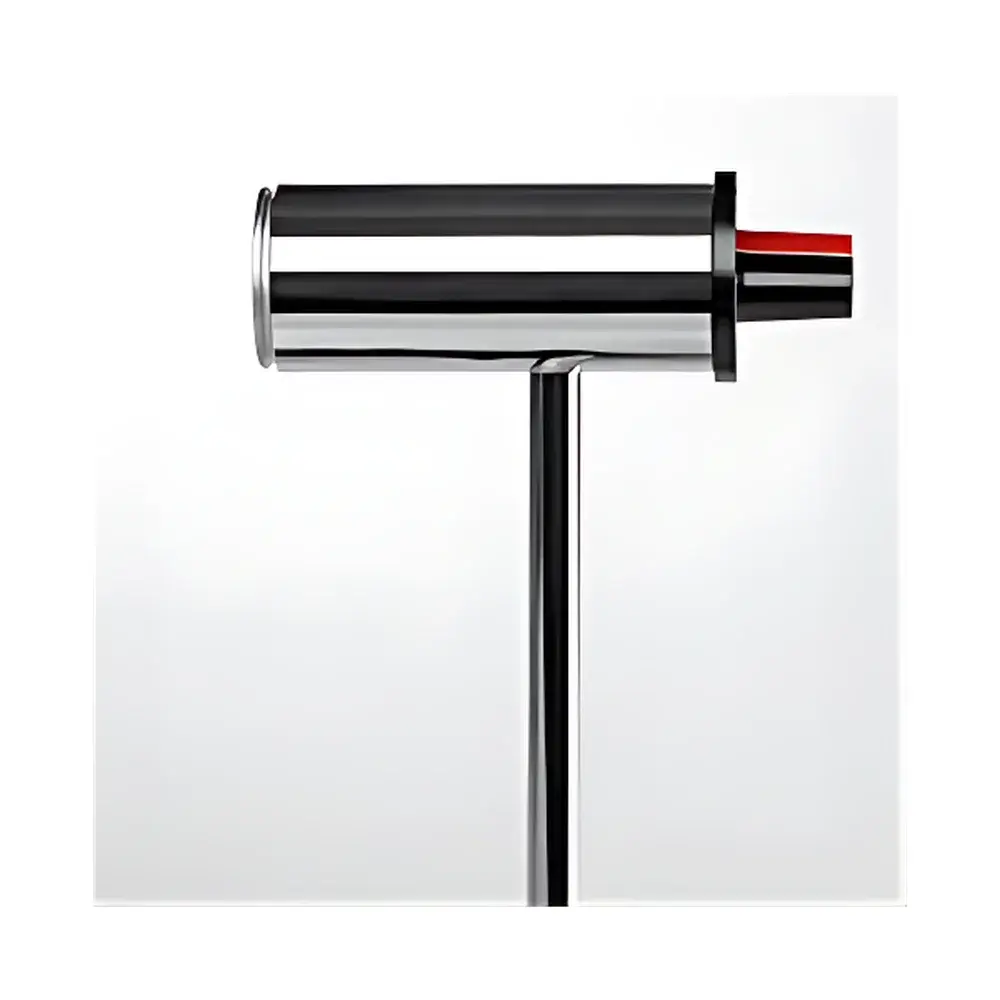
Kipp & Zonen CA2 Laboratory Thermopile Detector
| Brand | Kipp & Zonen |
|---|---|
| Origin | Netherlands |
| Model | CA2 |
| Spectral Range | 0.3–3 µm (with quartz window) / 0.2–50 µm (bare detector) |
| Sensitivity | 7–20 µV/W/m² |
| Impedance | 20–200 Ω |
| Output Range | 0–30 mV |
| Maximum Irradiance | 2000 W/m² |
| Response Time (63%) | < 6 s |
| Response Time (95%) | < 18 s |
| Operating Temperature | −40 °C to +80 °C |
| Relative Humidity | 0–100 % non-condensing |
| Power Supply | 12 VDC |
| Mounting Rod | 170 mm × 10 mm diameter |
| Field of View (90% energy acceptance) | 20° |
| Housing Material | Brass with conical reflector and removable quartz window |
Overview
The Kipp & Zonen CA2 Laboratory Thermopile Detector is a precision-calibrated, passive radiation sensor engineered for quantitative measurement of spectral irradiance in controlled laboratory environments. Unlike broadband pyranometers designed for hemispherical solar irradiance, the CA2 employs a thermopile-based detection principle—converting incident radiant flux into a proportional thermoelectric voltage via the Seebeck effect across multiple thermocouple junctions. Its defining optical architecture features a conical reflector housed within a cylindrical brass body, yielding a narrow 20° full-angle field of view (FOV) that captures radiation from discrete spatial directions or localized sources. This geometry enables targeted radiometric characterization—such as beam irradiance profiling, collimated source calibration, or directional emissivity testing—without interference from ambient scatter or off-axis contributions. The removable fused quartz window suppresses convective heat loss and minimizes thermal drift during static measurements while restricting transmission to the 0.3–3 µm near- to mid-infrared band; removal of the window extends spectral responsivity down to 0.2 µm and up to 50 µm, accommodating far-IR and thermal emission studies under inert or vacuum conditions.
Key Features
- Thermopile sensing element with high thermal mass stability and low zero-point drift, optimized for DC-coupled irradiance measurement
- 20° field of view (90% energy acceptance angle) defined by internal conical reflector geometry—ideal for directional flux quantification
- Removable fused quartz window enabling dual-mode operation: UV–NIR (0.3–3 µm) with window installed; extended IR (0.2–50 µm) with window removed
- Brass housing with integrated mounting rod (170 mm × 10 mm diameter) compatible with standard optical breadboards and kinematic mounts
- Electrical interface via screw-terminal block supporting bare wire termination or 4 mm banana plug connections
- Wide operating temperature range (−40 °C to +80 °C) and full 0–100% non-condensing humidity tolerance for use in environmental chambers and teaching labs
- Low-power, passive operation requiring only 12 VDC excitation for signal conditioning circuits—no internal amplification or active electronics
Sample Compatibility & Compliance
The CA2 is suitable for irradiance measurement of both natural and artificial sources—including tungsten-halogen lamps, blackbody emitters, laser diodes (with appropriate attenuation), and filtered LED arrays—provided spectral output falls within its responsivity envelope. Its mechanical design conforms to ISO 9060:2018 classification criteria for spectrally flat thermopile detectors used in reference-grade radiometry. While not certified to IEC 61724-1 for PV monitoring, it meets fundamental metrological requirements for traceable calibration transfer in accordance with NIST-traceable standards. The device supports GLP-compliant workflows when paired with calibrated data loggers featuring audit-trail functionality (e.g., compliant with FDA 21 CFR Part 11 when used in regulated R&D settings). No hazardous materials are employed in construction; RoHS and REACH compliance is maintained per Kipp & Zonen’s manufacturing specifications.
Software & Data Management
The CA2 operates as an analog transducer and does not include embedded firmware or digital communication protocols. It outputs a linear, low-impedance mV signal directly proportional to incident irradiance (W/m²), requiring external signal conditioning and digitization. For integration into automated test systems, users commonly pair the detector with high-resolution voltmeters (e.g., Keysight 3458A), programmable data acquisition units (e.g., National Instruments PXIe-6363), or dedicated radiometric DAQ platforms such as the Kipp & Zonen UVS-E-T. When used with compliant software environments—including LabVIEW, MATLAB Data Acquisition Toolbox, or Python-based PyVISA frameworks—the CA2 supports time-synchronized multi-channel logging, real-time irradiance mapping, and post-processing routines aligned with CIE S 026/E:2019 and ASTM E892 spectral weighting conventions. All raw voltage readings must be scaled using the unit-specific sensitivity factor (µV/W/m²), provided on the individual calibration certificate shipped with each detector.
Applications
- Radiometric calibration of secondary light sources against primary standards in metrology laboratories
- Directional emissivity and absorptivity measurements of material samples in thermal physics experiments
- Beam uniformity and divergence analysis of collimated optical systems in university optics labs
- Control loop feedback for industrial heating systems (e.g., infrared ovens, semiconductor annealing furnaces)
- Educational demonstrations of Planck’s law, Stefan–Boltzmann relationships, and Lambertian surface behavior
- Benchmarking spectral power distribution of LEDs and OLEDs when combined with monochromators and lock-in amplifiers
FAQ
Does the CA2 require external power to generate a signal?
No—the thermopile itself is a passive transducer. However, a 12 VDC supply is required if using optional signal conditioning modules (e.g., Kipp & Zonen SMP series interfaces) for amplification, cold-junction compensation, or analog-to-digital conversion.
Can the CA2 be used outdoors or in weather-exposed conditions?
No. The CA2 lacks weatherproofing, desiccant seals, or ventilation mechanisms found in field-deployable pyranometers (e.g., CMP3/CMP6). It is strictly intended for indoor laboratory use under stable environmental conditions.
What is the recommended calibration interval?
Kipp & Zonen recommends recalibration every 24 months for critical applications, or prior to high-accuracy experiments where traceability to national standards is required. Calibration certificates include uncertainty budgets per ISO/IEC 17025:2017.
Is the sensitivity value fixed across the spectral range?
No. The stated sensitivity (7–20 µV/W/m²) reflects peak responsivity near 1 µm. Spectral responsivity varies with wavelength and is documented in the unit-specific calibration report; users must apply spectral correction factors when measuring non-blackbody sources.
Related Products







