
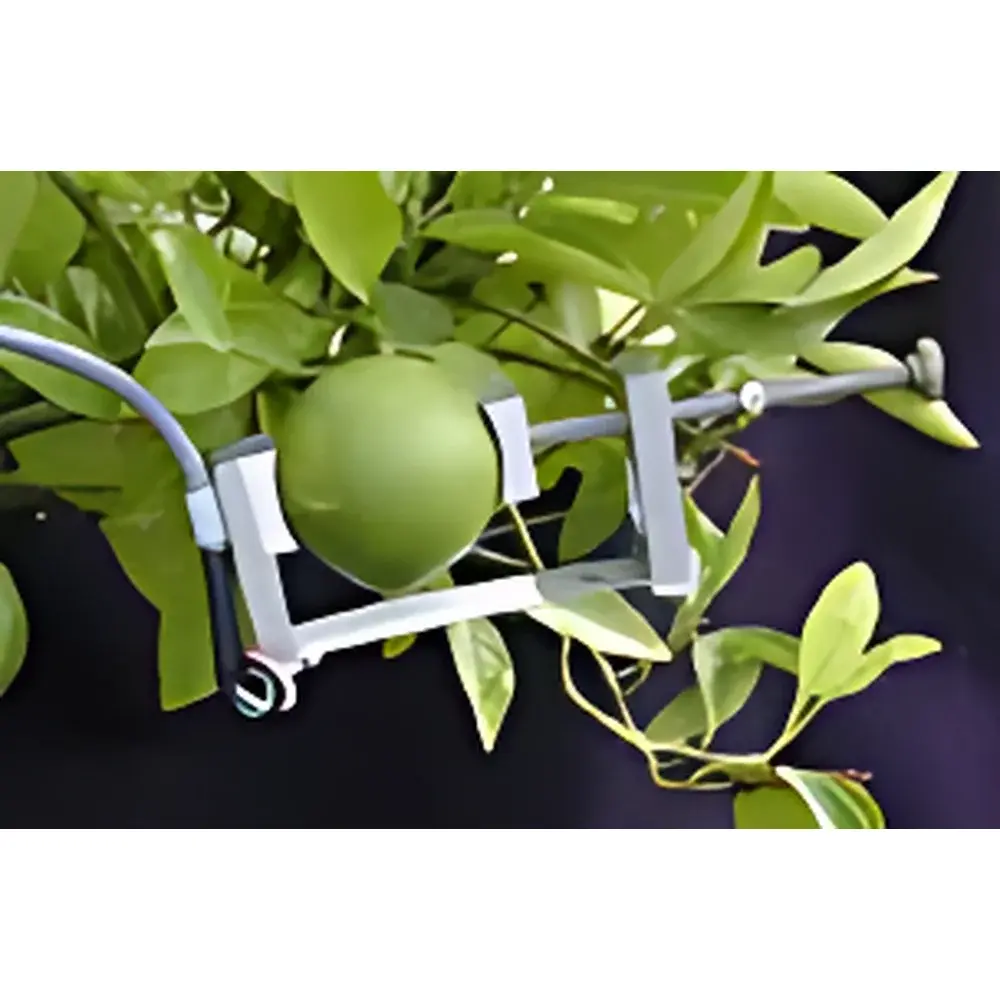
Dynamax DEX Fruit and Stem Growth Monitor
| Brand | Dynamax |
|---|---|
| Origin | USA |
| Model | DEX |
| Measurement Principle | Resistive Strain-Bridge Displacement Sensing with Integrated Temperature Compensation |
| Operating Temperature Range | –10 to 50 °C |
| Accuracy | ±0.050 mm (for ΔT > 20 °C) |
| Temperature Stability | 0.0025 mm/°C |
| Output Signal | Analog ±5 mV or ±2.5 mV (model-dependent) |
| Sensitivity | 0.05–0.5 mV/mm |
| Linearity Error | ±0.004 to ±0.01 mV/mm |
| Electrical Noise | ±0.01 mV |
| Compatible Data Loggers | Supports up to 8 or 32 sensors per system |
| IP-Rated Enclosure | Sealed Electronics for Outdoor & Field Deployment |
Overview
The Dynamax DEX Fruit and Stem Growth Monitor is a precision-engineered, non-destructive displacement transducer designed for continuous, high-resolution monitoring of diurnal and seasonal growth dynamics in woody and herbaceous plant tissues. It operates on the principle of resistive strain-bridge sensing: four balanced, temperature-compensated tension probes are mechanically coupled to the plant surface via calibrated mounting brackets; minute dimensional changes—induced by turgor-driven expansion, cambial activity, or fruit swelling—are converted into proportional analog voltage outputs (±5 mV or ±2.5 mV). Built-in thermal compensation ensures measurement stability across ambient fluctuations (–10 to 50 °C), mitigating drift commonly observed in uncorrected analog transducers. The DEX is not a standalone instrument but a modular sensor node—intended for integration into scalable environmental monitoring networks using industry-standard data loggers (e.g., Campbell Scientific CR series, Onset HOBO, or custom DAQ systems). Its design prioritizes long-term field reliability, low power consumption, and minimal mechanical interference with natural tissue biomechanics.
Key Features
- Four-point symmetrical tension probe architecture ensures uniform radial load distribution and eliminates torque-induced measurement artifacts
- Integrated temperature compensation circuitry reduces thermal drift to ≤0.0025 mm/°C—critical for multi-week deployments across seasonal gradients
- Hermetically sealed electronics with IP67-rated housing enable uninterrupted operation in rain, dew, dust, and high-humidity forest canopies
- Modular sizing: Four model variants (DEX20, DEX70, DEX100, DEX200) cover measurement ranges from 5–25 mm to 95–200 mm, each optimized for specific stem diameters or fruit expansion envelopes
- Analog output compatibility: Direct connection to 12- or 16-bit data acquisition systems without signal conditioning—simplifies calibration traceability and reduces noise coupling
- Low-noise analog interface (±0.01 mV baseline noise) supports detection of sub-micron-scale daily shrinkage/swelling cycles linked to water potential dynamics
Sample Compatibility & Compliance
The DEX system accommodates a broad spectrum of botanical specimens: young saplings (e.g., Populus tremuloides, Quercus rubra), mature orchard trees (e.g., Malus domestica, Pyrus communis), vine crops (Vitis vinifera), and fleshy fruits (e.g., tomato, apple, citrus). Mounting fixtures—available in three standard inner-diameter configurations (19×19 mm, 25×25 mm, 38×38 mm)—are fabricated from UV-stabilized acetal and stainless steel to prevent galvanic corrosion and mechanical creep. While the DEX itself carries no formal regulatory certification, its analog output architecture and stable calibration protocol align with GLP-compliant data collection frameworks. When paired with FDA 21 CFR Part 11–compliant data loggers and audit-trail-enabled software, it supports reproducible phenotyping workflows required in agricultural R&D and climate-resilience studies.
Software & Data Management
The DEX generates time-synchronized analog voltage streams that require digitization and unit conversion via external data acquisition hardware. Dynamax provides standardized calibration coefficients (e.g., 2.0–20.0 mm/mV, model-specific) and linearization equations in its technical documentation—enabling direct integration into MATLAB, Python (NumPy/Pandas), R, or LabVIEW environments. Third-party platforms such as EcoNet, Edaphic Scientific’s EnviroPro, and Campbell Scientific’s LoggerNet support native DEX channel configuration, automatic temperature-corrected scaling, and metadata tagging (sensor ID, plant ID, installation date). Raw voltage logs retain full bit-depth fidelity, permitting retrospective reprocessing when new physiological models (e.g., pressure-volume curve derivation) are applied. No proprietary firmware or cloud lock-in is imposed—users retain full ownership of raw and processed datasets.
Applications
- Quantifying diurnal stem shrinkage as a proxy for plant water status and stomatal conductance under drought stress trials
- Tracking cambial growth phenology in long-term forest ecology studies—correlating radial increment with microclimate variables (VPD, soil moisture, PAR)
- Monitoring fruit expansion kinetics during cell division vs. cell enlargement phases to optimize harvest timing and postharvest quality prediction
- Validating hydraulic architecture models by synchronizing stem diameter variation with sap flow (Heat Ratio Method) and leaf-level gas exchange measurements
- Assessing genotype-by-environment interactions in breeding programs—e.g., screening rootstock scion combinations for differential growth plasticity under elevated CO2 or heat stress
FAQ
How is the DEX calibrated prior to deployment?
Each DEX unit ships with factory-applied calibration coefficients (mm/mV) and linearity error specifications. Users perform two-point mechanical verification using precision gauge blocks before field installation; no field recalibration is required due to inherent thermal compensation.
Can multiple DEX sensors be synchronized on a single data logger?
Yes—up to 8 or 32 units (depending on logger model) can be daisy-chained via shielded twisted-pair cabling. Timestamp synchronization is maintained at the logger level with ≤10 ms inter-channel skew.
Is the DEX suitable for measuring rapid movements like nyctinastic leaf folding?
No—the DEX is optimized for slow, cumulative dimensional changes (µm/h to mm/day). It lacks the bandwidth for sub-minute physiological events; high-speed applications require piezoelectric or optical interferometric systems.
What maintenance is required during multi-season deployments?
Annual inspection of mounting brackets for biofouling or mechanical slippage is recommended. Probe surfaces may be gently cleaned with isopropyl alcohol; no lubrication or recalibration is necessary under normal operating conditions.
Does Dynamax provide OEM integration support for custom monitoring platforms?
Yes—Dynamax offers engineering documentation, pinout schematics, and analog signal conditioning guidelines for integration into proprietary IoT or wireless sensor network architectures.





