
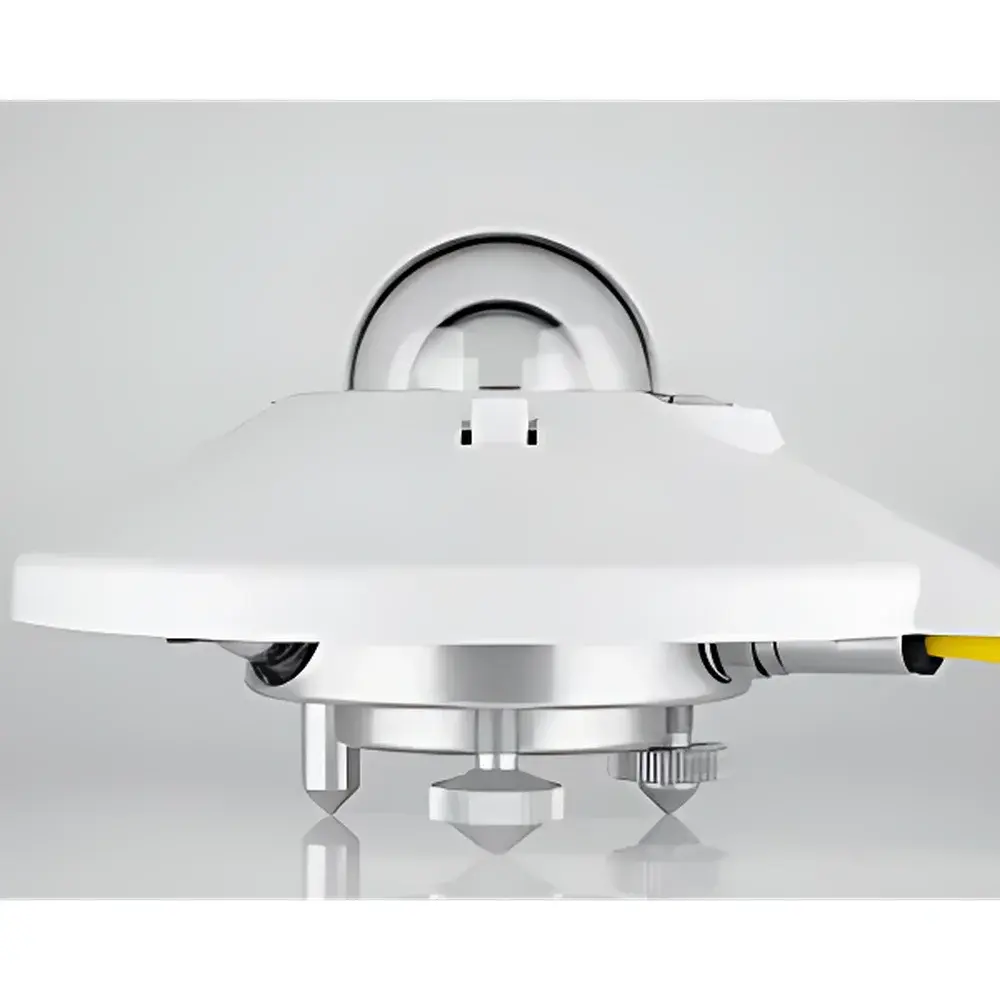
Kipp & Zonen CMP22 Pyranometer
| Key | Brand: Kipp & Zonen |
|---|---|
| Origin | Netherlands |
| Model | CMP22 |
| Spectral Range | 200–3600 nm |
| Sensitivity | 7–14 µV/W/m² |
| Response Time | 5 s |
| Zero Offset A | < 3 W/m² |
| Zero Offset B | < 1 W/m² |
| Directional Error (up to 80°, 1000 W/m² beam) | < 5 W/m² |
| Temperature Dependence of Sensitivity (−20 °C to +50 °C) | < 0.5 % |
| Operating Temperature Range | −40 °C to +80 °C |
| Maximum Irradiance | 4000 W/m² |
| Field of View | 180° |
| Output Signal | 0–20 mV (passive, no power required) |
Overview
The Kipp & Zonen CMP22 pyranometer is a thermopile-based broadband solar radiation sensor engineered for high-accuracy measurement of global horizontal irradiance (GHI) in meteorological, climatological, and solar energy applications. It operates on the principle of thermal detection: incident solar radiation—spanning the full solar spectrum from ultraviolet through visible to near-infrared—is absorbed by a blackened thermopile junction, generating a proportional millivolt output via the Seebeck effect. Unlike photodiode-based sensors, the CMP22 delivers spectrally flat response and minimal angular dependence, making it suitable for reference-grade monitoring per ISO 9060:2018 classification as a Secondary Standard pyranometer. Its quartz dome—distinct from the glass dome used in the CMP21—extends spectral transmission down to 200 nm and up to 3600 nm, enabling reliable quantification of both UV-B and near-IR components critical for PV performance modeling and atmospheric science.
Key Features
- High-transmission fused quartz hemispherical dome with optical homogeneity optimized to reduce directional error to < 5 W/m² at 80° zenith angle under 1000 W/m² beam irradiance
- Passive thermopile detector requiring no external power supply; outputs 0–20 mV signal directly proportional to irradiance (W/m²)
- Integrated bubble level relocated to top of housing for real-time leveling verification without removal of the redesigned snap-fit shadow band or disconnection of cabling
- Threaded desiccant cartridge for simplified moisture management; includes refill desiccant and tool-free access
- IP67-rated waterproof connector system with pre-terminated yellow signal cable; multiple standard cable lengths available (e.g., 5 m, 10 m, 20 m)
- Thermal offset compensation achieved through dual zero-offset specifications: < 3 W/m² (Zero Offset A, thermal irradiance-induced) and < 1 W/m² (Zero Offset B, internal temperature gradient-induced)
- Temperature-dependent sensitivity drift limited to < 0.5 % across −20 °C to +50 °C ambient range, validated per ISO/IEC 17025 traceable calibration protocols
Sample Compatibility & Compliance
The CMP22 is designed for outdoor deployment on fixed mounts, solar trackers, or meteorological masts, and is compatible with all standard data loggers supporting millivolt analog input (e.g., Campbell Scientific CR series, Delta-T DL2e, Onset HOBO UX120). It meets the performance criteria defined in ISO 9060:2018 for Secondary Standard pyranometers, including spectral selectivity, directional response, temperature response, and non-linearity. Calibration is performed traceably to the World Radiometric Reference (WRR) at PMOD/WRC, Davos, Switzerland. The instrument complies with IEC 61724-1:2021 for photovoltaic system monitoring and supports data quality assurance frameworks aligned with BSRN (Baseline Surface Radiation Network) and GCOS (Global Climate Observing System) requirements. No battery or auxiliary power is needed—eliminating failure modes associated with power conditioning in remote installations.
Software & Data Management
As a passive analog sensor, the CMP22 does not incorporate onboard firmware or digital communication interfaces. Raw millivolt output must be acquired via externally connected data acquisition systems. When integrated into compliant monitoring networks, its signal is typically conditioned using calibrated amplifiers (e.g., Kipp & Zonen AMPBOX) to generate 4–20 mA current loops or ±5 V voltage outputs compatible with SCADA and cloud-based platforms such as Solar-Log, MeteoControl, or custom Python- or LabVIEW-based DAQ environments. All calibration certificates include uncertainty budgets per GUM (Guide to the Expression of Uncertainty in Measurement) and are valid for two years under normal field conditions. Audit trails, calibration history, and sensor metadata can be maintained in accordance with ISO/IEC 17025 and FDA 21 CFR Part 11–compliant laboratory information management systems (LIMS) when paired with appropriate data logging hardware.
Applications
- Solar resource assessment for utility-scale PV plant feasibility studies and yield prediction models
- Long-term climate monitoring in national weather services and research observatories (e.g., NOAA SURFRAD, BSRN sites)
- Performance ratio (PR) and degradation rate analysis in operational solar farms
- Validation of satellite-derived irradiance products (e.g., CAMS, NSRDB)
- Albedo and surface reflectance characterization when deployed in paired upward/downward configurations
- UV index monitoring and ecological radiation studies requiring extended spectral fidelity
FAQ
Does the CMP22 require external power to operate?
No. It is a passive thermopile sensor and generates its own millivolt signal upon exposure to irradiance.
What is the recommended method to minimize thermal offset errors during installation?
Ensure mechanical leveling using the integrated bubble level, mount on a thermally stable surface (e.g., white-painted aluminum plate), and avoid direct shading or localized heating sources near the dome base.
Can the CMP22 be used for diffuse irradiance measurements?
Only when equipped with a properly aligned shading device (e.g., Kipp & Zonen SOLYS 2 sun tracker with shadow ring); standalone use measures global horizontal irradiance only.
How often should recalibration be performed?
Kipp & Zonen recommends recalibration every two years for critical applications; annual verification against a reference sensor is advised for high-accuracy solar monitoring programs.
Is the quartz dome resistant to environmental soiling and UV degradation?
Yes—the fused quartz material exhibits negligible solarization over time and maintains >92 % transmittance across its specified spectral range even after decades of field exposure.
Related Products







