
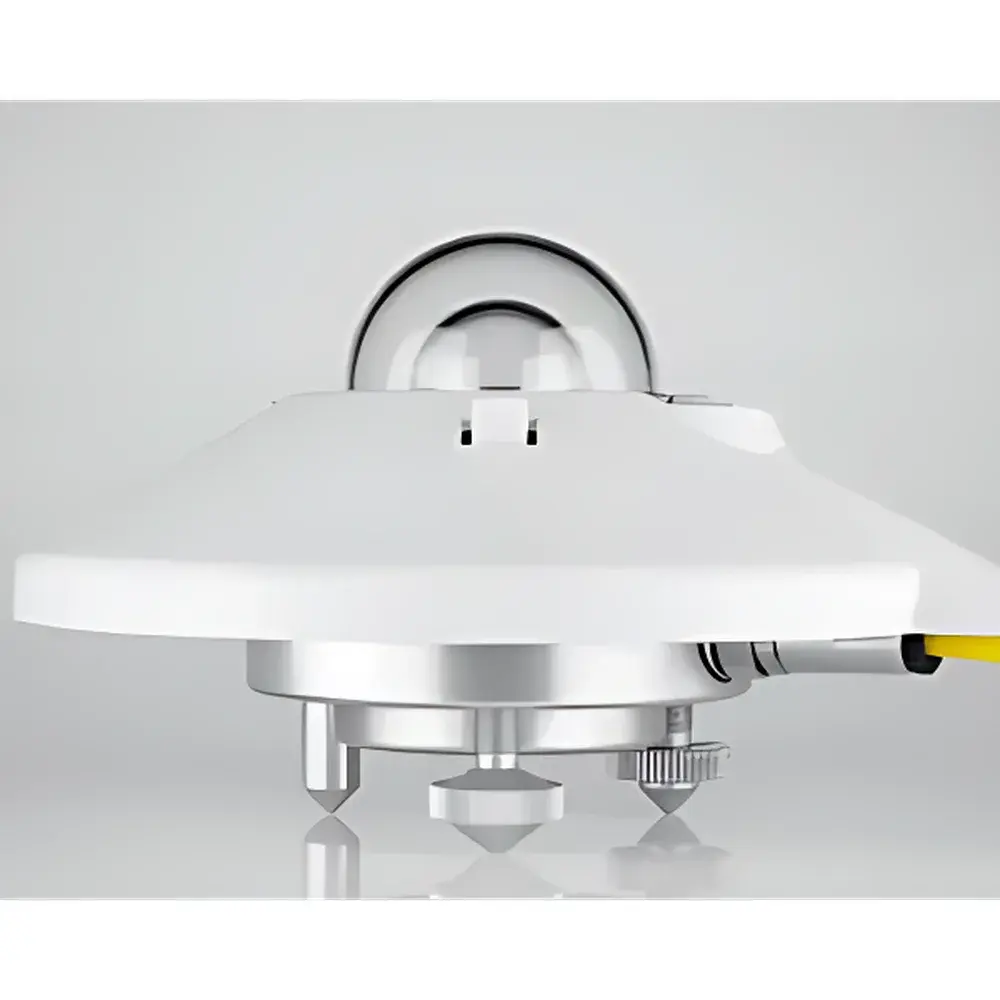
Kipp & Zonen SMP22 Secondary Standard Pyranometer
| Brand | Kipp & Zonen |
|---|---|
| Origin | Netherlands |
| Model | SMP22 |
| Spectral Range | 210–3600 nm |
| Response Time (63%) | < 0.5 s |
| Response Time (95%) | < 0.2 s |
| Zero Offset A | < 3 W/m² |
| Zero Offset B | < 1 W/m² |
| Directional Error (up to 80°, 1000 W/m² beam) | < 5 W/m² |
| Temperature Dependence of Sensitivity (−20 °C to +50 °C) | < 0.3 % |
| Analog Output (-V) | 0–1 V |
| Analog Output (-A) | 4–20 mA |
| Digital Output | 2-wire RS-485 |
| Supply Voltage | 5–30 VDC |
| Integrated Desiccant Lifetime | ≥10 years |
Overview
The Kipp & Zonen SMP22 is a secondary standard pyranometer engineered for high-accuracy, long-term solar irradiance measurement under ISO 9060:2018 classification (Class A). It integrates the proven thermopile-based sensor architecture and precision quartz dome design of the legacy CMP22 series with modern digital interface capabilities and enhanced thermal stability. Its measurement principle relies on a blackened thermopile detector housed beneath a hemispherical optical-grade quartz dome, converting incident broadband solar radiation (210–3600 nm) into a proportional millivolt-level signal. The thermopile’s thermal mass and dome geometry are optimized to minimize zero-offset drift—particularly thermal offset (Zero Offset A) induced by rapid ambient temperature changes and directional offset (Zero Offset B) arising from asymmetric heating. With a spectral response covering the full solar spectrum—from near-ultraviolet through visible to near-infrared—the SMP22 complies with the spectral requirements for global horizontal irradiance (GHI) monitoring in meteorological networks, photovoltaic performance assessment, and climate research applications.
Key Features
- Secondary standard classification per ISO 9060:2018 (Class A), validated through individual calibration traceable to the World Radiometric Reference (WRR) at PMOD/WRC, Davos
- Optimized quartz dome with anti-reflective coating and precise curvature to limit directional error to < 5 W/m² up to 80° zenith angle under 1000 W/m² beam irradiance
- Integrated desiccant cartridge with ≥10-year service life, eliminating routine maintenance and reducing long-term operational uncertainty
- Dual-output capability: analog (0–1 V or 4–20 mA) and digital (2-wire RS-485 Modbus RTU), enabling seamless integration into SCADA, PLC, and IoT-based environmental monitoring systems
- Individual cosine response characterization provided with each unit, supporting post-acquisition correction for non-ideal incidence angles in tilted-plane or albedo measurements
- Wide operating voltage range (5–30 VDC) and low power consumption (< 15 mW in standby, < 35 mW during active sampling), suitable for solar-powered remote stations
- Temperature-compensated analog output and per-unit temperature coefficient correction (< ±0.3 % over −20 °C to +50 °C) ensure metrological consistency across climatic extremes
Sample Compatibility & Compliance
The SMP22 is designed for outdoor deployment in unshaded, level-mounted configurations compliant with WMO No. 8 (Guide to Meteorological Instruments and Methods of Observation) and IEC 61724-1:2021 (Photovoltaic system performance—Monitoring guidelines). Its mechanical construction meets IP67 ingress protection, ensuring reliable operation in rain, dust, snow, and coastal salt environments. Each instrument undergoes factory calibration against a WRR-traceable reference pyranometer, with full uncertainty budget documentation—including combined standard uncertainty (k = 2) typically ≤ 1.5 % for GHI. The device satisfies data integrity requirements for GLP-compliant solar resource assessment and supports audit-ready traceability for regulatory reporting frameworks including ISO/IEC 17025-accredited laboratories.
Software & Data Management
The SMP22 is supported by SmartExplorer Windows™ software—a configuration, diagnostics, and data visualization tool that enables real-time parameter interrogation, firmware updates, and Modbus register mapping. All units ship with pre-programmed Modbus RTU addresses and configurable polling intervals (1 s to 10 min). When deployed in multi-sensor arrays, the RS-485 bus allows daisy-chained topology with up to 32 devices per segment, minimizing cabling complexity. Raw output values are accompanied by internal temperature readings and diagnostic flags (e.g., dome contamination warning, desiccant saturation status), facilitating automated QA/QC workflows. Data export formats include CSV and XML, compatible with industry-standard platforms such as PVsyst, Meteodyn WT, and NASA POWER. Optional integration with third-party cloud services (e.g., AWS IoT Core, Azure IoT Hub) is achievable via gateway-level protocol translation without proprietary middleware.
Applications
- Baseline solar resource assessment for utility-scale photovoltaic plant feasibility studies and bankable energy yield modeling
- Continuous GHI monitoring in national meteorological networks and climate observatories (e.g., BSRN, GAW)
- Performance ratio (PR) and degradation rate analysis in operational solar farms per IEC 61724-1
- Albedo and reflected irradiance measurement when paired with an inverted SMP22 or secondary shading assembly
- Calibration transfer and field reference duties for primary and secondary standard pyrheliometers and pyranometers
- Long-term trend analysis in atmospheric science research requiring sub-2 % annual repeatability
FAQ
Is the SMP22 suitable for use with ventilators like the CVF4?
Yes—the SMP22 is fully compatible with the CVF4 ventilation unit. Integration reduces dome soiling rates by >70 % and suppresses convective thermal gradients, improving measurement stability in high-dust or high-humidity environments.
Does the SMP22 require periodic recalibration?
Per ISO/IEC 17025 and WMO recommendations, recalibration is advised every two years for critical applications; however, its robust design and integrated desiccant support extended calibration intervals up to three years when operated within specification limits and verified via field intercomparisons.
Can the SMP22 be used for plane-of-array (POA) irradiance measurements?
Yes—when mounted parallel to a PV module surface and corrected using its supplied individual cosine response data, the SMP22 meets IEC 61724-1 Class A requirements for POA irradiance monitoring.
What is the difference between Zero Offset A and Zero Offset B?
Zero Offset A quantifies the signal shift caused by rapid ambient temperature changes (e.g., passing clouds), while Zero Offset B reflects asymmetry-induced errors due to non-uniform heating of the dome-sensor assembly under oblique irradiance—both are minimized through thermal mass optimization and dome geometry refinement.
Related Products







