
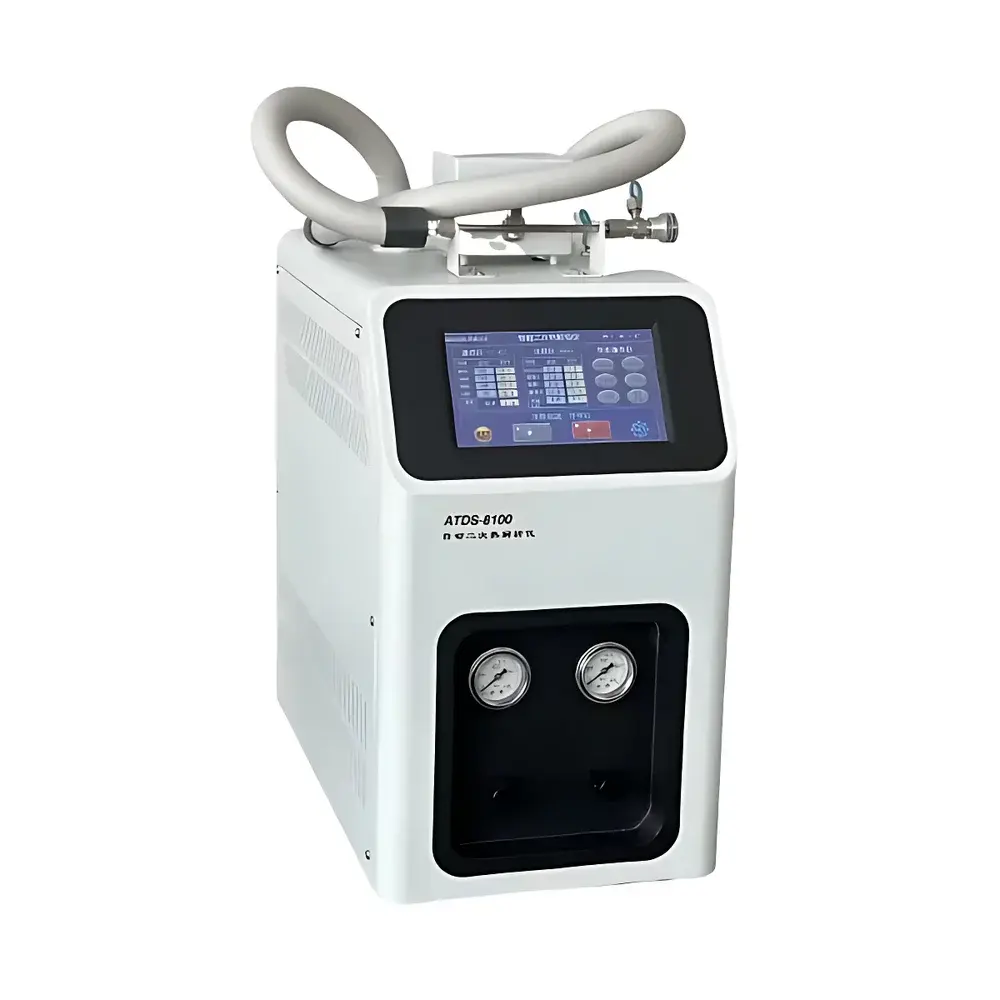
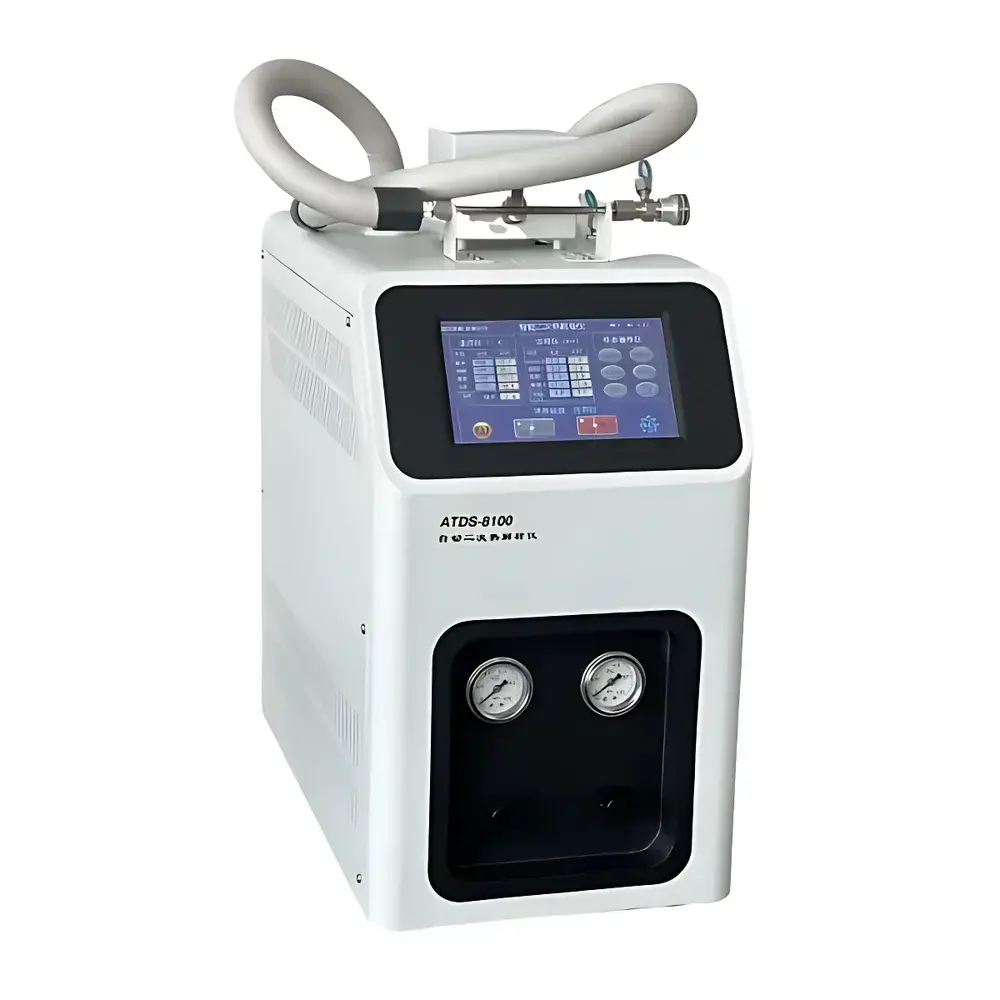
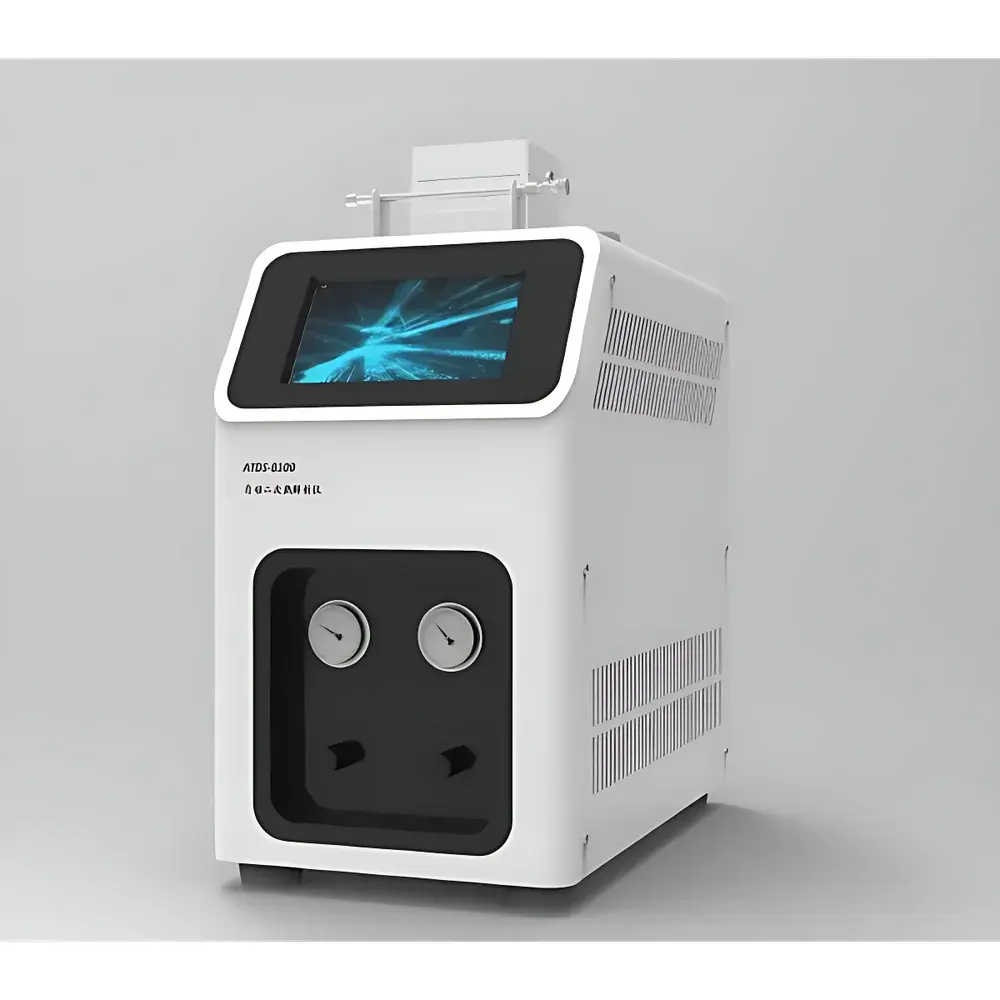
Luchuang ATDS-8100 Dual-Stage Thermal Desorber
| Brand | Luchuang |
|---|---|
| Origin | Shandong, China |
| Manufacturer Type | Direct Manufacturer |
| Model | ATDS-8100 |
| Instrument Type | Dual-stage thermal desorber |
| Automation Level | Semi-automatic |
| Primary Desorption Temp Range | 50–380 °C |
| Valve Injection Temp Range | Ambient to 260 °C |
| Transfer Line Temp Range | Ambient to 220 °C |
| Cryo-Trap Temp Range | –30 °C |
| Temperature Control Accuracy | ±0.1 °C |
| Desorption Recovery Rate | >80% |
| Sample Position Count | 1 |
Overview
The Luchuang ATDS-8100 Dual-Stage Thermal Desorber is an electronically cooled, direct-injection thermal desorption system engineered for trace-level analysis of volatile and semi-volatile organic compounds (VOCs and SVOCs) in complex environmental and industrial matrices. It implements a two-stage thermal desorption process—primary desorption from the sorbent tube followed by cryofocusing in a thermoelectrically cooled trap and secondary rapid desorption into the gas chromatograph (GC)—to achieve high analyte enrichment, sharp peak focusing, and minimal band broadening. This architecture ensures compatibility with capillary GC columns and supports quantitative analysis across an exceptionally wide dynamic range—from sub-ppt (ng/m³) concentrations in ambient air to percent-level volatiles in food packaging or roasted coffee headspace. The system operates via synchronized pneumatic and motor-driven valve actuation, eliminating reliance on external pressurized gases and enhancing operational safety and reproducibility in regulated laboratory environments.
Key Features
- Electronically refrigerated cold trap capable of reaching –30 °C (operational optimum at < –10 °C), enabling efficient cryofocusing of low-boiling compounds including C3–C12 hydrocarbons, halogenated VOCs, and polar species such as alcohols and carbonyls.
- Independent, precision temperature control (±0.1 °C) for primary desorption oven, injection valve, transfer line, and cold trap—each heated zone features low-thermal-mass construction and 24 V DC heating for stable, interference-free operation.
- Motor-driven six-port switching valve with integrated heating chamber eliminates cold spots along the sample path; all tubing is constructed from high-inertness, silanized fused silica or deactivated stainless steel to prevent adsorption and carryover.
- Full programmability of desorption cycles: automated sequence includes tube purging, primary desorption, cold trap trapping, secondary flash desorption, GC injection trigger output, and post-run bake-out—all configurable via intuitive 7-inch 64K-color touchscreen interface.
- Onboard calibration functionality supports standard vapor generation for method development and linear range verification; optional quartz-lined transfer lines available for highly reactive analytes (e.g., formaldehyde, hydrogen sulfide).
- No external gas supply required for valve actuation—fully motor-driven mechanism enhances reliability and simplifies integration into ISO 17025-accredited laboratories where compressed air quality control is a compliance burden.
Sample Compatibility & Compliance
The ATDS-8100 accommodates standard 6 mm × 160 mm sorbent tubes (e.g., Tenax TA, Carbopack B/C, graphitized carbon black composites) and supports direct coupling to all major GC platforms—including Agilent, Thermo Fisher, Shimadzu, and PerkinElmer—via TTL-triggered start synchronization. It complies with core analytical standards governing VOC analysis, including EPA Method TO-17 (determination of VOCs in air using sorbent tubes and GC/MS), ASTM D6196 (selection of sorbents for air sampling), and ISO 16000-6 (indoor air—determination of VOCs). Its design supports GLP/GMP-aligned workflows: audit-trail-capable method storage, timestamped run logs, and user-accessible system diagnostics facilitate regulatory readiness for pharmaceutical stability testing, food contact material migration studies, and indoor air quality certification per EN 16516.
Software & Data Management
The embedded firmware provides full cycle configuration—including desorption ramp rates (>3000 °C/min achievable during secondary desorption), hold times (0–60 min each stage), flow-controlled purge and back-flush (0–100 mL/min), and simulated sampling (0–160 mL/min). All parameters are stored with date/time stamps and operator ID. The system outputs standardized TTL pulses to initiate GC acquisition and data system recording, ensuring temporal alignment between thermal event timing and chromatographic data capture. While the ATDS-8100 does not include proprietary PC software, its open TTL/GPIB-compatible interface allows seamless integration with third-party chromatography data systems (CDS) that support external hardware triggering—enabling full traceability under FDA 21 CFR Part 11 when deployed with compliant CDS and electronic signature protocols.
Applications
- Ambient and workplace air monitoring for benzene, toluene, ethylbenzene, xylenes (BTEX), chlorinated solvents, and terpenes.
- Soil vapor intrusion assessment and landfill gas profiling.
- Analysis of residual solvents in pharmaceutical excipients and medical device packaging per ICH Q3C guidelines.
- Volatile flavor compound profiling in roasted coffee, spices, cereals, and dairy products.
- Migration testing of plasticizers, antioxidants, and monomers from food contact materials (e.g., PET bottles, laminated films).
- High-moisture sample handling—including humidified air, wastewater headspace, and biological fluid extracts—without compromising trap efficiency or column integrity.
FAQ
What sample tube formats are supported?
Standard 6 mm OD × 160 mm length sorbent tubes; compatible with multi-bed configurations (e.g., Tenax GR + Carbopack X + Carboxen 1000) for broad volatility coverage.
Does the system support quantitative calibration with internal standards?
Yes—integrated flow-controlled sampling and programmable spiking enable precise standard addition directly onto tubes or via vapor-phase calibration.
Can the ATDS-8100 be used with GC-MS systems?
Fully compatible; cold trap focusing minimizes solvent delay and improves MS detection sensitivity for trace analytes.
Is remote monitoring or network connectivity available?
No native Ethernet or Wi-Fi; however, TTL-triggered operation enables integration into centralized lab automation via PLC or CDS-based scheduling.
What maintenance intervals are recommended for optimal performance?
Valve seal inspection every 500 runs; cold trap cleaning every 2000 cycles; annual verification of temperature uniformity and recovery rate using certified test mixtures (e.g., TO-17 surrogate blend).




