
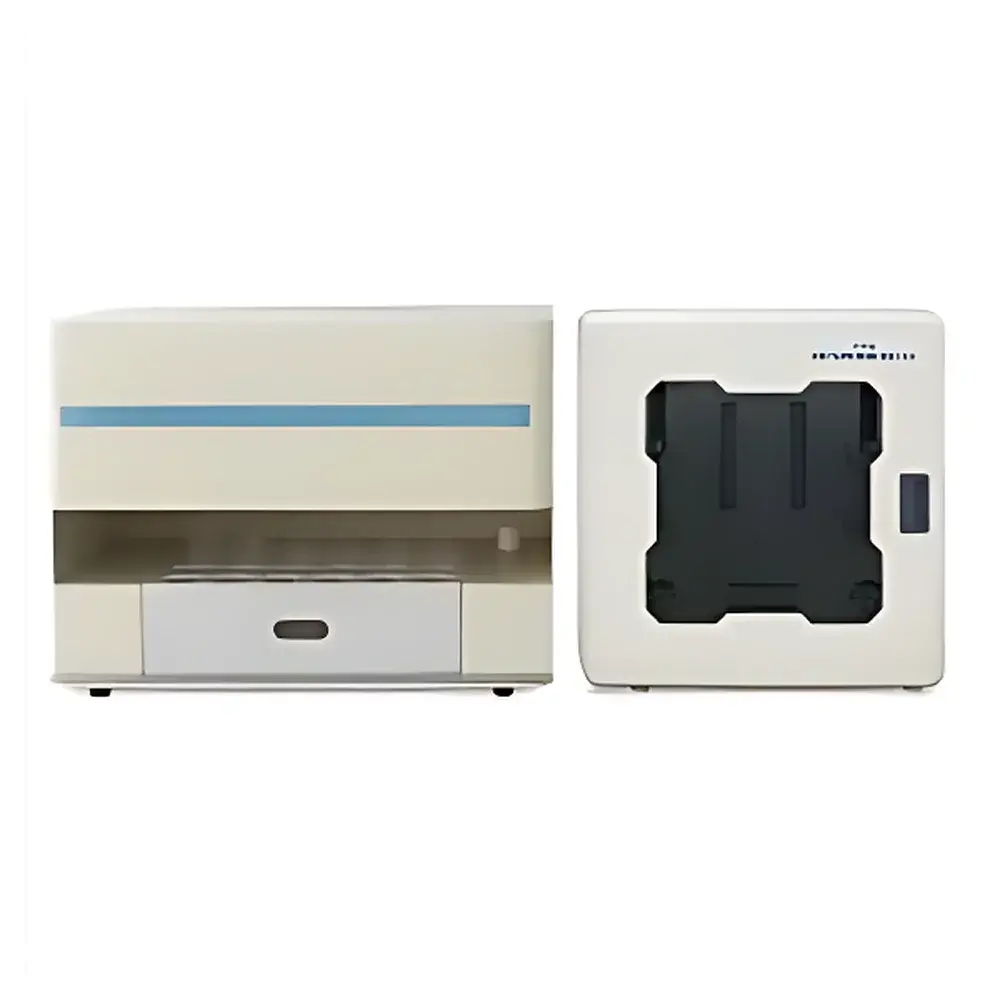
English Product Name
| Brand | HUANKONG |
|---|---|
| Origin | Shandong, China |
| Manufacturer Type | Direct Manufacturer |
| Instrument Type | Laboratory-Based Volatile Phenol & Anionic Detergent Analyzer |
| Model | 3100 |
| Compliance Standards | GB/T 7494–1987, GB/T 5750.4–2006, HJ 503–2009 |
| Configuration | Fully Automated Benchtop System with Integrated Sample Handling, Extraction, Reaction, and Photometric Detection |
Overview
The HUANKONG 3100 Integrated Online Extraction Analyzer is a dedicated benchtop instrument engineered for the simultaneous or independent quantitative determination of anionic surfactants (AS) and volatile phenols in aqueous environmental matrices—including surface water, groundwater, wastewater, and drinking water. It implements two standardized spectrophotometric methods in a single platform: the methylene blue active substances (MBAS) method per GB/T 7494–1987 for anionic detergents, and the 4-aminoantipyrine (4-AAP) colorimetric method per HJ 503–2009 for volatile phenols. Unlike conventional manual or flow-injection systems, the 3100 employs a closed-loop, sequential batch extraction architecture—eliminating open chloroform handling, minimizing operator exposure to hazardous organic solvents, and ensuring strict adherence to regulatory methodology without method deviation. Its core measurement principle relies on precise photometric detection at defined wavelengths (650 nm for MBAS; 510 nm for 4-AAP adducts), with optical path stability maintained via temperature-controlled cuvettes and dual-beam referencing to suppress drift.
Key Features
- Fully automated workflow: From sample aspiration and pH adjustment to solvent extraction (chloroform for AS; chloroform/isoamyl alcohol for phenols), phase separation, reagent addition, color development, and absorbance measurement—all executed unattended.
- Integrated safety engineering: Sealed 3D autosampler with exhaust ventilation ducting; real-time reagent volume monitoring with low-level alerts; leak-resistant fluidic pathways; and centralized waste collection compliant with laboratory chemical disposal protocols.
- High-throughput capacity: Supports 36- or 54-position sample racks with programmable sequence execution, enabling overnight runs and batch processing of up to 48 samples per cycle without intervention.
- Intelligent calibration and dilution: Onboard standard curve generation using multi-point calibration; auto-ratio dilution for out-of-range samples to maintain linearity within dynamic measurement ranges (e.g., 0.05–2.0 mg/L for AS; 0.002–2.0 mg/L for phenols, typical per standard method constraints).
- Robust hardware architecture: Corrosion-resistant fluidic components (PTFE, PEEK, borosilicate glass); maintenance-free peristaltic pumping system with extended-life tubing; and vibration-damped optical module for long-term photometric reproducibility.
Sample Compatibility & Compliance
The 3100 accepts raw, filtered, or centrifuged liquid samples with turbidity ≤ 5 NTU and suspended solids < 20 mg/L. It accommodates matrix variations common in municipal effluents, industrial discharges, and natural waters—provided samples are pre-acidified (for phenol analysis) or buffered (for AS analysis) per GB/T 7494–1987 and HJ 503–2009 requirements. All operational parameters—including reaction time, extraction cycles, and wavelength selection—are configurable to align with method-specific validation criteria. The system supports audit-ready documentation: full traceability of calibration events, reagent lot tracking, sample ID logging, and timestamped raw absorbance data—enabling compliance with GLP principles and internal QA/QC protocols. While not pre-certified to ISO/IEC 17025, its design facilitates method validation per ISO 11348 (for toxicity-related surfactant screening) and supports alignment with EPA Method 425.1 (for AS) and EPA Method 420.1 (for phenols) through documented equivalence studies.
Software & Data Management
Control and data acquisition are managed via Windows-based HUANKONG Analytical Suite v3.x, featuring bidirectional USB/Ethernet communication. The software provides real-time status dashboards (fluid levels, pressure diagnostics, temperature logs), customizable report templates (PDF/Excel export), and embedded data integrity safeguards—including user-level access control, electronic signatures, and immutable audit trails meeting FDA 21 CFR Part 11 readiness benchmarks. All measurement data—including raw absorbance values, calculated concentrations, recovery rates from spiked controls, and QC flagging (e.g., blank drift > ±0.005 AU)—are stored in a relational SQLite database with automatic backup scheduling. Raw spectral scans and kinetic reaction profiles are archived for retrospective review during method troubleshooting or regulatory inspection.
Applications
The 3100 serves laboratories performing routine compliance monitoring under China’s Environmental Monitoring Technical Specifications (HJ/T 91–2019) and municipal water quality reporting mandates. It is routinely deployed for: (1) wastewater treatment plant influent/effluent surveillance of LAS and alkylbenzene sulfonates; (2) source water assessment for phenolic contamination from petrochemical or pharmaceutical discharge; (3) inter-laboratory proficiency testing where method harmonization across sites is critical; and (4) research applications requiring high-precision, low-variance quantification of surfactant–phenol co-contamination in sediment pore water or leachate studies. Its automation reduces analyst hands-on time by >70% versus manual MBAS workflows while improving inter-day CVs to <3.5% (n=10) for certified reference materials.
FAQ
Does the 3100 require method modification to comply with GB/T 7494–1987?
No—the instrument executes the standard’s prescribed extraction, washing, and color development steps without procedural deviation; only the mechanical implementation is automated.
Can the system analyze both anionic detergents and volatile phenols in the same run?
No—each analysis requires separate method selection, reagent sets, and calibration curves; however, sequential analysis of the same sample batch is fully supported via programmable method switching.
What maintenance intervals are recommended for the fluidic system?
Peristaltic pump tubing should be replaced every 6 months under continuous operation; extraction manifold O-rings inspected quarterly; and optical path cleaned monthly using lint-free wipes and isopropanol.
Is remote monitoring or cloud data upload supported?
Local network sharing and scheduled FTP export are enabled; direct cloud integration requires on-premise IT infrastructure configuration and is not natively provided.
How is interference from sulfide or oxidizing agents addressed?
The software includes optional pre-treatment modules—such as ascorbic acid addition for sulfide masking or sodium thiosulfate dosing for residual chlorine removal—activated via protocol scripting.







