
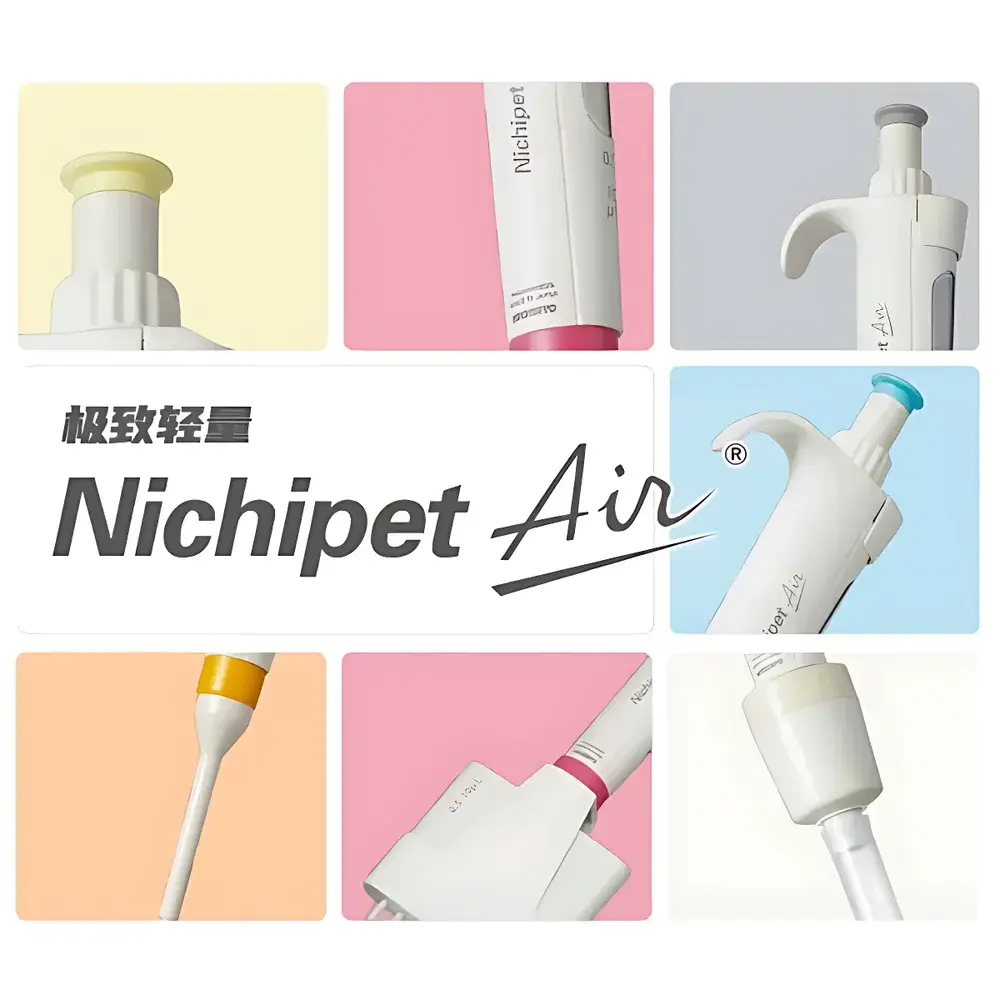
Nichipet Air Series Manual Pipettes by Nichiryo
| Brand | Nichiryo |
|---|---|
| Origin | Japan |
| Product Line | Nichipet Air |
| Pipette Type | Air-displacement Manual Pipette |
| Channel Configurations | Single-channel, 8-channel, 12-channel |
| Volume Range | 0.1–2 µL (ultra-low volume models) |
| Accuracy | ±3% |
| Weight Optimization | Reduced plunger force, minimized body mass, and low tip ejection force |
| Color Coding | 8 distinct pastel (macaron-style) color variants for single-channel models |
| Compliance | Designed in accordance with ISO 8655-2:2022 (Piston-operated volumetric apparatus — Part 2: Piston pipettes) and compatible with GLP/GMP workflows requiring traceable liquid handling |
Overview
The Nichipet Air Series represents Nichiryo’s third-generation evolution of ergonomic, high-precision air-displacement manual pipettes—engineered specifically for laboratories where repetitive, ultra-low-volume liquid handling is routine and operator fatigue must be systematically mitigated. Unlike traditional piston-driven pipettes relying on mechanical spring resistance, the Nichipet Air employs a re-engineered internal air cushion system and low-friction plunger mechanism to reduce actuation force by up to 40% compared to prior-generation models. This design directly addresses biomechanical stress points identified in longitudinal studies of laboratory personnel—particularly thumb flexion load during plunger depression and wrist extension during tip ejection. The series covers a continuous volume range from 0.1 µL to 10 mL across modular configurations, enabling consistent metrological performance under ISO 8655-2:2022 calibration protocols without cross-model compromise.
Key Features
- Ergonomic Load Reduction: Plunger depression force reduced to ≤0.8 N (at full scale for 10 mL model); tip ejection force ≤1.2 N—validated per ISO 8655-6 Annex C for user-force profiling.
- Ultra-Low Volume Capability: Dedicated 0.1–2 µL models incorporate tapered stainless-steel pistons and hydrophobic internal coatings to minimize surface adhesion and residual film formation—critical for viscous or volatile samples (e.g., PCR master mixes, organic solvents).
- Modular Channel Architecture: Single-channel, 8-channel, and 12-channel variants share identical ergonomics, calibration traceability, and tip-fit geometry—ensuring method transfer consistency across assay development and high-throughput screening.
- Visual Ergonomics System: Eight soft pastel color codes (mint, lavender, peach, sky blue, etc.) correspond to specific volume ranges and are applied via UV-stable, non-fading polymer sleeves—reducing visual strain during prolonged bench work and supporting rapid identification in shared lab environments.
- ISO-Traceable Calibration Interface: Integrated adjustment screw accessible via calibrated torque driver; factory-certified calibration reports include uncertainty budgets compliant with ISO/IEC 17025 requirements.
Sample Compatibility & Compliance
The Nichipet Air Series maintains compatibility with universal conical-tip consumables meeting ISO 8655-3 specifications—including filtered and low-retention tips from major global suppliers. Its air-displacement principle ensures reliable performance with aqueous buffers, saline solutions, ethanol/water mixtures, and moderately viscous reagents (1.2 g/cm³) without volumetric correction per ISO 8655-5 guidance. All units ship with CE marking and comply with IEC 61326-1:2013 (EMC for laboratory equipment). Documentation packages support FDA 21 CFR Part 11 readiness when used with validated electronic lab notebooks (ELNs) and audit-trail-enabled calibration management software.
Software & Data Management
While the Nichipet Air is a manual instrument, its design integrates seamlessly into digital lab ecosystems. Each unit carries a unique 12-digit serial number laser-etched on the barrel, enabling direct linkage to institutional calibration databases (e.g., LabWare LIMS, Thermo Fisher SampleManager). Nichiryo provides optional CSV-based calibration certificate templates aligned with ASTM E2918-20 for automated import into quality management systems (QMS). Firmware-upgradable docking stations (sold separately) allow firmware revision tracking and usage logging—supporting GLP audit requirements for instrument utilization history.
Applications
- Genomics & Molecular Biology: Accurate dispensing of restriction enzyme cocktails, CRISPR guide RNA complexes, and qPCR standards in sub-microliter volumes.
- Cell Culture & Bioprocessing: Serial dilution of growth factors and cytokines; inoculation of microtiter plates for monoclonal antibody titer assays.
- Clinical Diagnostics: Preparation of calibrators and controls for immunoassays (e.g., ELISA, CLIA), especially where lot-to-lot reproducibility impacts diagnostic sensitivity.
- Academic Teaching Labs: Low-force operation reduces learning curve for undergraduate students; color-coding reinforces volume-range recognition during technique training.
- QC/QA Environments: Validated use in ISO 17025-accredited testing labs for method verification of dissolution testing, extractables/leachables sampling, and reference standard preparation.
FAQ
Is the Nichipet Air Series suitable for use with filtered tips?
Yes—its tip cone geometry conforms to ISO 8655-3 dimensional tolerances and achieves secure, leak-free seals with both standard and filtered conical tips from leading manufacturers.
Can accuracy be verified in-house without external calibration services?
Yes—users may perform gravimetric verification per ISO 8655-5 using Class A analytical balances and certified distilled water at 20 °C; Nichiryo supplies detailed SOP templates and uncertainty calculation worksheets.
Does the pastel color coding affect chemical resistance or longevity?
No—the color layers consist of medical-grade, solvent-resistant polyolefin sleeves bonded via plasma treatment; accelerated aging tests confirm no degradation after 500 autoclave cycles (121 °C, 15 psi) or 10,000 tip ejection cycles.
Are multi-channel models individually adjustable per channel?
No—8- and 12-channel variants feature synchronized piston alignment; volume adjustment affects all channels uniformly, ensuring inter-channel precision within ±0.8% as verified per ISO 8655-2 Annex D.
What maintenance intervals are recommended for optimal metrological performance?
Daily visual inspection and tip cone cleaning; biannual internal lubrication (using Nichiryo-specified silicone grease); full recalibration every 6 months or after 10,000 actuations—whichever occurs first.



