
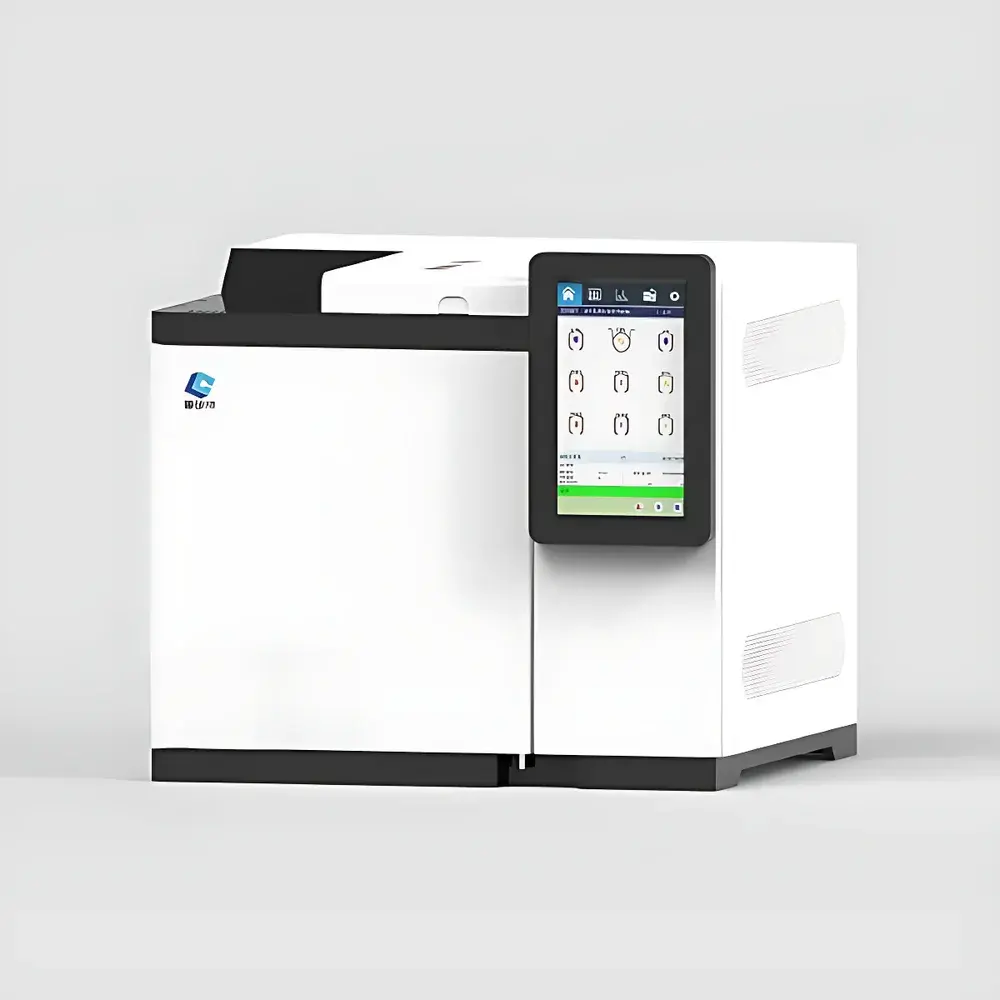
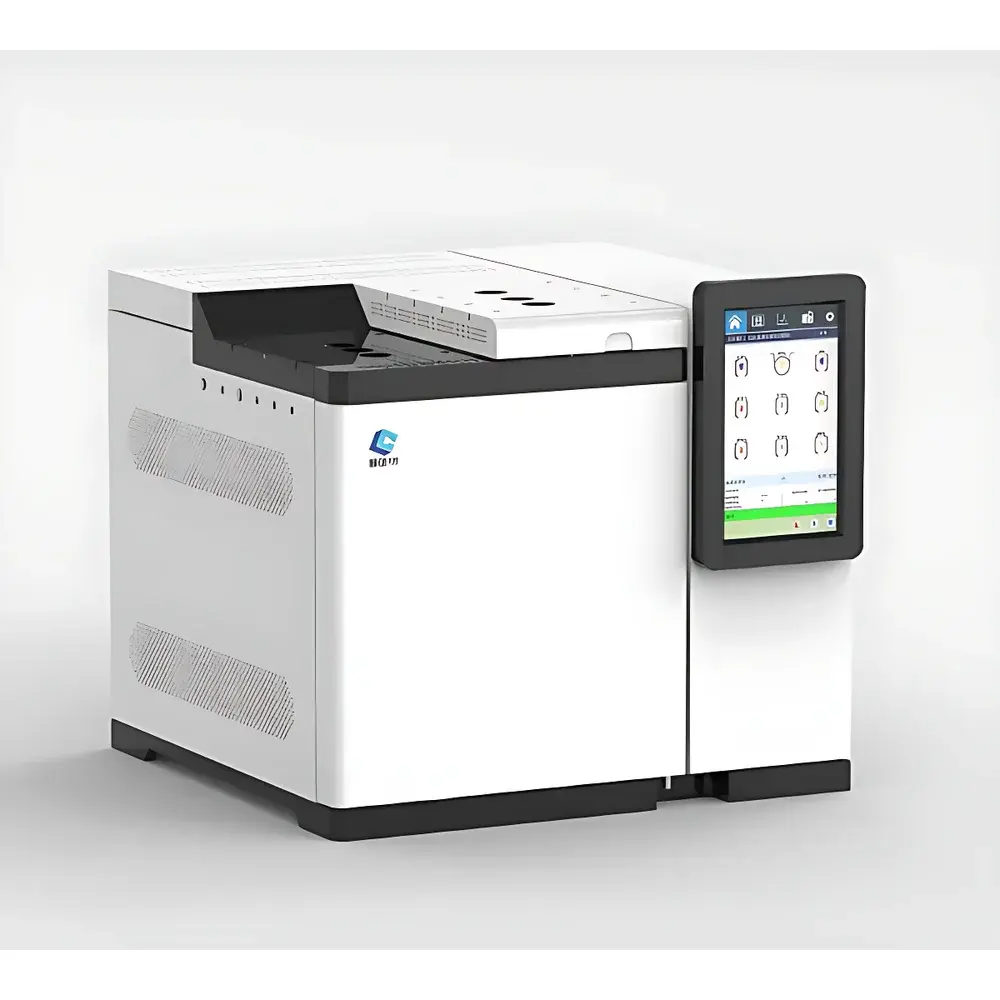
Luchuang GC-9870 Gas Chromatograph with 10-inch Capacitive Touchscreen
| Brand | Luchuang |
|---|---|
| Origin | Shandong, China |
| Manufacturer Type | Direct Manufacturer |
| Instrument Type | Laboratory Gas Chromatograph |
| Temperature Control Range | Ambient +8 °C to 450 °C |
| Maximum Ramp Rate | 65 °C/min |
| Cooling Rate | 3.5 min (300 °C → 100 °C at 25 °C ambient) |
| Temperature Stability | ±0.01 °C |
| Programmable Temperature Steps | Up to 99 |
| Oven Time Setting Range | 0–9999 min |
| Carrier Gas Flow Range | 0–1200 mL/min |
| Carrier Gas Pressure Range | 0–1000 psi |
| Injector Max Temp | 450 °C |
| Injector Pressure Set Range | 0–1000 psi |
| Injector Total Flow Set Range | 0–1200 mL/min |
| Detector Options | FID, TCD, ECD, FPD, NPD |
| Simultaneous Detectors | Up to 4 |
| Injector Ports | Up to 3 configurable ports |
| Available Injector Types | 6 modular configurations |
Overview
The Luchuang GC-9870 is a high-performance, laboratory-grade gas chromatograph engineered for precision, reproducibility, and operational flexibility in regulated and research-intensive environments. Based on classical packed and capillary column separation principles, it employs carrier gas-driven partitioning of volatile and semi-volatile compounds across a thermally stable stationary phase. Its architecture integrates modern electronic pneumatic control (EPC), real-time thermal management, and modular detector design—enabling robust quantification and identification across petrochemical, environmental, pharmaceutical, and quality control applications. Designed for compliance-critical workflows, the system supports method validation, audit-ready data integrity, and seamless integration into GLP/GMP-aligned laboratories.
Key Features
- 10-inch high-resolution capacitive touchscreen interface with intuitive graphical navigation—enabling rapid method setup, real-time parameter adjustment, and visual oven/detector status monitoring without external PC dependency.
- Advanced temperature control system featuring optimized internal heat exchange geometry and dual-sensor feedback loops—achieving ±0.01 °C isothermal stability and programmable ramp rates up to 65 °C/min across 99 temperature segments.
- Modular injector architecture supporting up to three independently configurable inlet ports; compatible with split/splitless, cool-on-column, PTV, and direct capillary interfaces—six interchangeable inlet modules available for application-specific optimization.
- Electronic pressure and flow control (EPC/EFC) across all gas lines—replacing analog gauges with digital readouts calibrated to NIST-traceable standards; carrier, makeup, and detector gases precisely regulated within 0.1 psi and 0.1 mL/min resolution.
- Multi-detector capability: simultaneous installation of up to four detectors—including FID, TCD, ECD, FPD, and NPD—with independent temperature zoning, power regulation, and signal conditioning circuits.
- Integrated embedded chromatography workstation running a Linux-based IoT-enabled OS—supporting remote instrument control, real-time data streaming, automated calibration sequence execution, and secure user access management.
Sample Compatibility & Compliance
The GC-9870 accommodates a broad range of sample matrices including hydrocarbon mixtures, residual solvents, pesticide residues, volatile organic compounds (VOCs), and halogenated contaminants. It meets essential performance criteria referenced in ASTM D3606, ASTM D5186, ISO 10301, USP , and EPA Method 8021B/8270. All detector specifications—including FID detection limit (≤2×10⁻¹² g/s n-hexadecane), TCD sensitivity (≥10,000 mV·mL/mg benzene), and ECD radioisotope source (⁶³Ni)—are validated per IUPAC-recommended protocols. The system supports 21 CFR Part 11-compliant electronic signatures, audit trails, and role-based user permissions when paired with optional compliant software modules.
Software & Data Management
The onboard chromatography platform provides native acquisition, processing, and reporting functions—including peak integration with baseline correction algorithms, retention time locking (RTL), library search (NIST MS compatible), and customizable report templates. Raw data files adhere to ANDI/NetCDF format for cross-platform interoperability. Remote access is enabled via HTTPS-secured web interface or dedicated client application, allowing method deployment, queue management, and live chromatogram review from offsite locations. Data export supports CSV, PDF, XML, and LIMS-compatible HL7/Acceptance Test Protocol (ATP) outputs—facilitating automated QA/QC workflows and regulatory submission preparation.
Applications
- Petrochemical analysis: Hydrocarbon group-type determination (PIONA), gasoline oxygenate profiling, and refinery stream characterization per ASTM D5769 and D6730.
- Environmental monitoring: Chlorinated pesticides (e.g., HCH, DDT), PCB congeners, and VOC emissions testing aligned with EPA TO-17 and Method 8260.
- Pharmaceutical QC: Residual solvent testing (ICH Q3C), extractables/leachables screening, and chiral compound separation using certified capillary columns.
- Food safety: Fatty acid methyl ester (FAME) profiling, flavor compound fingerprinting, and mycotoxin screening in grain and oil matrices.
- Academic research: Reaction kinetics studies, polymer degradation product identification, and micro-extraction method development (SPME, SBSE).
FAQ
Does the GC-9870 support 21 CFR Part 11 compliance?
Yes—when configured with the optional validated software package, it provides electronic signature enforcement, immutable audit trails, and user-level permission controls required for FDA-regulated environments.
Can the instrument operate unattended overnight?
Yes—the embedded scheduler supports multi-method sequences with auto-shutdown, leak detection alerts, and thermal protection logic to ensure safe extended operation.
Is column switching functionality supported?
Yes—via optional backflush and valve module integration, enabling heart-cutting, multidimensional GC (MDGC), and selective analyte refocusing.
What maintenance intervals are recommended for the FID and ECD?
FID jet cleaning every 200 injections; ECD ⁶³Ni source replacement every 2–3 years under typical usage—both documented in the included GLP-maintained service log template.
Are method transfer capabilities available between GC-9870 and other major GC platforms?
Yes—retention time prediction tools, universal method translation libraries, and vendor-neutral method import/export (via AIA/CDF) facilitate cross-platform migration with minimal revalidation.







