
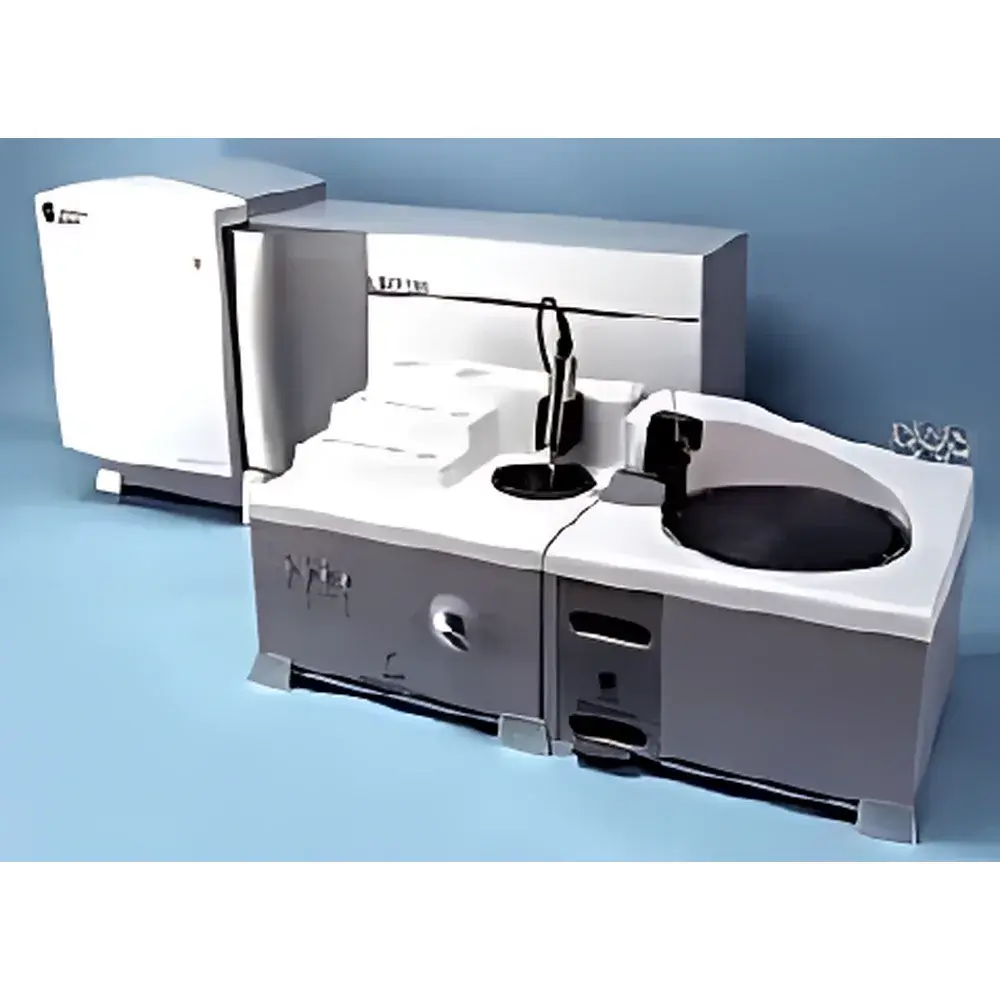
Beckman Coulter LS Series Laser Particle Size Analyzer
| Brand | Beckman Coulter |
|---|---|
| Origin | USA |
| Model | LS Series |
| Measurement Range | 17 nm – 2000 µm |
| Accuracy | < 1% |
| Repeatability | < 1% |
| Resolution | Capable of resolving two peaks with a peak diameter ratio > 2.5 |
| Detection Channels | 116 |
| Detector Array | 132 photodiode detectors |
| Light Source | Solid-state laser (rated lifetime > 70,000 hours) |
| Optical Design | Dual-lens patented configuration with multi-wavelength and polarized light capability |
| Sample Introduction | Dry dispersion and wet suspension modes supported |
| Compliance | Designed to support ISO 13320, ASTM E2412, and USP <429> requirements for particle size distribution analysis |
Overview
The Beckman Coulter LS Series Laser Particle Size Analyzer is an advanced instrument engineered for precision particle size distribution (PSD) characterization based on the physical principle of laser diffraction. It operates under Mie and Fraunhofer scattering theories, enabling quantitative analysis of particulate systems across a broad dynamic range—from colloidal nanoparticles to coarse powders. The system employs a collimated, multi-wavelength laser beam coupled with polarized illumination and dual-lens optical geometry to enhance signal fidelity for submicron particles. Its design targets laboratories requiring regulatory-compliant, high-reproducibility PSD data in pharmaceutical development, advanced materials R&D, catalyst formulation, and quality control of industrial powders.
Key Features
- Dual-lens patented optical architecture: Optimizes angular light collection efficiency, particularly for particles below 100 nm, minimizing truncation error and improving low-end sensitivity.
- 132-element photodiode detector array: Provides superior spatial resolution of scattered light intensity profiles, supporting robust deconvolution algorithms and accurate bimodal/multimodal distribution modeling.
- Multi-wavelength & polarized illumination: Enhances contrast and signal-to-noise ratio for fine particles (< 1 µm), enabling reliable differentiation of closely spaced peaks in complex distributions.
- Extended dynamic range (17 nm – 2000 µm): Achieved through synchronized dry and wet measurement modules, eliminating the need for method switching or instrument reconfiguration between nanoscale and micron-scale analysis.
- Long-life solid-state laser source: Rated for > 70,000 hours of continuous operation, ensuring long-term stability and reducing maintenance frequency and calibration drift over time.
- 116-channel data acquisition: Enables high-fidelity digitization of scattering patterns, preserving subtle features critical for distinguishing overlapping populations in heterogeneous samples.
Sample Compatibility & Compliance
The LS Series accommodates diverse sample types—including aqueous suspensions, organic dispersions, and free-flowing dry powders—via interchangeable sample modules (e.g., universal liquid module, aerodynamic dry disperser). All configurations maintain traceable alignment and standardized optical path lengths per ISO 13320 Annex A. Instrument validation protocols align with ASTM E2412 for laser diffraction instrumentation and support 21 CFR Part 11-compliant audit trails when integrated with Beckman Coulter’s optional LSPS software suite. Data output formats comply with ASTM E2922 for reporting PSD metrics (D10, D50, D90, span, relative standard deviation), facilitating cross-platform comparison with sieve analysis, sedimentation, and electron microscopy-derived datasets.
Software & Data Management
The LS Series operates with Beckman Coulter’s proprietary Laser Diffraction Software (LDS), a validated platform supporting method development, automated SOP execution, and GLP/GMP-aligned data archiving. LDS includes built-in refractive index libraries, real-time Mie theory parameter adjustment, and statistical batch trending tools. Raw scattering data are stored in vendor-neutral HDF5 format; processed reports export to PDF, CSV, and XML with embedded metadata (operator ID, timestamp, instrument serial number, environmental conditions). Optional integration with laboratory information management systems (LIMS) enables seamless workflow handoff for QC release testing and regulatory submissions.
Applications
- Pharmaceutical solid dosage form development (e.g., API crystallization monitoring, excipient blending uniformity assessment)
- Quality assurance of nanomaterials (carbon nanotubes, metal oxides, lipid nanoparticles)
- Characterization of battery electrode slurries and cathode/anode precursor powders
- Emulsion and suspension stability evaluation in cosmetics and agrochemical formulations
- Process validation and in-line PAT support via optional flow-cell integration
- Comparative analysis against legacy methods (sedimentation, sieving) per ISO/IEC 17025-accredited protocols
FAQ
What standards does the LS Series comply with?
The instrument conforms to ISO 13320 for laser diffraction methodology, ASTM E2412 for instrument qualification, and supports USP for pharmaceutical particle sizing.
Can the LS Series measure both dry and wet samples without hardware modification?
Yes—switching between dry dispersion and wet suspension modes requires only module interchange and software configuration; no optical recalibration is needed.
Is the 17 nm lower detection limit applicable to all sample types?
The 17 nm specification assumes optimal dispersion stability, appropriate refractive index contrast, and use of polarized multi-wavelength mode; actual lower limit may vary depending on particle composition and matrix effects.
How is data integrity maintained during regulatory audits?
With optional 21 CFR Part 11-compliant software, the system provides electronic signatures, immutable audit logs, role-based access control, and encrypted raw data storage.
Does the LS Series support automated method transfer between instruments?
Yes—LDS enables export/import of validated SOPs, including optical parameters, dispersion settings, and analysis models, ensuring consistent results across multi-site deployments.



