
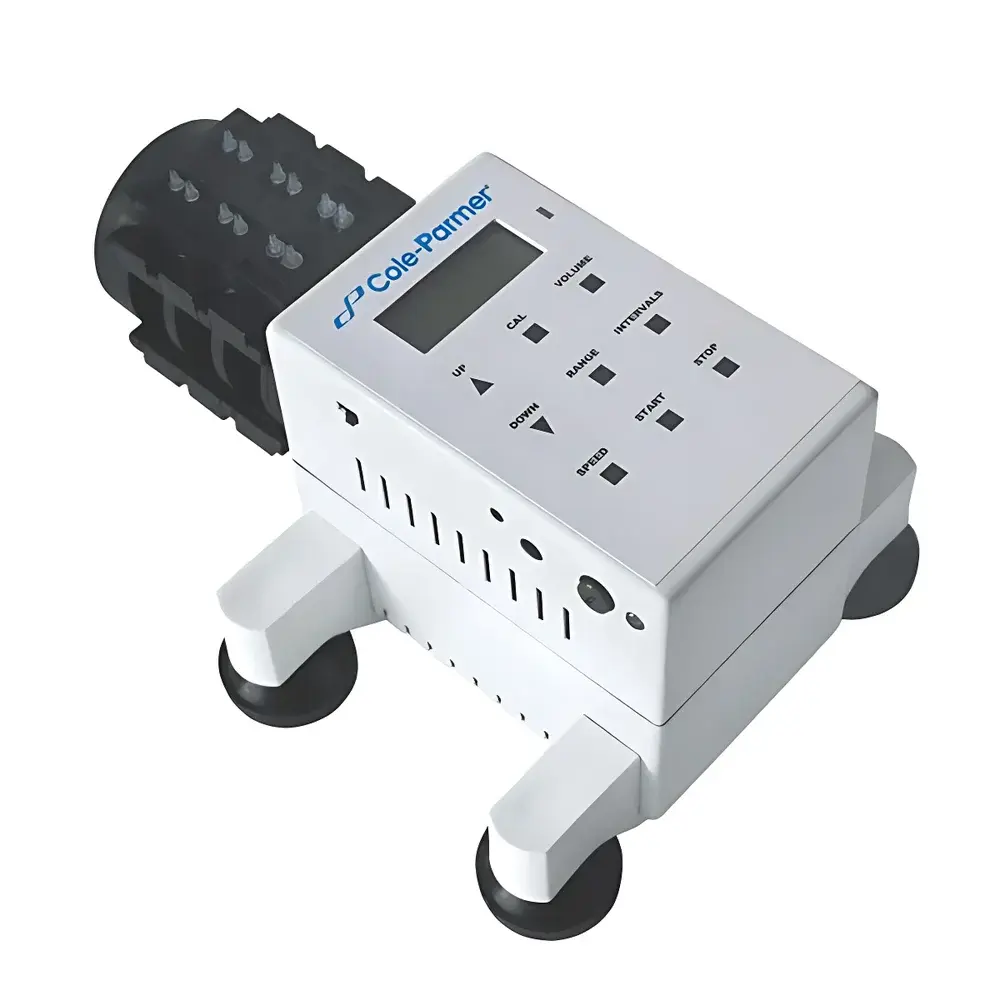
Cole-Parmer Masterflex L/S Digital Multichannel Peristaltic Pump Model 78190-00
| Brand | Cole-Parmer |
|---|---|
| Origin | USA |
| Model | 78190-00, 78190-02, 78190-04 |
| Drive Speed | 340 rpm |
| Flow Range (per channel) | 4–200 µL/min (ID 0.51 mm tubing) |
| Pulsation Reduction | 8-roller head design |
| Repeatability | ±5% |
| Programmable Steps | up to 99 per program |
| Interval Timing | 1–99 s per step |
| Dimensions (L×W×H) | 14 × 18 × 12.2 cm |
| Power Input | 100–240 VAC, 50/60 Hz |
| Standard Accessories | Foot switch, power cord |
Overview
The Cole-Parmer Masterflex L/S Digital Multichannel Peristaltic Pump (Model 78190-00 series) is an engineered solution for precise, low-volume fluid handling in analytical, pharmaceutical, and life science laboratories. Utilizing positive displacement peristaltic action—where rollers compress flexible tubing against a curved housing—the pump delivers pulse-minimized flow without fluid contact with mechanical components. Its 8-roller head architecture significantly reduces flow pulsation compared to conventional 2- or 4-roller designs, enhancing volumetric accuracy and long-term reproducibility in applications requiring stable microflow delivery. Designed for multi-channel parallel operation, the system supports scalable configurations: 4-channel (78190-00), 8-channel (78190-02), and 12-channel (78190-04) variants—all sharing identical control logic, timing resolution, and tubing compatibility. The digital interface enables full programmability without external software, making it suitable for integration into GLP-compliant workflows where auditability and operator independence are essential.
Key Features
- Eight-roller peristaltic head for reduced pulsation and improved flow linearity across all tubing sizes
- Bidirectional DC motor enabling forward/reverse operation—critical for priming, backflushing, and closed-loop recirculation
- 99-step programmable memory with user-defined interval timing (1–99 seconds per step), supporting complex dispensing sequences including timed pauses, direction reversal, and speed ramping
- Digital speed control (0–340 rpm) with real-time RPM display and fine-grained adjustment (1 rpm increments)
- Modular channel architecture: identical drive electronics per channel ensure inter-channel flow consistency; no cross-talk or load imbalance between channels
- Compact footprint (14 × 18 × 12.2 cm) optimized for benchtop use in fume hoods, biosafety cabinets, or automated workstations
- Universal power supply (100–240 VAC, 50/60 Hz) compliant with international laboratory electrical standards
- Included foot switch enables hands-free start/stop—ideal for sterile or glove-required environments
Sample Compatibility & Compliance
The pump accommodates standard Masterflex L/S-compatible tubing in five inner diameters (0.51 mm to 2.54 mm), each certified for chemical resistance and biocompatibility per USP Class VI and ISO 10993-5 requirements. Pharmed BPT tubing—supplied as optional accessories (e.g., 78190-40 through 78190-48)—exhibits low extractables, high resilience, and validated performance with aqueous buffers, organic solvents, and mild acids/bases. Flow calibration is traceable to NIST-traceable gravimetric methods; repeatability of ±5% is verified per ASTM D3418 for rotational viscoelastic characterization of pump systems. The device meets IEC 61000-6-3 (EMC emissions) and IEC 61000-6-2 (immunity) standards. While not inherently 21 CFR Part 11 compliant, its programmable log structure—including timestamped step execution records—supports retrospective validation when paired with secure networked data capture systems.
Software & Data Management
This is a stand-alone, firmware-controlled instrument with no proprietary PC software dependency. All programming, execution, and status monitoring occur via the integrated LED keypad and display. Each program stores step number, direction, speed, duration, and interval—retained after power cycling. No internal storage or USB export is provided; however, the foot switch input and TTL-compatible start/stop triggers (via rear-panel DB9 connector) enable synchronization with external PLCs, data loggers, or LIMS platforms. For regulated environments, users may document program parameters and execution logs manually or via third-party SCADA integration. Audit trails are maintained through procedural SOPs—not embedded electronic records—aligning with traditional GLP laboratory practices where instrument use is operator-logged and reviewed by QA personnel.
Applications
- Automated reagent dispensing in ELISA, PCR setup, and cell culture media preparation
- Continuous perfusion in microfluidic organ-on-chip systems and bioreactor feed control
- Calibration standard delivery for HPLC autosamplers and ICP-MS nebulizer systems
- Parallel sample dilution and fraction collection in preparative chromatography
- Cleaning-in-place (CIP) and rinse cycles for analytical flow cells and sensor housings
- Low-flow nutrient or drug infusion in zebrafish or C. elegans exposure studies
- Controlled solvent addition in reaction calorimetry and in-situ FTIR flow cells
FAQ
What tubing sizes are supported, and how does ID affect flow range?
The pump accepts L/S-series tubing with inner diameters of 0.51 mm, 1.03 mm, 1.52 mm, 2.06 mm, and 2.54 mm. Flow rate scales approximately with the square of tubing ID; thus, larger IDs support higher total throughput but reduce low-end resolution. Minimum measurable volume per second improves with smaller IDs—critical for nanoliter-scale dispensing.
Is the pump suitable for sterile or closed-system applications?
Yes. Tubing remains the only fluid-contact component; single-use, gamma-sterilizable Pharmed BPT tubing can be installed and discarded per experiment. No lubricants or seals contact the fluid path.
Can multiple pumps be synchronized?
Not natively. However, TTL trigger inputs allow master-slave configuration using external timing hardware. Each unit operates independently unless externally coordinated.
Does the pump require recalibration after tubing replacement?
No. Flow is determined by tubing geometry and roller speed—not internal sensors. Users must reference published flow charts or perform gravimetric verification when changing tubing type or ID.



