
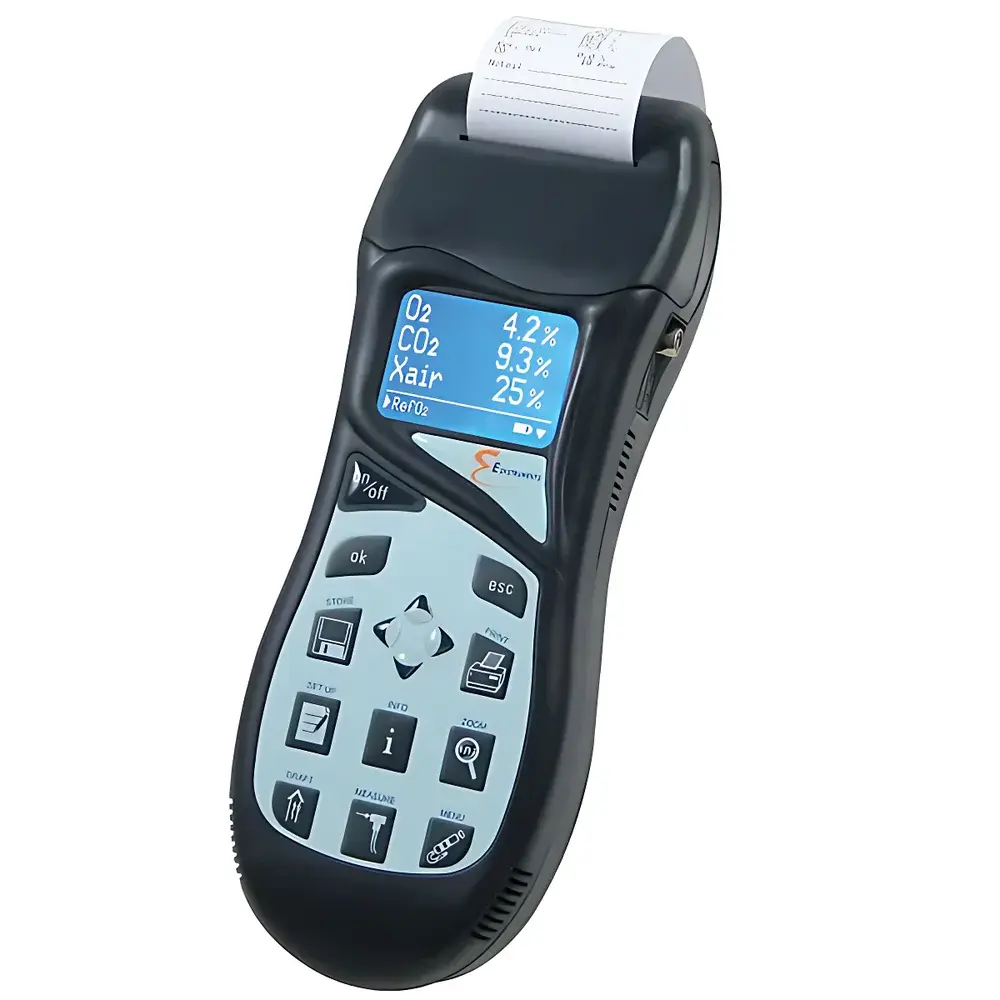
Cole-Parmer 86494-15 Portable Combustion Efficiency & Multi-Gas Emissions Analyzer with Integrated Thermal Printer
| Brand | Cole-Parmer |
|---|---|
| Origin | USA |
| Model | 86494-15, 86494-25, 86494-35, 86494-40, 86494-45 |
| Type | Portable |
| Detection Targets | O₂, CO, CO₂, NO, NO₂, NOₓ, SO₂, Draft Pressure, Flue Gas Temperature, Ambient Temperature |
| O₂ Range | 0–25% vol (0.1% res, ±0.2% vol) |
| CO Range | 0–8000 ppm (1 ppm res |
| CO₂ Range | 0–99.9% vol (0.1% res) |
| NO Range | 0–4000 ppm (1 ppm res |
| NO₂ Range | 0–1000 ppm (1 ppm res |
| SO₂ Range | 0–4000 ppm (1 ppm res |
| NOₓ Range | 0–5000 ppm (1 ppm res) |
| Draft Pressure | ±0–40" H₂O (0.001" H₂O res, ±5% of reading) |
| Flue Gas Temp | –23 to 1000°C (0.1°C res, ±1°C) |
| Ambient Temp | –23 to 100°C (0.1°C res, ±1°C) |
| Combustion Efficiency | 0–100% (0.1% res) |
| Exhaust Flow | ≥1.00 (0.01 res) |
| Fuel Library | 10 preloaded fuels (natural gas, propane, butane, No. 2/4/6 fuel oil, wood, coal) |
| Data Logging | Up to 600 records |
| Power | Rechargeable battery + AC adapter (9 hrs operation without printing) |
| Communication | RS-232 (86494-15/-25), USB (86494-35/-40/-45) |
| Included | Dual-channel sampling hose (10 ft), 12" metal probe, factory-calibrated sensors, calibration certificate, non-thermal printer paper, rubber feet, carrying case |
Overview
The Cole-Parmer 86494-15 is a portable, field-deployable combustion efficiency and multi-gas emissions analyzer engineered for precision diagnostics of industrial and commercial combustion systems—including boilers, furnaces, kilns, and incinerators. It operates on electrochemical sensor technology for real-time quantification of key flue gas constituents (O₂, CO, CO₂, NO, NO₂, SO₂) and physical parameters (draft pressure, flue and ambient temperatures), enabling direct calculation of combustion efficiency, excess air, NOₓ equivalence, and theoretical CO₂ concentration per ASTM D5865 and ISO 12953 standards. Its integrated dual-path probe design permits simultaneous gas aspiration and exhaust venting, minimizing cross-contamination and ensuring representative sampling under dynamic stack conditions. The instrument supports compliance-driven workflows in low-NOₓ retrofit projects, energy audits, and regulatory reporting (e.g., EPA Method 204, EN 15549, and local air quality ordinances), delivering traceable, auditable data without reliance on external PCs during on-site commissioning.
Key Features
- Integrated thermal printer for immediate hard-copy documentation of measurements—no external peripherals required for field reporting or client handover.
- Dual-channel stainless-steel sampling probe with ruggedized metal connector, rated for continuous exposure up to 1000°C flue gas temperature.
- Onboard data logging capacity for up to 600 measurement sets, each timestamped and tagged with operator ID, fuel type, and test location metadata.
- Preloaded fuel library with 10 standard combustion fuels (including natural gas, propane, No. 2 fuel oil, anthracite coal, and seasoned hardwood), enabling automatic stoichiometric correction for accurate efficiency calculations.
- Rechargeable lithium-ion battery system with 9-hour runtime (non-printing mode) and universal AC charging compatibility—designed for extended shift coverage in remote or off-grid facilities.
- Modular configuration across five model variants (86494-15 through -45), supporting scalable gas detection capability—from basic O₂/CO/CO₂/T to full-spectrum NOₓ/SO₂/NO₂ analysis—with corresponding communication interfaces (RS-232 or USB).
Sample Compatibility & Compliance
The analyzer is validated for use with dry, particulate-free flue gases from fossil-fueled and biomass-fired systems operating within standard draft pressure ranges (±40″ H₂O). Its electrochemical sensors meet IEC 60079-29-1 requirements for intrinsic safety in non-hazardous zones and are certified to EN 50104 for toxic gas detection reliability. All factory calibrations are traceable to NIST-certified reference gases, and calibration certificates include uncertainty budgets per ISO/IEC 17025. The device supports GLP-compliant operation through user-accessible calibration logs, sensor life tracking, and configurable audit trails—essential for QA/QC departments maintaining FDA 21 CFR Part 11–aligned documentation practices in pharmaceutical or food processing environments.
Software & Data Management
Models 86494-25, -35, -40, and -45 include proprietary PC software for post-acquisition data export, trend visualization, and report generation in PDF or CSV formats. The software enforces structured data entry (e.g., facility ID, burner ID, operator signature) and embeds digital signatures compliant with electronic record retention policies. Raw sensor outputs are stored with full metadata—including ambient humidity compensation flags and sensor response time stamps—to support root-cause analysis of transient combustion anomalies. Exported datasets retain native resolution and error bounds, enabling third-party integration with CMMS platforms (e.g., IBM Maximo, SAP PM) or environmental management information systems (EMIS).
Applications
- Tuning low-NOₓ burners and staged combustion systems to balance thermal efficiency against regulated NOₓ and CO limits.
- Conducting ASHRAE Guideline 12–based commissioning of HVAC boiler plants to verify design-point combustion performance.
- Performing periodic stack testing for Title V permit compliance under 40 CFR Part 60 Subpart Db (commercial/industrial boilers).
- Validating retrofit outcomes after installation of flue gas recirculation (FGR), over-fire air (OFA), or selective catalytic reduction (SCR) systems.
- Supporting ISO 50001 energy management system audits by quantifying baseline fuel-to-heat conversion efficiency and identifying excess air losses.
- Training technical staff in combustion fundamentals using real-time stoichiometric feedback and visualized lambda curves.
FAQ
What gases does the base model 86494-15 measure?
O₂, CO, CO₂, flue gas temperature, ambient temperature, draft pressure, and derived combustion efficiency—no NO, NO₂, or SO₂ capability in this variant.
Is the thermal printer compatible with standard receipt paper?
No—it uses proprietary non-thermal, long-life paper supplied with the unit to ensure legibility under high-temperature field conditions and archival stability exceeding 10 years.
Can the instrument be used in wet or condensing flue streams?
Not directly—condensate must be removed upstream via a chilled mirror or permeation dryer; the analyzer accepts only conditioned, dry gas samples to prevent sensor poisoning and drift.
How often does the system require calibration verification?
Per manufacturer recommendation and ISO 14644-3, zero and span checks should be performed before each daily use; full sensor calibration is advised every 90 days or after exposure to extreme gas concentrations.
Does the software support automated report generation for regulatory submissions?
Yes—the included software templates align with EPA Form 7500-3 and EU Directive 2010/75/EU Annex VI reporting structures, including auto-populated emission factor tables and uncertainty annotations.







