
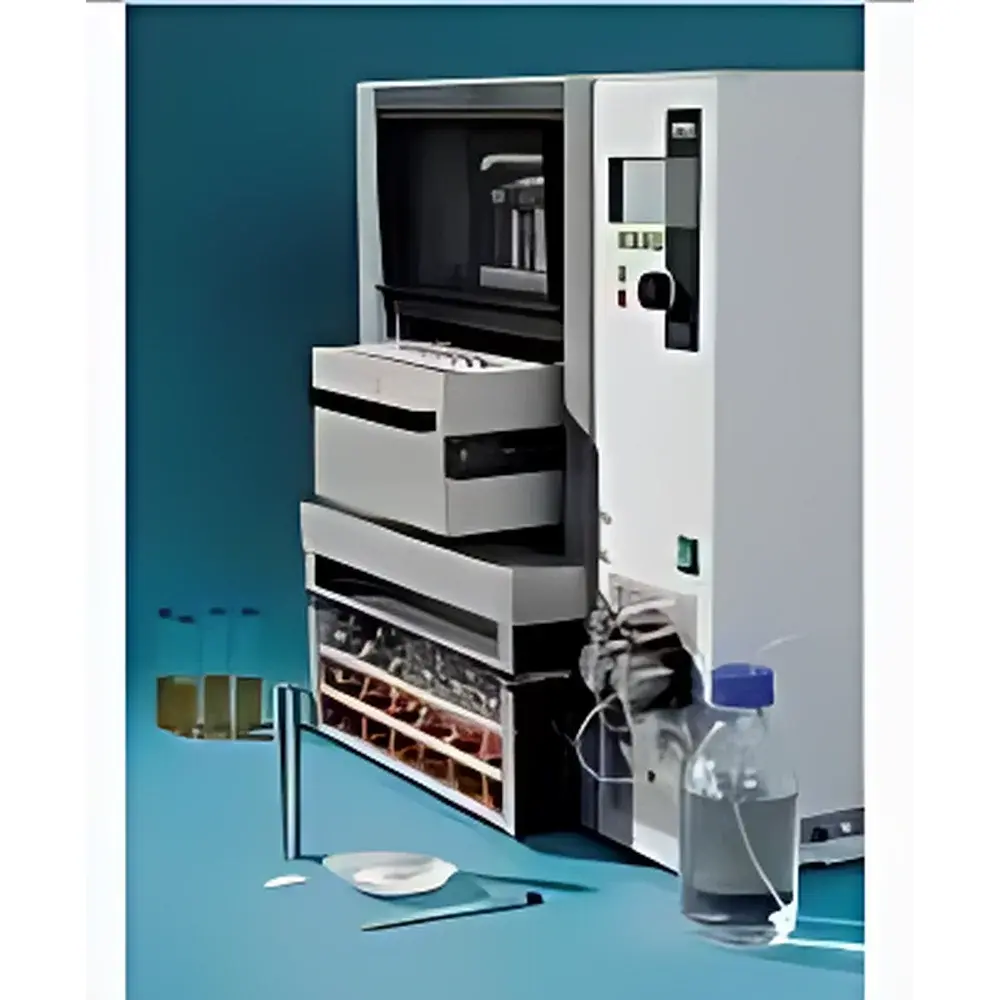
BUCHI SpeedExtractor E-916 Accelerated Solvent Extractor
| Brand | BUCHI |
|---|---|
| Origin | Switzerland |
| Model | SpeedExtractor E-916 |
| Temperature Range | 50–200 °C (±3 °C) |
| Pressure Range | 50–150 bar (±5 bar) |
| Extraction Cell Volumes | 10, 20, 40 mL |
| Solvent Consumption per Sample | 5–200 mL |
| Solvent Delivery Flow Rate | 0.01–50 mL/min (±2 %) |
| Integrated Solvent Mixer | 2-port or 4-port |
| Power Consumption | 1750 W |
| Electrical Supply | 100–240 VAC ±10 %, 50–60 Hz |
| Nitrogen Supply Requirement | 5–10 bar, purity 4.5–5.0 |
| Wetted Materials | FEP, FFPM, PEEK, PTFE, stainless steel, ceramic, borosilicate glass |
| Interface | USB 2.0 |
| Dimensions (W×H×D) | 670 × 725 × 500 mm |
| Weight | 90 kg |
| Ingress Protection | IP21 |
| Certifications | CE, CSA |
Overview
The BUCHI SpeedExtractor E-916 is an advanced accelerated solvent extractor engineered for high-throughput, parallel pressurized fluid extraction (PSE) under precisely controlled temperature and pressure conditions. Based on the principle of pressurized liquid extraction (PLE), it utilizes elevated temperatures (up to 200 °C) and pressures (up to 150 bar) to enhance solvent penetration, solubility, and mass transfer kinetics—thereby significantly reducing extraction time while maintaining quantitative recovery of analytes from solid or semi-solid matrices. Unlike conventional sequential PSE systems, the E-916 implements true parallel processing across six independent extraction cells, enabling simultaneous treatment of up to six samples in a single run. This architecture eliminates serial bottlenecks and delivers full extraction cycles—including heating, static extraction, rinse, and purge—in as little as 20 minutes. Designed for compliance with standardized analytical workflows, the system supports validated methods including US EPA SW-846 Methods 3545 and 6860, and aligns with GLP/GMP data integrity requirements through integrated audit-trail-capable software.
Key Features
- True parallel 6-cell extraction architecture—no sample sequencing delays
- Programmable temperature range: 50–200 °C (±3 °C); pressure range: 50–150 bar (±5 bar)
- Modular extraction cell options: 10, 20, and 40 mL volumes for the E-916 configuration
- Integrated 2-port or 4-port solvent mixer for on-demand binary or quaternary solvent blending
- Automated cell sealing and pressure integrity verification prior to each run
- Eco Mode functionality: automatic heater shutdown post-extraction to reduce standby energy consumption
- Rinse-to-waste capability with dedicated waste line routing—eliminates need for secondary collection vessels during cleaning
- Intuitive one-button operation with method recall and multi-user access control
- Comprehensive safety architecture: real-time pressure/temperature monitoring, hardware interlocks, and redundant thermal cutoffs
Sample Compatibility & Compliance
The SpeedExtractor E-916 accommodates diverse sample types—including soils, sediments, biological tissues, foodstuffs, polymers, pharmaceutical tablets, and botanical materials—across a broad volume range (1–40 mL for E-916). Its wetted components are constructed from chemically inert, high-purity materials (FEP, FFPM, PEEK, PTFE, 316 stainless steel, alumina ceramics, and borosilicate glass), ensuring compatibility with aggressive solvents such as dichloromethane, acetone, hexane, methanol, and ethyl acetate. The system meets CE and CSA safety directives and conforms to IEC 61010-1 for laboratory equipment. It supports IQ/OQ qualification packages compliant with ISO/IEC 17025 and FDA 21 CFR Part 11 when used with SpeedExtractorRecord software, which provides electronic signatures, user-level permissions, and immutable process logs—including timestamps, parameter deviations, and manual interventions.
Software & Data Management
SpeedExtractorRecord software serves as the central platform for method development, execution, and regulatory reporting. It enables full traceability of all extraction parameters (temperature ramp profiles, pressure hold times, solvent delivery sequences, rinse volumes), along with system status events and operator actions. Reports are exportable in PDF and CSV formats and include digital signatures, revision history, and metadata required for audit readiness. The software integrates seamlessly with LIMS environments via standard USB 2.0 connectivity and supports automated backup to network drives. All firmware updates and calibration records are version-controlled within the software interface, facilitating ongoing compliance with ISO 17025 internal audit requirements and routine instrument requalification.
Applications
- Environmental analysis: Quantitative recovery of PAHs, PCBs, dioxins/furans, TPH, and organochlorine pesticides from soil, sludge, and sediment per US EPA 3545A and 6860 protocols
- Food & agricultural testing: Fat determination (AOAC 999.04), pesticide residue analysis (EN 15662), and mycotoxin extraction from cereals, spices, and processed foods
- Polymers & additives: Rapid extraction of plasticizers (e.g., phthalates), flame retardants (e.g., PBDEs), antioxidants, and UV stabilizers from PVC, PET, and polyolefins
- Pharmaceutical & natural products: Isolation of active pharmaceutical ingredients (APIs), alkaloids, flavonoids, and terpenes from plant matrices or dosage forms under mild, reproducible conditions
- Forensic & clinical toxicology: Solid-phase matrix cleanup followed by PLE for drug metabolites in hair, tissue, or filter papers
FAQ
What distinguishes parallel PSE from sequential extraction?
Parallel PSE processes all six samples simultaneously in thermally and hydraulically isolated cells, eliminating cumulative dwell time and delivering consistent cycle duration regardless of sample number. Sequential systems require repeated heating/cooling and pressure cycling per sample—introducing variability and extending total throughput time.
Can the E-916 be qualified for GxP-regulated laboratories?
Yes. When deployed with SpeedExtractorRecord software and validated IQ/OQ protocols, the system meets ALCOA+ data integrity principles and supports 21 CFR Part 11 compliance, including electronic signatures, audit trails, and role-based access control.
Is nitrogen purging mandatory for all applications?
Nitrogen is required only for oxygen-sensitive extractions (e.g., lipid oxidation-prone samples) or when inert atmosphere is specified by method. Standard extractions operate without nitrogen; the system includes optional N₂ integration with pressure regulation and purity monitoring (5–10 bar, 4.5–5.0 grade).
How does solvent optimization impact method robustness?
The integrated 2-/4-port solvent mixer allows precise, programmable gradient formation—critical for complex matrices where polarity modulation improves selectivity and reduces co-extractives. Combined with scalable cell volumes (10–40 mL), this enables stoichiometric solvent matching to sample mass, minimizing dilution and maximizing detection sensitivity.



