
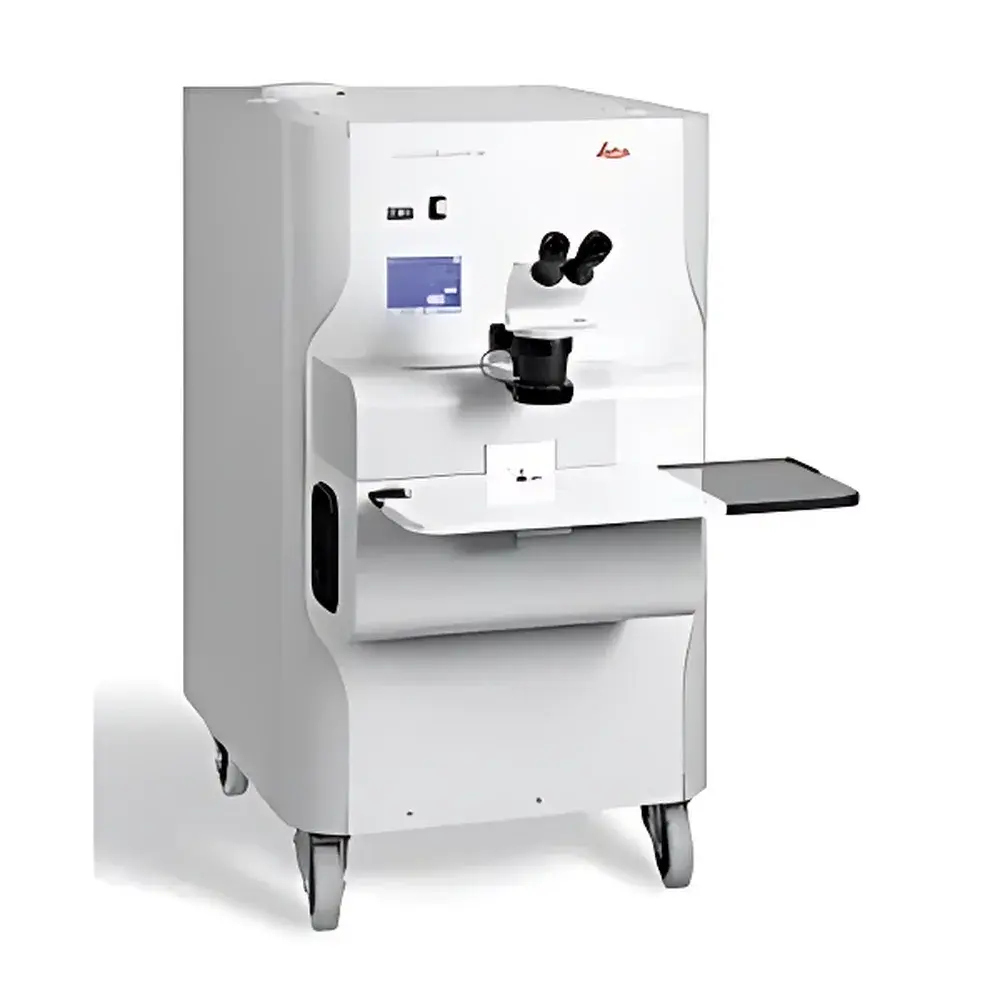
Leica EM HPM100 High-Pressure Freezer
| Brand | Leica |
|---|---|
| Origin | Germany |
| Model | Leica EM HPM100 |
| Maximum Sample Thickness | 5 mm × 0.6 mm |
| Effective Vitrification Depth | 200 µm |
| Operating Pressure | 2100 bar |
| Liquid Nitrogen Consumption | 20 L for initial cooldown, 50 mL per freeze cycle, 5 L/h standby |
| Sample Holders | 3 mm / 6 mm flat, 3 mm / 4.6 mm freeze-fracture, biopsy, suspension (tube), and light/electron microscopy correlative systems |
Overview
The Leica EM HPM100 is a high-precision, laboratory-grade high-pressure freezer engineered for cryo-preservation of biological specimens under ultra-rapid vitrification conditions. Unlike chemical fixation—which induces structural artifacts through cross-linking, extraction, or diffusion delays—the HPM100 employs high-pressure freezing (HPF) to immobilize cellular architecture in near-native state within milliseconds. By applying 2100 bar of hydrostatic pressure during immersion in liquid nitrogen, the device suppresses ice crystal nucleation and growth by depressing the freezing point of water to approximately −20 °C. This enables vitrification—glass-like solidification—of aqueous compartments up to 200 µm deep, preserving membrane integrity, protein conformation, enzymatic activity, antigenicity, and subcellular ion distribution with exceptional fidelity. The system is purpose-built for structural biology workflows requiring high-fidelity sample preparation for cryo-electron microscopy (cryo-EM), freeze-substitution, and correlative light and electron microscopy (CLEM).
Key Features
- High-pressure vitrification at 2100 bar ensures ice-free preservation across tissue sections up to 5 mm in diameter and 0.6 mm in thickness.
- Integrated stereo microscope (with adjustable magnification and coaxial illumination) and motorized precision stage enable real-time sample positioning and verification prior to freezing.
- Low liquid nitrogen consumption: only 50 mL per freeze cycle after stabilization; 20 L required for initial cooldown; 5 L/h maintenance during standby—optimized for operational continuity and cost efficiency.
- Modular sample carrier platform supporting multiple standardized geometries: flat carriers (3 mm and 6 mm), freeze-fracture holders (3 mm and 4.6 mm), biopsy capsules, suspension tubes, and dual-modality carriers compatible with both light and electron microscopy workflows.
- Intuitive 7-inch capacitive touchscreen interface with embedded data logging—records and displays synchronized pressure and temperature profiles during each freeze cycle.
- USB port for export of raw freeze metadata (time-stamped pressure/temperature traces, actuation timestamps, operator ID if configured) to support GLP-compliant documentation and audit readiness.
Sample Compatibility & Compliance
The Leica EM HPM100 accommodates diverse specimen types—including cultured cells, thin tissue slices, organoids, biofilms, and suspension-based samples—without requirement for chemical pretreatment. Its mechanical design conforms to IEC 61000-6-2 (electromagnetic immunity) and IEC 61000-6-3 (emission) standards. While not certified as medical device under EU MDR or FDA 510(k), the system supports research-use-only (RUO) applications aligned with ISO/IEC 17025–accredited laboratories conducting structural analysis under Good Laboratory Practice (GLP) frameworks. Freeze-cycle traceability meets foundational requirements for 21 CFR Part 11–aligned data integrity when paired with validated LIMS or ELN integration.
Software & Data Management
The HPM100 operates via embedded firmware with no external PC dependency. All freeze events are timestamped and stored locally with full pressure–temperature temporal resolution (100 Hz sampling). Data export is performed via standard USB mass-storage mode; exported .csv files contain columnar time-series data suitable for post-acquisition analysis in MATLAB, Python (NumPy/Pandas), or commercial scientific graphing tools. Optional integration with Leica’s EM Connect platform enables remote monitoring, multi-instrument fleet logging, and centralized metadata archiving—facilitating reproducibility tracking across user groups and time points.
Applications
- Cryo-EM specimen preparation for near-atomic resolution structure determination.
- Freeze-substitution protocols requiring artifact-free lipid bilayer preservation.
- Correlative microscopy studies where identical regions must be imaged first by fluorescence light microscopy and subsequently by TEM or FIB-SEM.
- Structural analysis of dynamic processes—e.g., synaptic vesicle cycling, mitochondrial remodeling, or pathogen–host interface formation—captured at defined physiological timepoints.
- Validation of cryo-fixation efficacy in comparative studies involving alternative methods (e.g., plunge freezing, slam freezing, or chemical fixation).
FAQ
What is the maximum sample thickness that achieves complete vitrification?
Vitrification depth is validated up to 200 µm under standard operating conditions (2100 bar, LN₂ bath); thicker specimens (e.g., 0.6 mm) require empirical optimization of pressure ramp rate and thermal equilibration time.
Can the HPM100 be integrated into automated sample preparation lines?
Yes—the system provides TTL-compatible trigger I/O and RS-232 serial command set for synchronization with robotic handlers, cryo-transfer devices, or environmental chambers.
Is training provided for safe operation and maintenance?
Leica Microsystems offers factory-certified on-site installation, safety briefing, and application-specific protocol development—covering pressure vessel handling, LN₂ management, and failure mode response.
Does the instrument comply with pressure equipment directives?
The HPM100 is CE-marked per PED 2014/68/EU (Category IV pressure equipment) and includes redundant pressure relief valves, real-time strain monitoring, and automatic shutdown upon deviation from nominal operating envelope.



