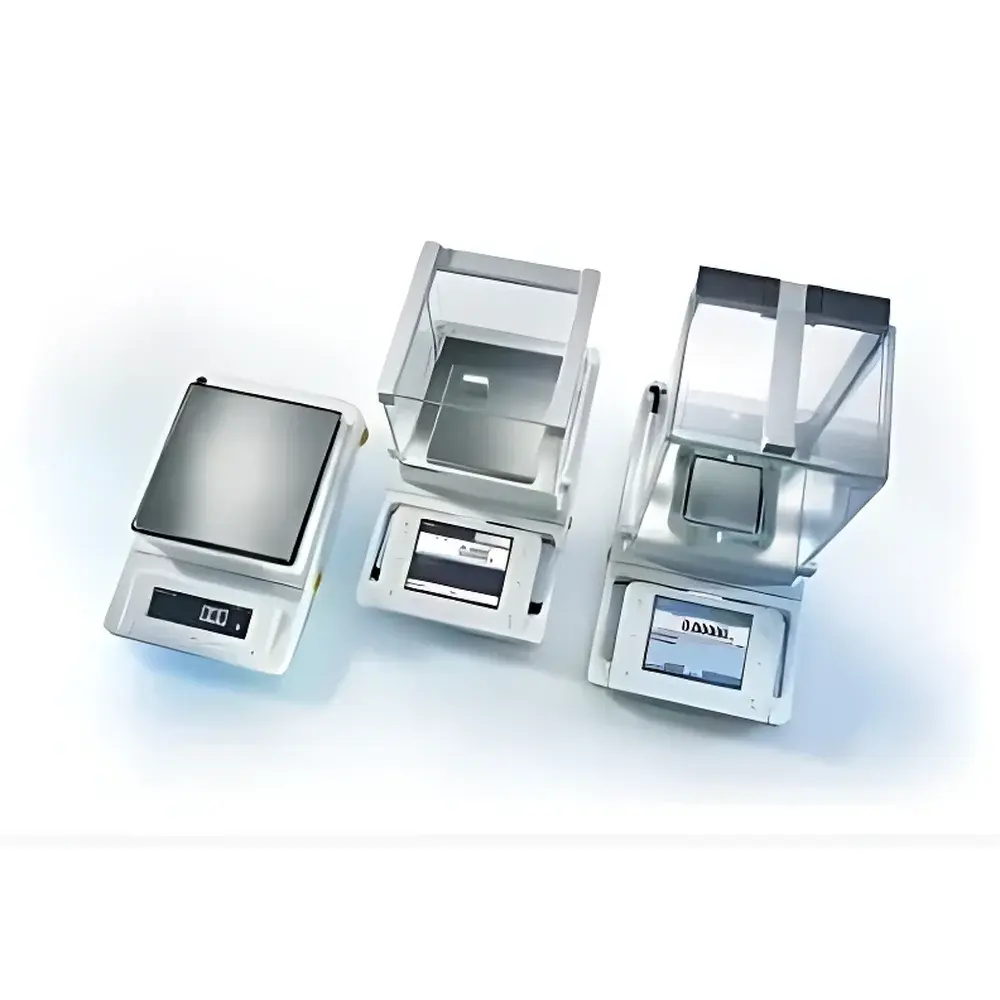
Sartorius Cubis® High-Performance Analytical Balance
| Brand | Sartorius |
|---|---|
| Origin | Germany |
| Model | CUBIS® |
| Instrument Type | Analytical Balance |
| Maximum Capacity | 200–500 g (standard analytical modules) |
| Readability | 1 µg (0.000001 g) |
| Repeatability | ≤ ±0.001 mg |
| Calibration | Fully Automatic Internal Calibration (isoCAL®) |
| Compliance | ISO/IEC 17025, USP <41>, <1251>, ASTM E898, GLP/GMP-ready with audit trail support |
Overview
The Sartorius Cubis® High-Performance Analytical Balance is an ISO 17025–engineered platform designed for laboratories operating under stringent regulatory frameworks—including pharmaceutical QC/QA, clinical research, reference material certification, and advanced materials science. Built on a monolithic granite base and utilizing electromagnetic force compensation (EMFC) transduction technology, the Cubis® delivers traceable mass measurement with 1 µg readability and sub-microgram repeatability. Its core architecture adheres to the principles of metrological integrity: temperature-compensated load cells, active drift correction, and real-time environmental monitoring (temperature, air pressure, humidity) ensure stability across variable lab conditions. Unlike legacy monolithic balances, the Cubis® implements a true three-module physical separation—weighing module, display & control unit, and draft shield—enabling independent validation, modular recalibration, and future-proof hardware upgrades without system-wide downtime.
Key Features
- Modular Metrology Architecture: Physically decoupled weighing module, control unit, and draft shield allow independent verification per ISO/IEC 17025 Clause 6.4 and facilitate calibration traceability at component level.
- isoCAL® Fully Automatic Internal Calibration: Integrated motor-driven calibration mass deployment with thermal drift compensation; compliant with USP repeatability and linearity requirements.
- 1 µg Readability with ≤ ±0.001 mg Repeatability: Achieved via dual-frequency EMFC sensor array and adaptive digital filtering—validated per ASTM E898 Annex A3 for microgram-level static weighing.
- Q-Apps™ Embedded Application Framework: Pre-validated, FDA 21 CFR Part 11–compliant workflows (e.g., formulation, differential weighing, density determination) executed directly on the balance—no external PC required.
- Electrostatic-Neutralizing Draft Shields: Conductive-coated glass panels (DF, DM, DI, DA, DU, DE, DR variants) reduce electrostatic interference to <0.5 µg deviation—critical for low-mass powder and filter weighing per USP .
- Multi-Interface Data Integrity: Native Ethernet (TCP/IP), RS-232, USB Device/Host, and optional Wi-Fi; all interfaces support configurable data logging with timestamped, digitally signed output per ALCOA+ principles.
Sample Compatibility & Compliance
The Cubis® supports diverse sample types—from hygroscopic APIs and nanomaterials to volatile solvents and ceramic filters—via application-optimized draft shield configurations. The DF stainless-steel manual shield is certified for USP heavy metal filter weighing; the DM auto-lift shield with self-learning door motion ensures minimal air turbulence during ultra-micro weighing (<10 mg). All modules comply with EU Directive 2014/30/EU (EMC), 2014/35/EU (LVD), and are CE-marked. Full documentation packages—including Factory Acceptance Test (FAT) reports, metrological certificates, and IQ/OQ protocols—are provided for GxP environments. The system meets data integrity requirements of FDA 21 CFR Part 11 (electronic signatures, audit trails, role-based access) and EU Annex 11 when deployed with Q-Apps™ and Sartorius LabX® integration.
Software & Data Management
Embedded firmware supports local execution of Q-Apps™—pre-validated, parameterized workflows that enforce procedural compliance (e.g., mandatory tare confirmation, weight range validation, auto-rejection of out-of-spec results). Raw measurement data, metadata (operator ID, timestamp, environment logs), and application state are stored in encrypted SQLite databases with SHA-256 hashing. Export options include CSV (GLP-compliant headers), PDF (digitally signed reports), and direct transmission to LabX® or LIMS via configurable REST API or OPC UA. Audit trails record all user actions—including method edits, calibration events, and data deletions—with immutable timestamps and operator attribution. Firmware updates follow IEC 62304 Class B software lifecycle controls.
Applications
- Pharmaceutical: Active pharmaceutical ingredient (API) assay, reference standard preparation, dissolution testing sample dosing, and USP repeatability verification.
- Chemical Metrology: Certified reference material (CRM) gravimetric preparation per ISO Guide 35; high-purity salt synthesis quantification.
- Materials Science: Nanoparticle mass fraction determination, catalyst loading accuracy assessment, and thin-film deposition yield analysis.
- Environmental Testing: Filter-based particulate matter (PM₂.₅/PM₁₀) gravimetric analysis per EPA Method IO-3.2 and ISO 12103-1.
- Academic Research: Isotope ratio mass spectrometry (IRMS) sample loading, cryogenic sample handling, and microfluidic device calibration.
FAQ
Does the Cubis® support 21 CFR Part 11 compliance?
Yes—when configured with Q-Apps™ and LabX® integration, it provides electronic signatures, audit trails, role-based access control, and data immutability per FDA requirements.
Can the weighing module be calibrated independently from the display unit?
Yes—the modular architecture enables separate calibration and certification of the weighing module per ISO/IEC 17025 Clause 6.4.2.
What draft shield is recommended for weighing 5 mg of hygroscopic powder?
The DM auto-lift shield with self-learning door motion and conductive glass is recommended to minimize moisture adsorption and electrostatic drift.
Is isoCAL® sufficient for daily verification in GMP environments?
isoCAL® satisfies USP daily repeatability checks; however, full periodic verification per ASTM E898 requires external weights traceable to NIST or PTB.
How is environmental drift compensated during extended measurements?
Real-time ambient sensors feed into adaptive filtering algorithms that adjust gain and offset every 2 seconds—documented in the balance’s internal environmental log.