
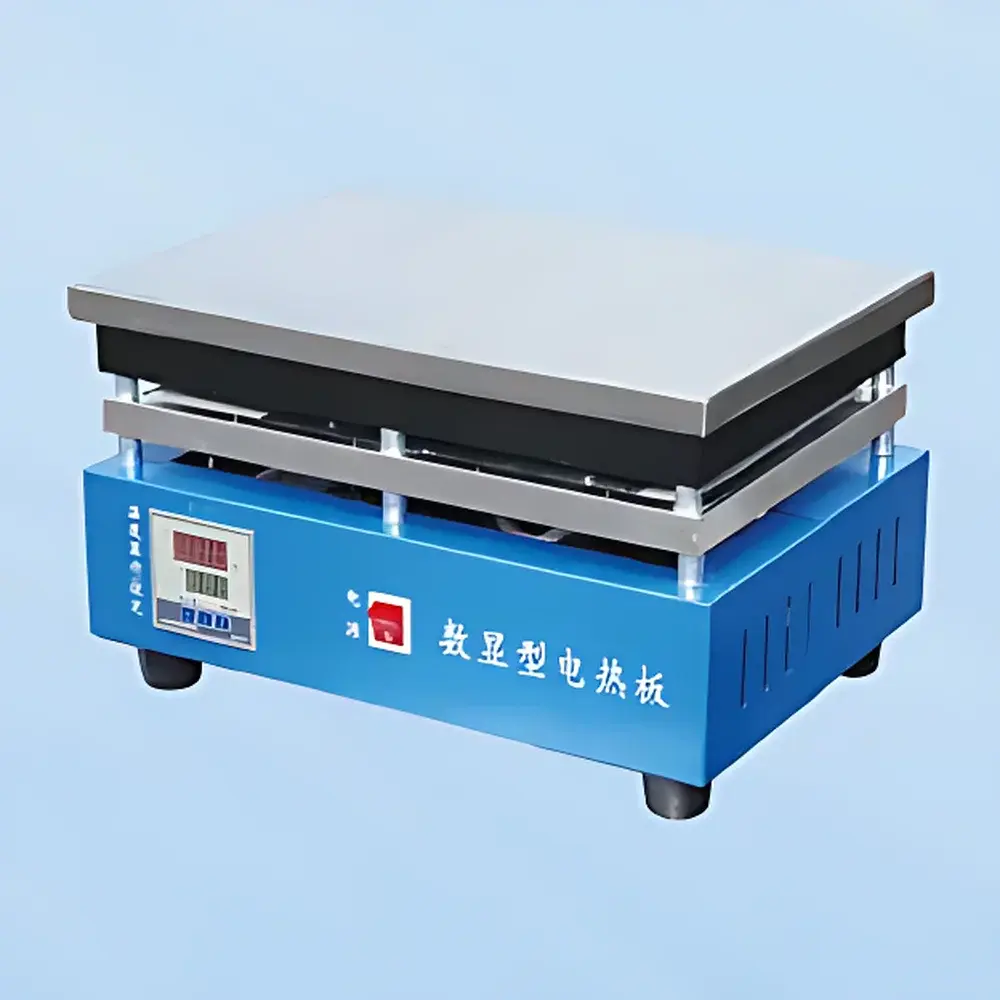
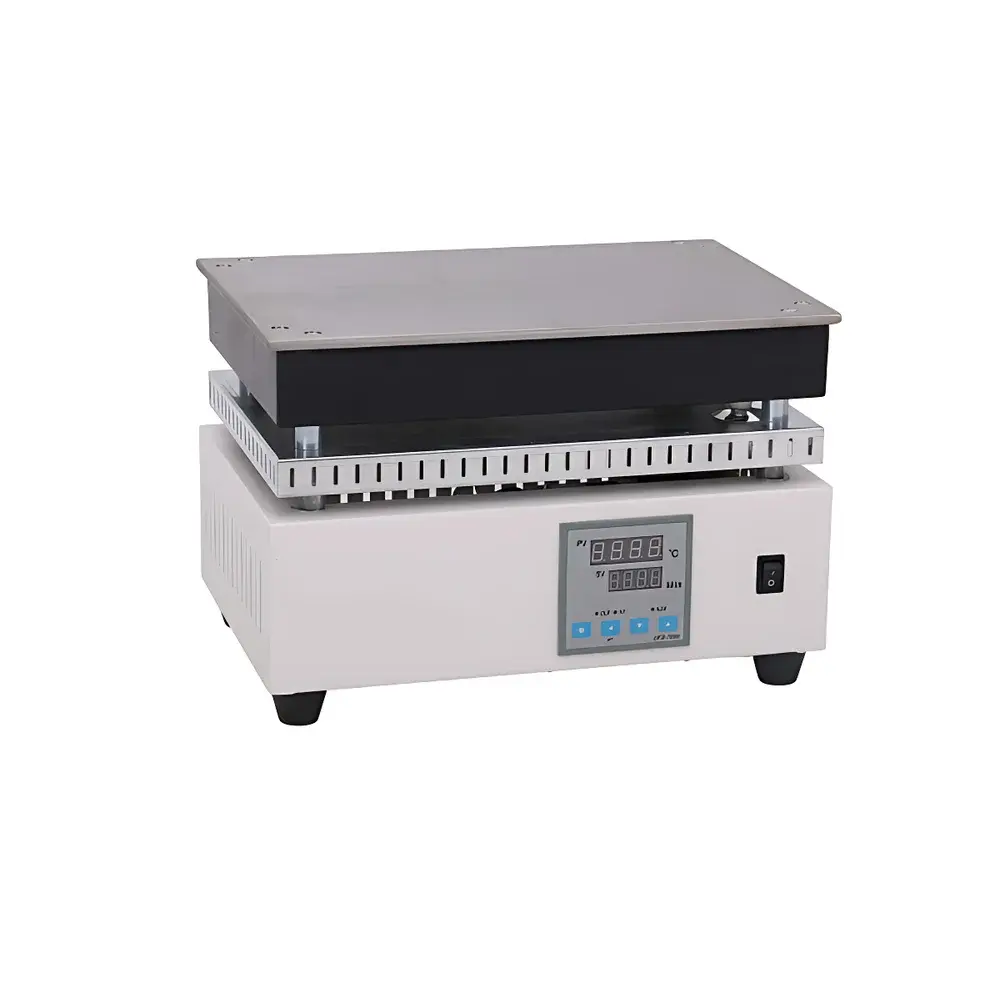
Zhongke Aobo ML Series Digital Display Stainless Steel Heating Plate
| Brand | Zhongke Aobo |
|---|---|
| Model | ML |
| Type | Benchtop Digital Thermostatic Heating Plate |
| Construction | Cold-rolled steel housing with epoxy coating |
| Heating Surface | 304 stainless steel or cast iron (user-selectable) |
| Temperature Control | PID-regulated digital LED controller |
| Max Operating Temperature | 400 °C |
| Power Range | 1.5–3 kW (model-dependent) |
| Input Voltage | 220 V AC, 50 Hz |
| Dimensions (L×W×H) | 400×280×200 mm / 450×350×200 mm / 600×400×200 mm |
| Compliance | CE-marked design principles |
Overview
The Zhongke Aobo ML Series Digital Display Stainless Steel Heating Plate is a precision-engineered benchtop thermal platform designed for stable, controllable conductive heating in analytical, preparatory, and quality control laboratories. Unlike open-coil hot plates or oil baths, this unit employs a fully enclosed resistive heating element embedded beneath a solid, corrosion-resistant metal plate—eliminating flame hazards, reducing ambient heat loss, and enabling reproducible surface temperature uniformity across the active zone. Its operation is grounded in Joule heating physics, where electrical energy is converted directly into thermal energy within a high-resistivity alloy coil, thermally coupled to the plate via high-conductivity thermal interface materials. The integrated digital PID temperature controller continuously monitors surface temperature via a calibrated PT100 RTD sensor embedded near the center of the plate, delivering closed-loop regulation with ±2 °C accuracy over the full 25–400 °C operating range. This architecture ensures minimal thermal overshoot, rapid stabilization (<15 min to 300 °C), and long-term drift <0.5 °C/h—critical for applications requiring adherence to ASTM E220, ISO 17025 clause 5.4.2 (equipment calibration), or USP analytical instrument qualification protocols.
Key Features
- Robust industrial-grade enclosure fabricated from cold-rolled steel with electrostatic epoxy powder coating for chemical resistance and mechanical durability.
- Heating surface options: electropolished 304 stainless steel (standard) or high-carbon cast iron (optional), both treated with passivation or black oxide finish to inhibit oxidation at elevated temperatures.
- Full-seal heating module prevents dust ingress, moisture penetration, and accidental contact with live elements—meeting IEC 61010-1 Class II safety requirements for laboratory equipment.
- Digital LED display with 1 °C resolution and intuitive push-button interface for setpoint entry, real-time temperature readout, and manual override of auto-tuning parameters.
- Over-temperature cut-off protection (independent hardware limiter) activates at 420 °C to prevent thermal runaway, satisfying GLP audit requirements for fail-safe instrumentation.
- Modular power rating selection (1.5 kW, 2 kW, or 3 kW) matched to plate dimensions—ensuring optimal watt density (1.3–1.9 W/cm²) for uniform thermal distribution without localized hot spots.
Sample Compatibility & Compliance
The ML Series accommodates standard laboratory vessels including borosilicate glass beakers (up to 2 L), porcelain crucibles, stainless steel digestion blocks, and PTFE-lined reaction flasks. Its flat, non-porous surface supports consistent heat transfer to containers with planar bases and eliminates wobble-induced thermal gradients. The unit complies with fundamental safety and electromagnetic compatibility directives aligned with CE marking conventions (2014/30/EU EMC Directive, 2014/35/EU Low Voltage Directive). While not certified to specific pharmacopeial standards out-of-the-box, its documented temperature stability, traceable calibration capability (via external reference thermometer port), and audit-ready operational logs make it suitable for environments operating under GMP Annex 15, FDA 21 CFR Part 11 (when paired with compliant data capture software), and ISO/IEC 17025 Clause 6.4 (equipment verification and maintenance records).
Software & Data Management
The ML Series operates as a standalone analog-digital hybrid system with no embedded firmware-based data logging. However, its analog output (0–5 V DC proportional to measured temperature) and RS-485 Modbus RTU interface (optional accessory module) enable integration into centralized laboratory monitoring systems such as LabWare LIMS, Siemens Desigo CC, or custom SCADA architectures. When connected, users can configure automated temperature ramping profiles, export time-stamped thermal histories with UTC timestamps, and generate PDF reports compliant with ALCOA+ data integrity principles. All configuration changes—including setpoint modifications and calibration offsets—are recorded in non-volatile memory with user ID tagging, supporting 21 CFR Part 11-compliant electronic recordkeeping when deployed with validated third-party middleware.
Applications
- Controlled evaporation of solvents during sample concentration prior to GC-MS or ICP-MS analysis.
- Pre-heating of reagents and standards in environmental testing labs following EPA Method 3005A.
- Thermal conditioning of polymer films and composites per ASTM D696 coefficient of linear expansion procedures.
- Drying of filter papers and gravimetric precipitates in water quality labs adhering to APHA Standard Methods 2540B.
- Support heating for reflux condensation setups in organic synthesis workflows requiring precise bath-equivalent temperature control.
- Calibration verification of liquid-in-glass thermometers and digital probes against NIST-traceable references.
FAQ
What is the recommended calibration interval for the ML Series heating plate?
Annual calibration against a NIST-traceable reference thermometer is advised; more frequent verification (e.g., quarterly) is required in GLP/GMP environments or when used for critical process steps.
Can the ML heating plate be used under a fume hood?
Yes—its sealed construction and absence of volatile emissions permit safe operation inside Class I or II biological safety cabinets and general-purpose fume hoods, provided adequate airflow does not disrupt thermal equilibrium.
Is the stainless steel plate resistant to hydrochloric acid splashes?
Electropolished 304 stainless steel offers moderate resistance to dilute HCl at room temperature but is not recommended for prolonged exposure above 10% concentration or elevated temperatures; use cast iron or optional PTFE-coated variants for aggressive acid handling.
Does the unit support external temperature probe input for vessel-bottom sensing?
No—the built-in RTD measures plate surface temperature only; however, the analog output signal can be repurposed to feed an external PID controller equipped with immersion probe feedback.
How is traceability maintained during IQ/OQ/PQ validation?
Factory-provided calibration certificate (including as-found/as-left data), serial-numbered hardware logbook, and modifiable electronic configuration history collectively fulfill IQ documentation requirements; OQ protocols must verify temperature uniformity per ASTM E1112 and stability per ISO 17025 Annex A.2.



