
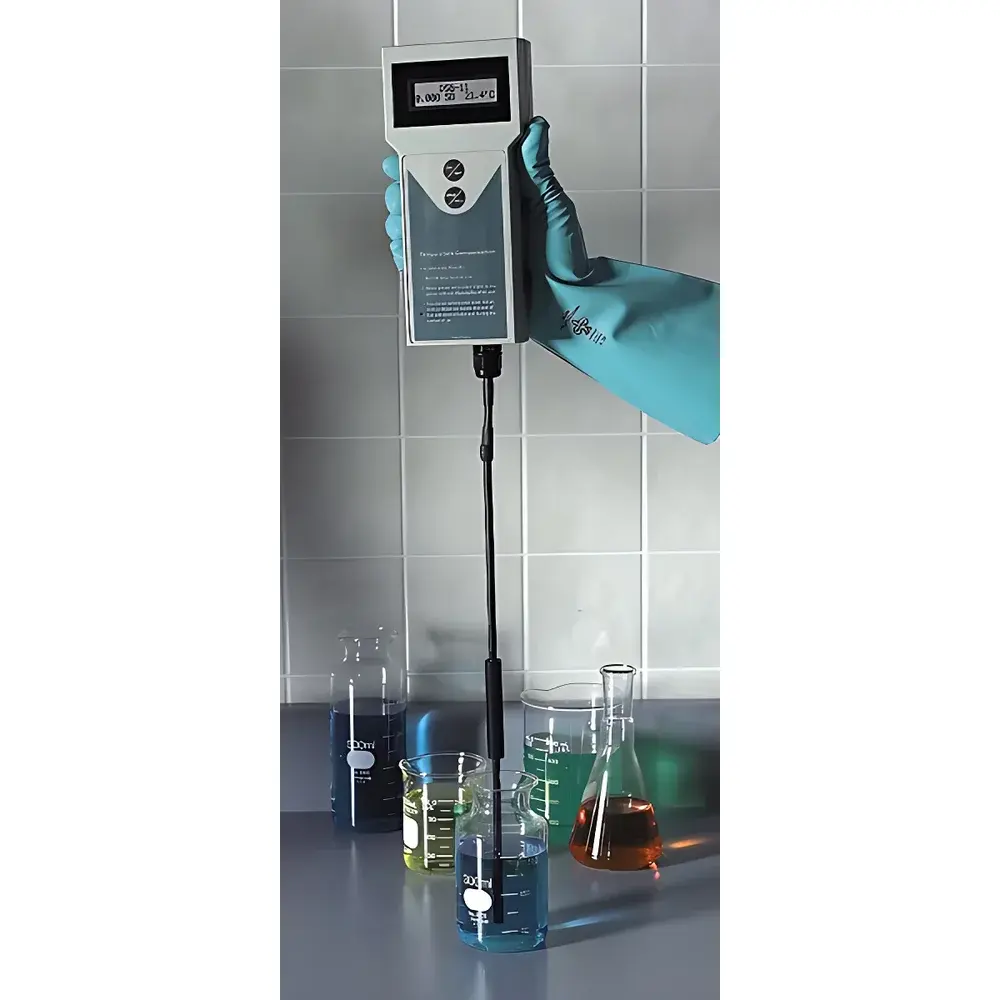
Cole-Parmer 25755-xx Economical Digital Density & Temperature Meter
| Brand | Cole-Parmer |
|---|---|
| Origin | USA |
| Model | 25755-xx |
| Density Range (25755-00/14) | 0.750–1.000 g/cm³ |
| Density Range (25755-04/20) | 1.000–1.300 g/cm³ |
| Density Range (25755-10) | 1.300–1.600 g/cm³ |
| Density Resolution | 0.001 g/cm³ |
| Density Accuracy | ±0.03 g/cm³ |
| Temperature Range (°C models) | 0–50 °C |
| Temperature Range (°F models) | 32–120 °F |
| Temperature Resolution | 0.1 °C or 0.1 °F |
| Temperature Accuracy | ±0.8 °C / ±0.5 °F |
| Max Sample Viscosity | 400 cP |
| Probe Immersion Depth | 5 in (127 mm) |
| Display | Dual-line backlit LCD |
| Power | 4 × AA batteries (included) |
| Probe Dimensions | 8 in L × 1.25 in dia (203 mm × 32 mm) |
| Instrument Dimensions | 4 in W × 8.25 in H × 1.5 in D (102 mm × 210 mm × 38 mm) |
Overview
The Cole-Parmer 25755-xx Economical Digital Density & Temperature Meter is a field-deployable, handheld instrument engineered for rapid, on-site determination of liquid density and temperature in petroleum refining, fuel blending, lubricant formulation, and quality control laboratories. Unlike traditional hydrometers or oscillating U-tube densitometers, this device employs a precision-calibrated vibrating-element sensor combined with integrated platinum resistance thermometry (PT1000-class) to deliver real-time, direct digital readings traceable to NIST standards. Its design adheres to the fundamental principle that density—expressed as grams per cubic centimeter (g/cm³), equivalent to specific gravity at 15.6 °C (60 °F)—is a critical physical parameter correlated with hydrocarbon composition, volatility, and thermal stability. The meter supports three interchangeable density ranges to accommodate light distillates (e.g., gasoline, naphtha), mid-range fuels (e.g., diesel, kerosene), and heavy fractions (e.g., residual fuel oils, bitumen cutbacks), making it suitable for ASTM D1298 (Standard Test Method for Density, Relative Density, and API Gravity of Crude Petroleum and Liquid Petroleum Products by Hydrometer Method) screening-level verification and process monitoring.
Key Features
- Triple-range modular calibration: Selectable density scales (0.750–1.000, 1.000–1.300, or 1.300–1.600 g/cm³) via model-specific probe assemblies—no software reconfiguration required.
- Simultaneous dual-parameter measurement: Independent, synchronized acquisition of density and temperature with automatic thermal compensation applied per ASTM D1250 Annex A guidelines.
- Ruggedized industrial probe: Stainless-steel-sheathed sensor with 5-inch minimum immersion depth ensures stable readings in turbulent or shallow tanks; compatible with aggressive hydrocarbons and low-volatility solvents.
- Backlit dual-line LCD display: High-contrast numeric readout shows density and temperature concurrently; large font size (≥0.3 in height) enables legibility under ambient refinery lighting or portable lamp illumination.
- Battery-operated portability: Powered by four standard AA alkaline cells (supplied), providing >200 hours of continuous operation without external power—ideal for mobile QC teams or remote terminal inspections.
- IP65-rated enclosure: Dust-tight and protected against low-pressure water jets, supporting use in outdoor tank farms, marine bunkering stations, and production skids where environmental exposure is routine.
Sample Compatibility & Compliance
The 25755-xx series is validated for use with transparent to slightly hazy liquid petroleum products including gasoline, aviation turbine fuel (Jet A/A-1), diesel fuel oil (ASTM D975), heating oil (ASTM D396), and light crude blends. It is not intended for opaque suspensions, emulsions, or highly viscous residues exceeding 400 cP at measurement temperature. While not a primary compliance instrument for final regulatory reporting, its accuracy and repeatability meet the performance thresholds outlined in ASTM D1298 Section 8 (Precision Statements) for field screening applications. Data output conforms to GLP documentation requirements when paired with manual logbook entry; optional RS-232 interface (available via third-party adapter) enables timestamped data capture for internal audit trails.
Software & Data Management
This meter operates as a standalone, firmware-based instrument with no embedded operating system or cloud connectivity. All calibration coefficients, unit preferences (g/cm³ vs. °API), and temperature scale selection (°C or °F) are hard-coded per model variant during factory programming—eliminating user-configurable settings that could compromise metrological integrity. No proprietary software is required, nor is firmware upgrade capability provided, aligning with IEC 61508 SIL-1 principles for safety-critical auxiliary instrumentation. For traceability, each unit ships with a NIST-traceable calibration certificate listing as-found/as-left values at three density points and two temperature points across its specified range. Audit-ready records may be maintained manually using Cole-Parmer’s free LabLog Pro template (downloadable from coleparmer.com/resources), compliant with FDA 21 CFR Part 11 for electronic record retention in non-GMP environments.
Applications
- Routine verification of incoming crude assay reports prior to charging into atmospheric distillation units.
- On-the-spot density checks during pipeline batch transfer to detect interface mixing or product contamination.
- Field validation of fuel blending ratios (e.g., ethanol-gasoline, biodiesel-diesel) where API gravity deviation exceeds ±0.5°.
- Pre-shipment inspection of marine fuel oils (IFO 180/380) to confirm conformance with ISO 8217 Table 1 specifications.
- Educational use in petroleum technology programs for illustrating density–temperature relationships and thermal expansion coefficients of hydrocarbon mixtures.
FAQ
Is this instrument certified for custody transfer or fiscal metering?
No. The 25755-xx is classified as a Class II field verification tool per API RP 2550 and does not meet the metrological requirements (e.g., uncertainty ≤ ±0.0005 g/cm³) for fiscal measurement under OIML R-117 or ISO 9001 Clause 7.6.
Can the probe be immersed in hot crude above 50 °C?
No. Exceeding the rated temperature range (0–50 °C for Celsius models; 32–120 °F for Fahrenheit models) risks permanent drift of the piezoelectric sensor and invalidates calibration. Use only within specified limits.
Does it require periodic recalibration?
Yes. Cole-Parmer recommends annual recalibration against certified reference standards traceable to NIST or UKAS, especially after mechanical shock or exposure to solvent vapors that may affect sensor housing integrity.
Is battery life affected by backlight usage?
Yes. Continuous backlight operation reduces total runtime by approximately 15%; the display automatically dims after 30 seconds of inactivity to conserve power.
Are replacement probes available separately?
Yes. Model-specific probe assemblies (e.g., 25755-00-PROBE, 25755-10-PROBE) are stocked and sold individually with full calibration documentation.




