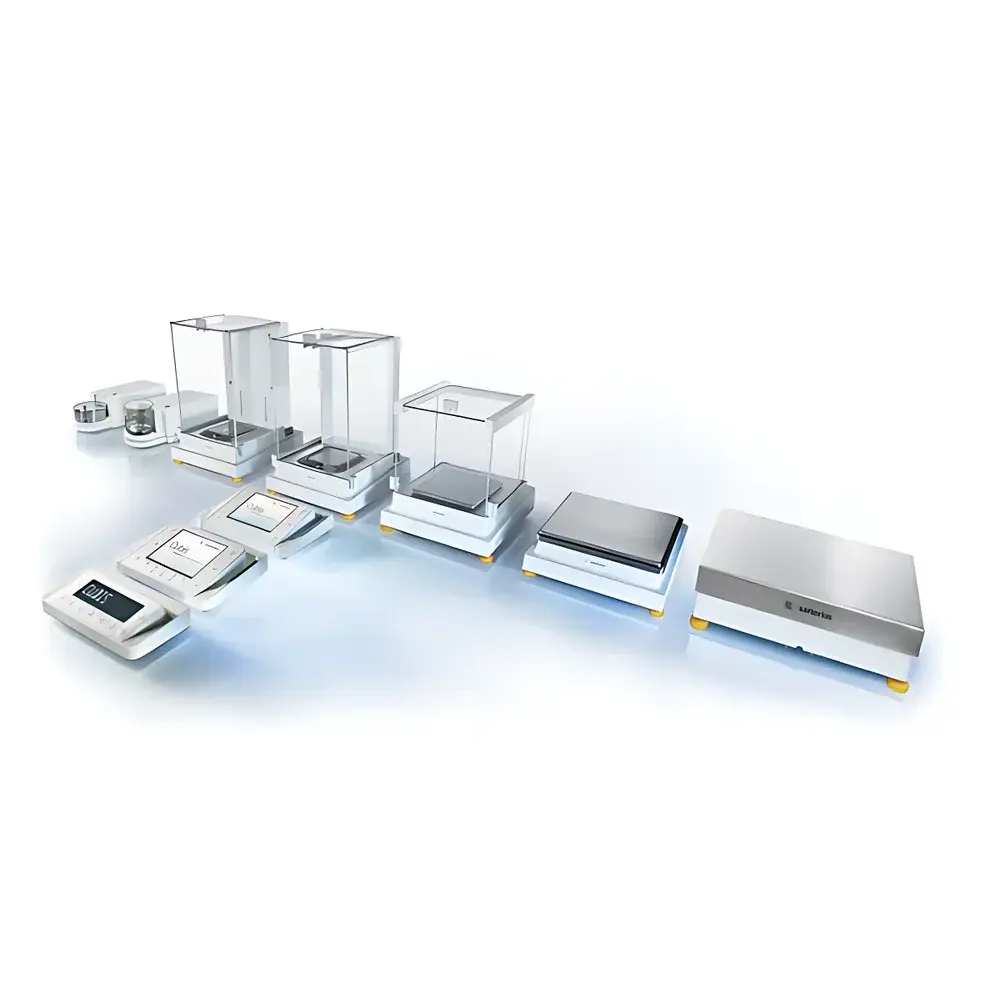
Sartorius Cubis® II High-Performance Analytical Balance
| Brand | Sartorius |
|---|---|
| Origin | Germany |
| Instrument Type | Analytical Balance |
| Model | Cubis® II |
| Readability | 0.01–0.1 mg |
| Weighing Range | 120–320 g |
| Display Options | MSA (Color TFT Touchscreen), MSU (Monochrome Graphic Display with Tactile Keypad), MSE (High-Contrast LCD with Guided Menu) |
| Leveling | Manual Q-Level (interactive guidance) or Motorized Auto-Leveling (select models) |
| Calibration | isoCAL® Fully Automatic Internal Calibration & Adjustment |
| Compliance Features | User Management, Audit Trail, ALIBI Memory, 21 CFR Part 11 Ready, GLP/GMP Support |
| Connectivity | USB, RS-232, Ethernet, SD Card Slot |
| Anti-Static Option | Integrated Ionizer in Draft Shield (optional) |
| Design | Top-Loading Semi-Micro Configuration, Space-Saving Footprint (up to 25% reduction vs. conventional designs) |
Overview
The Sartorius Cubis® II is a modular high-performance analytical balance engineered for precision, traceability, and operational flexibility in regulated and research-intensive laboratory environments. Built on the foundational principles of electromagnetic force compensation (EMFC), it delivers exceptional stability and repeatability across its full weighing range—from routine mass determination to critical pharmaceutical assay preparation and quantitative sample dispensing. Unlike fixed-configuration balances, the Cubis® II adopts a true system architecture: users select and integrate discrete functional modules—including display/control units (MSA, MSU, MSE), draft shields (manual or motorized), weighing cells (0.01 mg to 0.1 mg readability), and interface options—to construct a purpose-built instrument aligned precisely with workflow complexity, regulatory scope, and ergonomic requirements. Its design complies with ISO/IEC 17025, USP , and ASTM E898 standards for analytical balance performance verification, and supports full validation documentation packages per IQ/OQ/PQ protocols.
Key Features
- Q-Guided Workflow Management (Q-Operate): Task-based user interface with context-sensitive wizards—enabling consistent execution of multi-step procedures such as formulation, differential weighing, pipette calibration, and statistical process control without programming expertise.
- Q-Level Intelligent Leveling System: Real-time visual and haptic feedback during manual leveling; motorized auto-leveling available on select 1 mg and higher readability models—ensuring optimal sensor alignment prior to every measurement cycle.
- Q-Pan Dynamic Load Compensation: First-in-class automatic eccentric load correction via integrated position-sensing and real-time algorithmic adjustment—minimizing positional error and maximizing accuracy across the entire pan surface.
- isoCAL® Fully Automatic Calibration & Adjustment: Temperature- and time-triggered internal recalibration with dual-mass verification, eliminating manual intervention while maintaining metrological integrity under ambient drift conditions.
- Modular Draft Shield Architecture: Three shield variants (standard manual, motorized lift, ionizer-integrated) designed for rapid decontamination, minimal footprint, and electrostatic mitigation—critical for low-mass powders and hygroscopic materials.
- Regulatory-Ready Firmware Architecture: Role-based user authentication, immutable ALIBI memory with timestamped event logging, electronic signature support, and configurable audit trail export—all compliant with FDA 21 CFR Part 11 and EU Annex 11 requirements.
Sample Compatibility & Compliance
The Cubis® II accommodates diverse sample forms—including solids, powders, liquids in tared vessels, and volatile compounds—via its wide pan geometry and optional anti-static draft shields. Its modular construction allows seamless integration into cleanroom workflows (ISO Class 5–7), biosafety cabinets, and glovebox environments. All firmware versions undergo periodic cybersecurity assessment per IEC 62443-3-3, and the balance supports GxP-aligned data integrity practices: raw data, metadata, and operator actions are stored together in encrypted binary format with SHA-256 hashing. Full compliance documentation—including test certificates traceable to PTB (Physikalisch-Technische Bundesanstalt) and NIST standards—is provided with each system.
Software & Data Management
Data handling is centralized through Sartorius’ labworldsoft® suite (optional), enabling bidirectional communication, automated report generation (PDF/CSV/XLSX), and LIMS/ELN integration via OPC UA or RESTful API. Local storage utilizes an embedded SD card slot supporting FAT32 formatting (up to 32 GB), with automatic timestamped file naming and folder structuring by user, date, and task ID. All communication interfaces—USB device/host, RS-232 (for legacy peripherals), Ethernet (TCP/IP), and optional Bluetooth 5.0—support standard SCPI command sets, ensuring interoperability with third-party automation platforms. Audit trail entries include operator ID, action type, timestamp (with millisecond resolution), parameter values before/after change, and reason-for-change fields where applicable.
Applications
- Pharmaceutical QC/QA: Active pharmaceutical ingredient (API) assay, reference standard weighing, content uniformity testing, and dissolution sample preparation per USP .
- Academic & Industrial Research: Nanomaterial dosing, catalyst loading, gravimetric sorption analysis, and micro-reaction stoichiometry.
- Clinical Diagnostics: Reagent kit formulation, calibrator preparation, and trace element standardization for ICP-MS and AAS.
- Materials Science: Density determination via pycnometry, polymer additive dispersion quantification, and thermal degradation mass loss monitoring.
- Food & Beverage: Nutrient fortification verification, allergen threshold testing, and moisture content validation per AOAC 950.46.
FAQ
Does the Cubis® II support GLP-compliant electronic signatures?
Yes—role-based digital signatures are fully implemented and configurable per user privilege level, meeting ALCOA+ data integrity criteria.
Can isoCAL® be scheduled independently of temperature fluctuations?
Yes—calibration intervals can be set by time (e.g., every 2 hours), temperature delta (e.g., ±1.5 °C), or manual trigger, with full audit trail capture.
Is the ALIBI memory battery-backed or flash-based?
It resides in non-volatile flash memory with hardware write protection—retaining >10 years of event logs without power.
What draft shield options include integrated ionization?
Only the motorized draft shield variant (Order No. YDP001-ION) features a built-in, adjustable ionizer with real-time discharge monitoring.
Are MSA, MSU, and MSE displays interchangeable on the same base unit?
Yes—module swapping requires no tools and retains all configuration settings, enabling rapid reconfiguration for different SOPs or operators.