
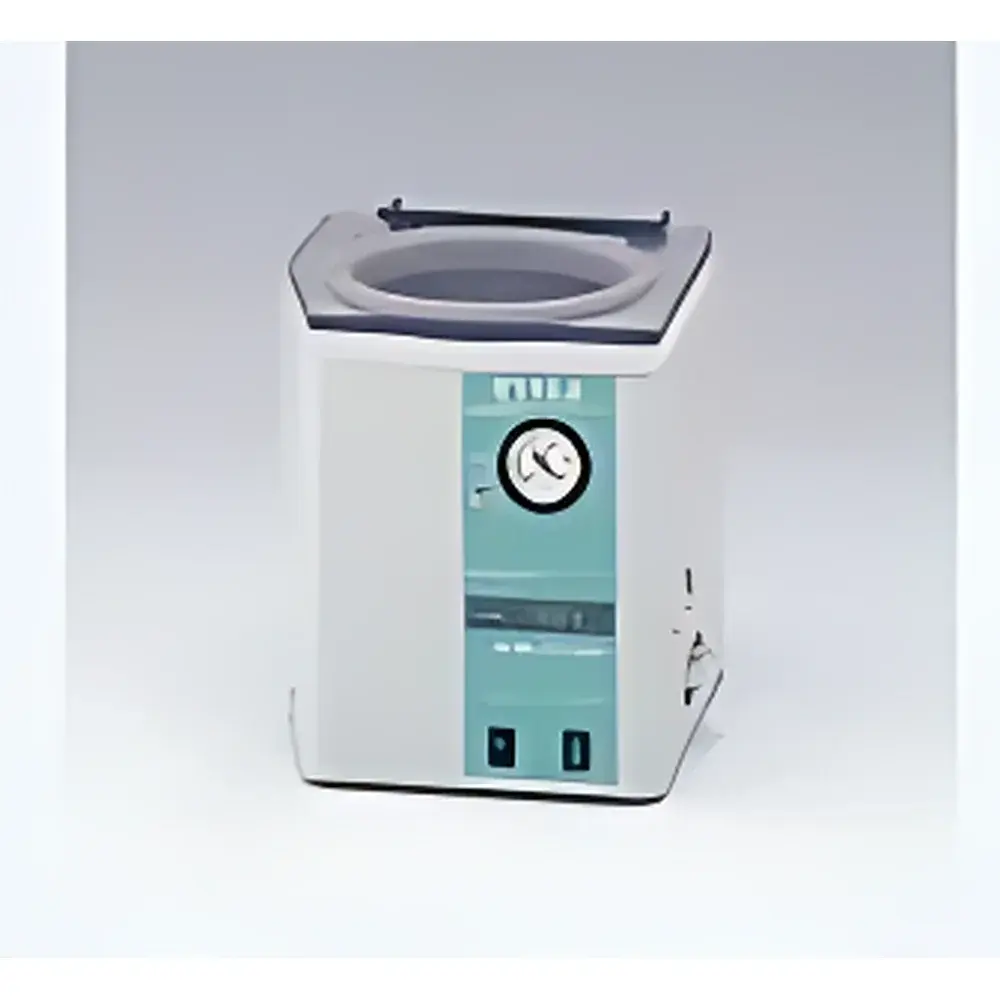
EYELA CVE-2000 Vacuum Centrifugal Concentrator
| Brand | EYELA |
|---|---|
| Origin | Japan |
| Model | CVE-2000 |
| Rotational Speed | 1400 rpm (fixed) |
| Temperature Control Range | Ambient +5°C to 80°C |
| Ultimate Vacuum (internal pump) | 3 kPa |
| Ultimate Vacuum (external pump) | ≤1.33 kPa |
| Chamber Dimensions | Ø160 mm × H105 mm |
| Rotor Capacity | 24 × 1.5 mL microtubes (Ø10.8 mm) |
| Chamber & Tubing Material | Chemically Resistant Polymer Alloy |
Overview
The EYELA CVE-2000 Vacuum Centrifugal Concentrator is an engineered solution for gentle, efficient solvent removal from heat-labile biological and pharmaceutical samples under controlled reduced-pressure conditions. It operates on the principle of simultaneous centrifugation and vacuum-assisted evaporation: rotation generates radial force (up to 1,400 rpm) that counteracts bubble formation and prevents sample splashing or foaming, while a built-in corrosion-resistant diaphragm vacuum pump achieves stable low-pressure environments down to 3 kPa. This dual-action mechanism enables rapid concentration without thermal degradation—critical for nucleic acids, peptides, enzymes, metabolites, and labile small molecules. Unlike conventional rotary evaporators or nitrogen blow-down systems, the CVE-2000 maintains sample integrity by eliminating direct heating above ambient +5°C and avoiding turbulent gas flow across delicate surfaces.
Key Features
- Integrated chemically resistant diaphragm vacuum pump capable of reaching ≤3 kPa absolute pressure—optimized for compatibility with common organic solvents including ethanol, acetone, acetonitrile, ethyl acetate, and chloroform.
- Dual vacuum configuration: internal pump for standard applications; external vacuum port (KF16 flange) supports connection to higher-capacity pumps for demanding protocols requiring ≤1.33 kPa.
- Precise temperature control from ambient +5°C to 80°C via PID-regulated heating block, with real-time digital display and setpoint adjustment on an intuitive LCD interface.
- Multi-format rotor accommodating up to 24 × 1.5 mL microcentrifuge tubes (Ø10.8 mm), plus three additional tube configurations (Ø10–13 mm) for flexible workflow integration—total capacity up to 72 tubes per run.
- Chamber and fluid-path components fabricated from high-purity fluoropolymer-reinforced polymer alloys, ensuring long-term resistance to solvent swelling, hydrolysis, and acid/base exposure.
- Robust mechanical architecture with balanced rotor assembly, sealed bearing system, and vibration-dampened base—designed for continuous operation in regulated laboratory environments.
Sample Compatibility & Compliance
The CVE-2000 is routinely deployed in molecular biology, proteomics, and preclinical pharmacokinetic workflows where sample recovery, reproducibility, and trace-level integrity are non-negotiable. It complies with core operational requirements for Good Laboratory Practice (GLP) and current Good Manufacturing Practice (cGMP) environments, particularly when used in conjunction with validated SOPs. While the instrument itself does not carry FDA 21 CFR Part 11 certification (as it lacks electronic record generation), its analog/digital controls support audit-ready documentation when integrated into broader data capture systems. The device meets ISO 13485-aligned design principles for medical device ancillary equipment and conforms to IEC 61010-1 safety standards for laboratory electrical apparatus. Its solvent compatibility profile aligns with ASTM D1296 and USP guidelines for residual solvent analysis preparation.
Software & Data Management
The CVE-2000 operates via a standalone embedded control system with no proprietary software dependency. All parameters—including temperature setpoint, run duration (timer function), and vacuum status—are displayed and adjustable directly on the front-panel LCD. No drivers, cloud connectivity, or firmware updates are required. For laboratories requiring electronic batch records, the unit can be operated within time-stamped procedural logs maintained externally (e.g., ELN platforms such as LabArchives or Benchling). Optional analog output signals (0–10 V) for temperature and vacuum level are available upon request for integration into centralized monitoring systems compliant with Annex 11 or EU GMP Chapter 4 requirements.
Applications
- Concentration and lyophilization-preparatory drying of DNA, RNA, and oligonucleotides from aqueous or ethanol precipitates—preserving secondary structure and enzymatic activity.
- Recovery of electrophoresis-eluted proteins and post-digestion peptide fragments with minimal oxidation or deamidation.
- Final volume reduction of synthetic peptides following solid-phase synthesis and cleavage steps—enabling accurate quantification prior to HPLC purification.
- Pre-analytical processing of biofluid-derived metabolites (e.g., plasma, urine, CSF) for LC-MS/MS analysis, where solvent exchange and concentration must avoid thermal decomposition.
- Routine preparation of calibration standards and QC samples in regulated bioanalytical labs handling small-molecule drugs and biotransformation products.
FAQ
Does the CVE-2000 support programmable multi-step methods?
No—the CVE-2000 features fixed-speed rotation (1400 rpm) and single-setpoint temperature control. Method flexibility is achieved through manual stage sequencing (e.g., low-temp concentration followed by warm dry-down).
Can it handle hydrochloric acid or trifluoroacetic acid (TFA) vapors?
The chamber and pump are rated for intermittent exposure to diluted TFA (<5%) and low-concentration HCl vapor, but prolonged use with strong mineral acids requires external cold trap and exhaust scrubbing.
Is rotor balancing required before each run?
Yes—symmetrical loading is mandatory. The rotor accepts only matched tube sets; unbalanced loads trigger automatic shutdown to prevent mechanical stress.
What maintenance intervals are recommended for the built-in vacuum pump?
Diaphragm replacement every 6,000 operating hours or 24 months (whichever occurs first); inlet filter cleaning every 200 hours; full pump oil-free operation eliminates lubrication servicing.
Is the unit suitable for Class A/B cleanroom installation?
It is not certified for ISO 5/Class A environments due to non-hermetic housing and lack of HEPA-filtered exhaust, but may be installed in ISO 7/Class C support areas with appropriate venting.



