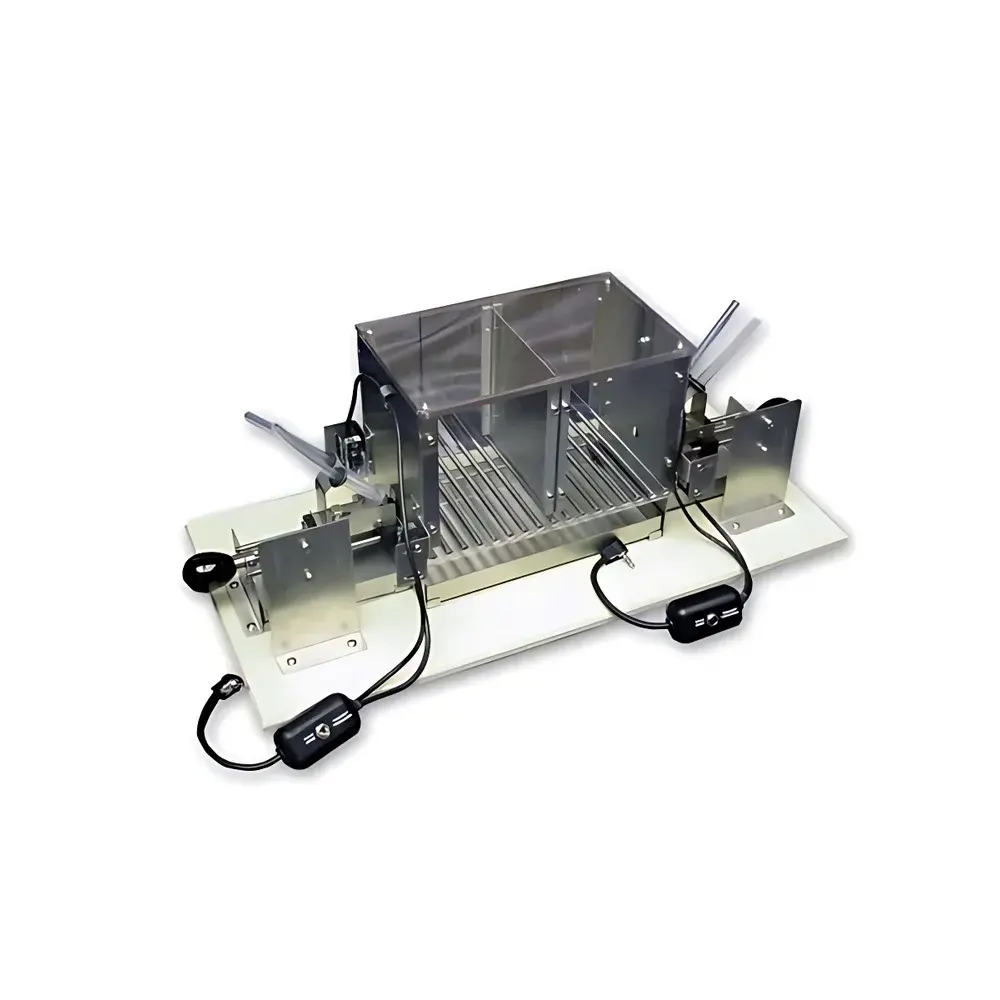
Lafayette Model 80870 Automated Mouse Paw Grasping Test Chamber
| Origin | USA |
|---|---|
| Manufacturer Type | Authorized Distributor |
| Import Status | Imported |
| Model | 80870 |
| Price | USD 13,500 (FOB) |
| Dimensions (Overall) | 48.26 cm × 22.86 cm × 18.54 cm |
| Chamber Dimensions (per side) | 20.23 cm × 11.18 cm × 11.68 cm |
| Detection System | Dual industrial-grade optical detectors |
| Construction Material | 316 stainless steel |
| Display | Integrated LCD digital counter |
| Optional Accessories | Model 86060 digital event counter (2 units), Model 80875 training funnel |
Overview
The Lafayette Model 80870 Automated Mouse Paw Grasping Test Chamber is a purpose-built behavioral phenotyping platform engineered for objective, high-throughput quantification of forelimb motor coordination, sensorimotor integration, and motivated operant behavior in murine models. Based on the validated paw-grasping paradigm, the system measures voluntary, goal-directed forepaw retrieval of food pellets through a standardized aperture—leveraging principles of operant conditioning and motor learning assessment. Unlike manual scoring methods, the Model 80870 employs dual industrial-grade optical detection sensors to register each successful grasp attempt with millisecond temporal resolution, eliminating observer bias and enabling precise event timestamping. Its modular, dual-chamber architecture supports parallel testing of two subjects under identical environmental conditions, significantly improving experimental throughput while maintaining intersubject comparability—a critical requirement for longitudinal studies in neurodegenerative disease models (e.g., SOD1-G93A ALS mice), stroke recovery, or dopaminergic pathway modulation.
Key Features
- Dual independent test chambers housed within a single rigid 316 stainless steel enclosure, each with fully isolated environmental control and independent detection logic.
- Removable central partition enables seamless transition between paired and single-animal protocols—supporting social interaction paradigms, dominance hierarchies, or stimulus generalization experiments when combined with external cue delivery systems.
- Integrated LCD digital counter (Model 86060 compatible) displays real-time grasp attempts per chamber; counters are programmable for session-based reset and support RS-232 output for external data logging.
- Optical detection system utilizes infrared beam interruption at the pellet aperture, calibrated to distinguish full-paw retrieval from partial contact or nose-only probing—minimizing false positives without requiring tactile force thresholds.
- Stainless steel training funnel (Model 80875) provides standardized shaping protocol for acquisition of grasping behavior, reducing inter-laboratory variability in baseline training duration and success rate.
- ABET II-compatible interface allows direct synchronization with Lafayette’s ABET behavioral control software for automated trial sequencing, conditional stimulus presentation, and integrated event tagging in time-stamped binary data streams.
Sample Compatibility & Compliance
The Model 80870 is validated for use with C57BL/6, BALB/c, CD-1, and transgenic mouse strains aged 8–24 weeks. Chamber dimensions accommodate standard adult mouse body mass (18–32 g) without compromising natural posture or limb extension range. All materials comply with ISO 10993-5 (biological evaluation of medical devices — cytotoxicity) and meet USP Class VI plastic equivalency standards where applicable. The system supports GLP-compliant operation when used with ABET II v5.0+ and FDA 21 CFR Part 11–enabled audit trail modules. Experimental protocols align with NIH Guide for the Care and Use of Laboratory Animals and adhere to ARRIVE 2.0 reporting guidelines for behavioral neuroscience studies.
Software & Data Management
Data acquisition is natively supported via ABET II Behavioral Testing Software (v5.2+), which provides preconfigured task templates for progressive ratio, fixed-ratio, and extinction paradigms. Each grasp event is logged with absolute timestamp (microsecond precision), chamber ID, and optional metadata tags (e.g., stimulus condition, reward type). Raw event files export in CSV and HDF5 formats for downstream analysis in MATLAB, Python (Pandas/SciPy), or R. ABET’s built-in reporting engine generates summary statistics—including grasp latency, inter-response time distribution, session-level success rate, and coefficient of variation across trials—automatically aligned to experimental phase boundaries defined in the protocol script.
Applications
- Preclinical assessment of motor deficits in Parkinson’s disease, Huntington’s disease, and spinal cord injury models.
- Evaluation of rehabilitative interventions including pharmacotherapy, deep brain stimulation, or physical enrichment protocols.
- Characterization of sensorimotor gating and effort-based decision making in depression and schizophrenia-relevant genetic models (e.g., DISC1, Neuregulin-1 mutants).
- Validation of novel therapeutic antibodies targeting neuromuscular junction integrity or corticospinal tract regeneration.
- High-content screening of compound libraries for pro-motor or anti-dystonic activity in phenotypic drug discovery pipelines.
FAQ
Is the Model 80870 compatible with rats or other rodent species?
The chamber geometry and aperture size are optimized for mice; rat adaptation requires Model 80871 (larger aperture variant) and recalibrated detection thresholds.
Can grasp force be measured with this system?
No—this is a binary detection system for grasp occurrence, not force magnitude. For quantitative grip strength, refer to Lafayette Model 76070 Grip Strength Meter.
What maintenance is required for the optical sensors?
Sensors require quarterly inspection for dust accumulation and alignment verification using the included calibration jig; no recalibration is needed under normal laboratory conditions.
Does the system support video synchronization?
Yes—ABET II triggers external USB or GigE cameras via TTL pulse output, enabling frame-accurate alignment of grasp events with behavioral video streams.
Is remote monitoring available during long-duration sessions?
ABET II supports secure remote desktop access and live event dashboard viewing over institutional LAN/WAN, with encrypted data transmission compliant with HIPAA/FERPA network policies.