
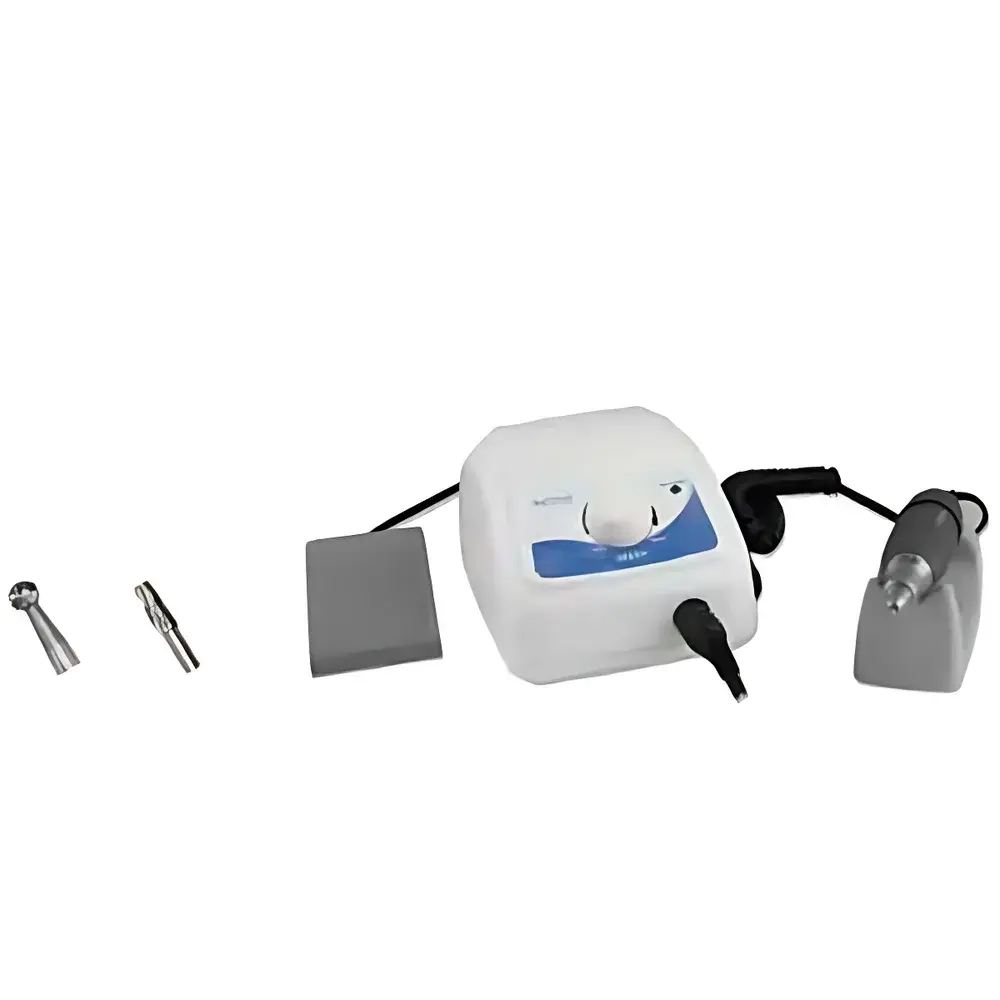
RWD 78001 Miniature Handheld Cranial Drill
| Brand | RWD |
|---|---|
| Origin | Guangdong, China |
| Manufacturer Type | Manufacturer |
| Country of Origin | China |
| Model | 78001 |
| Max Speed | 38,000 rpm |
| Rotation Direction | Forward/Reverse selectable |
| Control Mode | Manual trigger or foot switch |
| Mounting Compatibility | Compatible with RWD stereotaxic frames via drill holder (Model 68605) |
| Drill Bit Range | 0.5–2.3 mm (round and flat tip options available) |
Overview
The RWD 78001 Miniature Handheld Cranial Drill is an engineered precision instrument designed for controlled, low-trauma craniotomy in preclinical neuroscience research. It operates on a high-speed rotary cutting principle—utilizing micro-precision DC motor-driven rotation—to create accurately sized burr holes in rodent and small mammalian skull bone during stereotaxic surgery. The device is purpose-built for integration into standard stereotaxic workstations, enabling reproducible access to targeted brain regions for electrode implantation, viral vector delivery, microdialysis probe insertion, or cannula placement. Its compact ergonomic design minimizes hand fatigue during extended procedures, while its variable-speed capability supports optimization across diverse bone thicknesses and species (e.g., mouse, rat, ferret, and juvenile non-human primates). All mechanical and electrical components comply with IEC 60601-1 general safety requirements for medical electrical equipment used in laboratory animal applications.
Key Features
- High-speed brushless DC motor delivering up to 38,000 rpm with stable torque output across the full speed range
- Bidirectional rotation control (forward/reverse) for enhanced debris clearance and reduced thermal buildup during drilling
- Dual activation modes: integrated manual trigger for fine tactile control and optional foot switch interface for hands-free operation
- Modular collet system compatible with standardized 1.6 mm shank drill bits (ISO 11049), supporting rapid bit interchange without tools
- Direct mechanical coupling with RWD stereotaxic frames via accessory holder Model 68605, enabling precise Z-axis micro-positioning through the manipulator arm
- Low-vibration housing and balanced rotor assembly to minimize unintended skull displacement or dural tear risk
- CE-marked power supply unit with overcurrent and thermal protection circuits
Sample Compatibility & Compliance
The RWD 78001 is validated for use with murine (C57BL/6, BALB/c, CD-1), rat (Sprague-Dawley, Wistar), and other small laboratory mammals requiring craniotomy ≤ 3 mm in diameter. Drill bit selection (0.5–2.3 mm) accommodates species-specific calvarial thickness and surgical objectives—e.g., 0.5–0.8 mm for mouse cortical injections, 1.0–1.6 mm for rat hippocampal electrode arrays. All drill bits are manufactured from medical-grade tungsten carbide (HM-series) or high-speed steel (HM3-series), sterilizable via autoclaving (121°C, 20 min) or ethylene oxide. The system conforms to ISO 10993-1 (biological evaluation of medical devices) for short-term tissue contact and supports GLP-compliant experimental documentation when paired with traceable bit lot numbers and usage logs.
Software & Data Management
While the RWD 78001 operates as a standalone electromechanical tool without embedded firmware or digital connectivity, it is fully compatible with third-party lab information management systems (LIMS) and electronic lab notebooks (ELN) through manual entry of procedural metadata—including bit type, lot number, rotational speed setting, duration, and anatomical coordinates. For audit readiness, users may record operational parameters in accordance with AAALAC International accreditation standards and NIH OLAW guidelines. Optional integration with RWD’s Stereotaxic Suite Software (v3.2+) allows timestamped synchronization of drill activation events with coordinate positioning data, facilitating retrospective analysis of procedural consistency across cohorts.
Applications
- Stereotaxic intracranial injection of AAV, lentivirus, or tracer compounds
- Implantation of chronic EEG, LFP, or single-unit recording electrodes
- Placement of guide cannulas for microinjection or optogenetic fiber optics
- Microdialysis probe insertion in awake, freely moving paradigms
- Calvarial window preparation for longitudinal two-photon imaging
- Controlled cortical impact (CCI) model setup requiring precise craniectomy margins
FAQ
Is the RWD 78001 suitable for use in non-rodent models such as rabbits or marmosets?
Yes—when paired with appropriate drill bit diameters (e.g., 1.8–2.3 mm) and adjusted speed settings (≤25,000 rpm for thicker calvaria), the device has been successfully deployed in marmoset and New Zealand white rabbit studies under IACUC-approved protocols.
Can the drill be sterilized between uses?
All detachable metal components—including the handpiece body, collet, and drill bits—are autoclavable at 121°C for 20 minutes. The motor housing must not be immersed or exposed to steam; wipe-down with 70% ethanol is recommended for external surfaces.
Does RWD provide calibration or maintenance documentation?
Yes—each unit ships with a Certificate of Conformance and a Maintenance Log Template aligned with ISO/IEC 17025 traceability requirements. Annual performance verification (speed accuracy ±3%, runout <0.02 mm) is advised using NIST-traceable tachometry and dial indicator measurement.
Are replacement parts and service support available outside China?
Global technical support and spare parts distribution are provided through RWD’s authorized regional distributors in the US, EU, Japan, and Australia, with lead times of ≤10 business days for standard components.




