
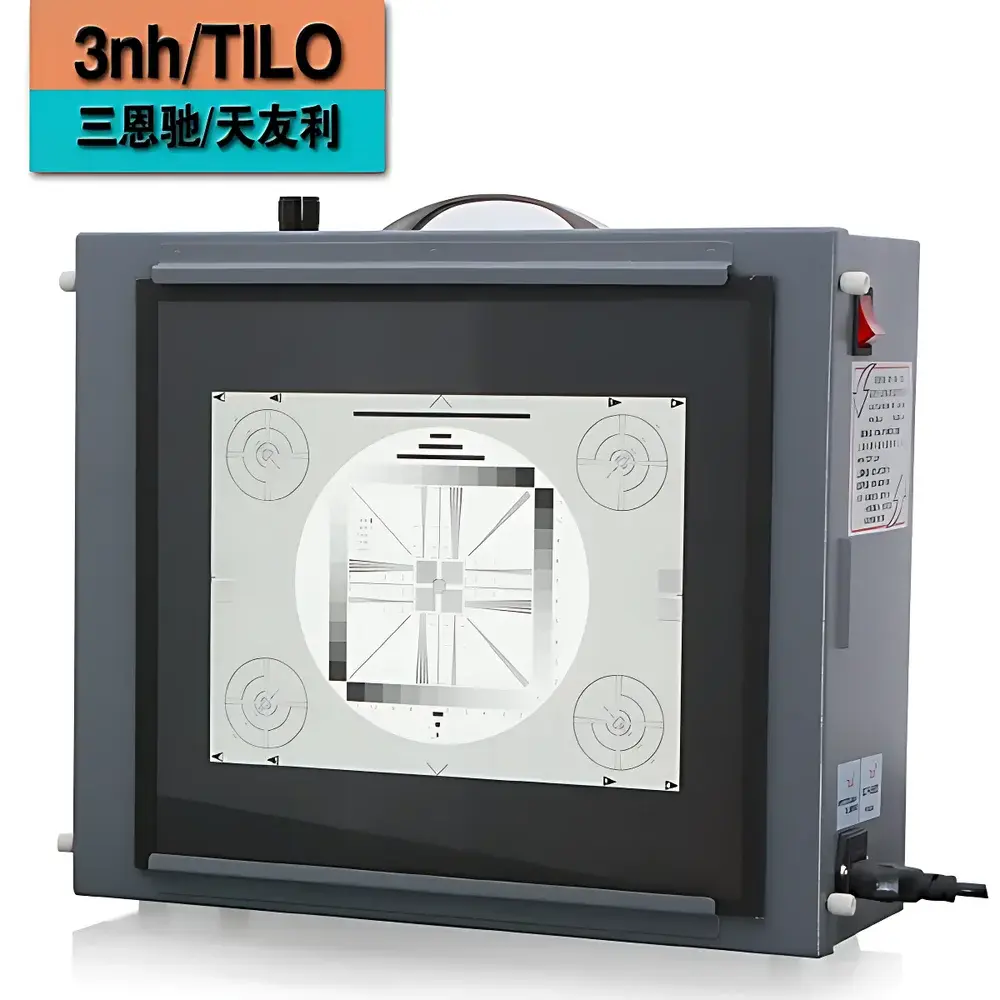
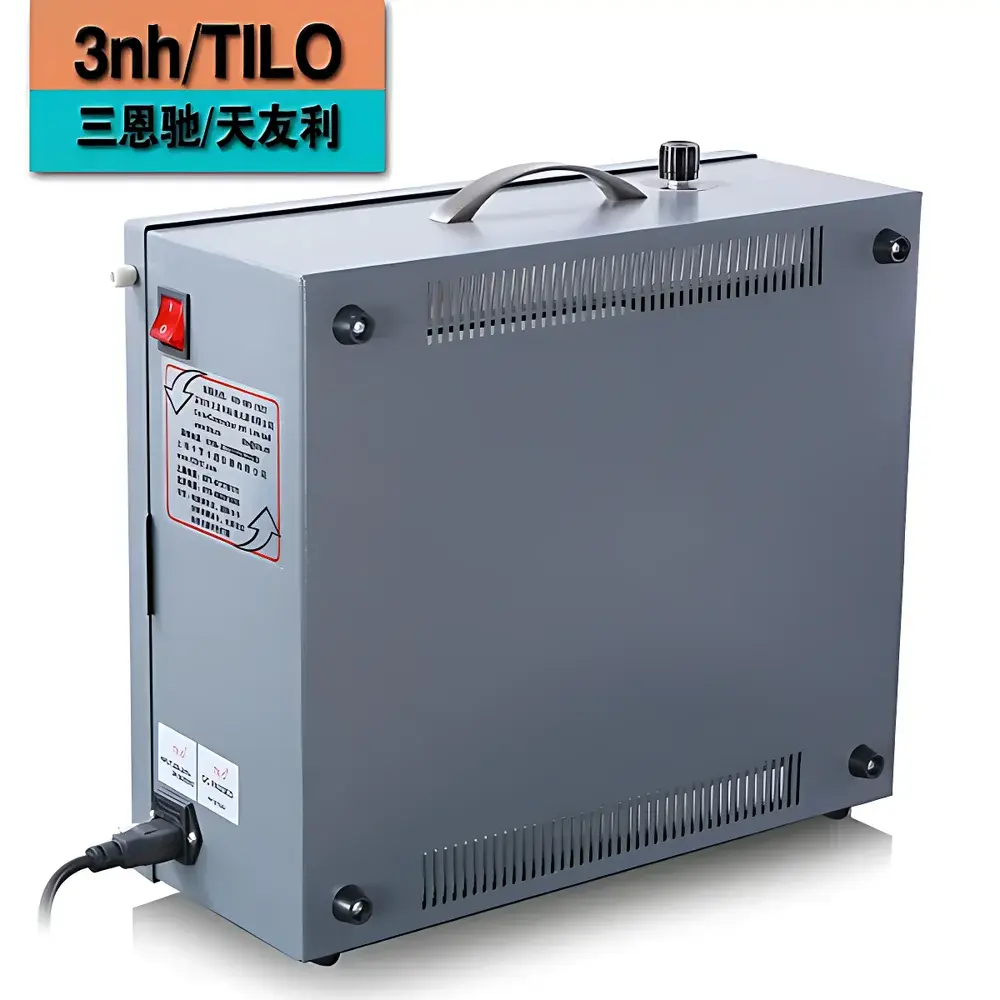
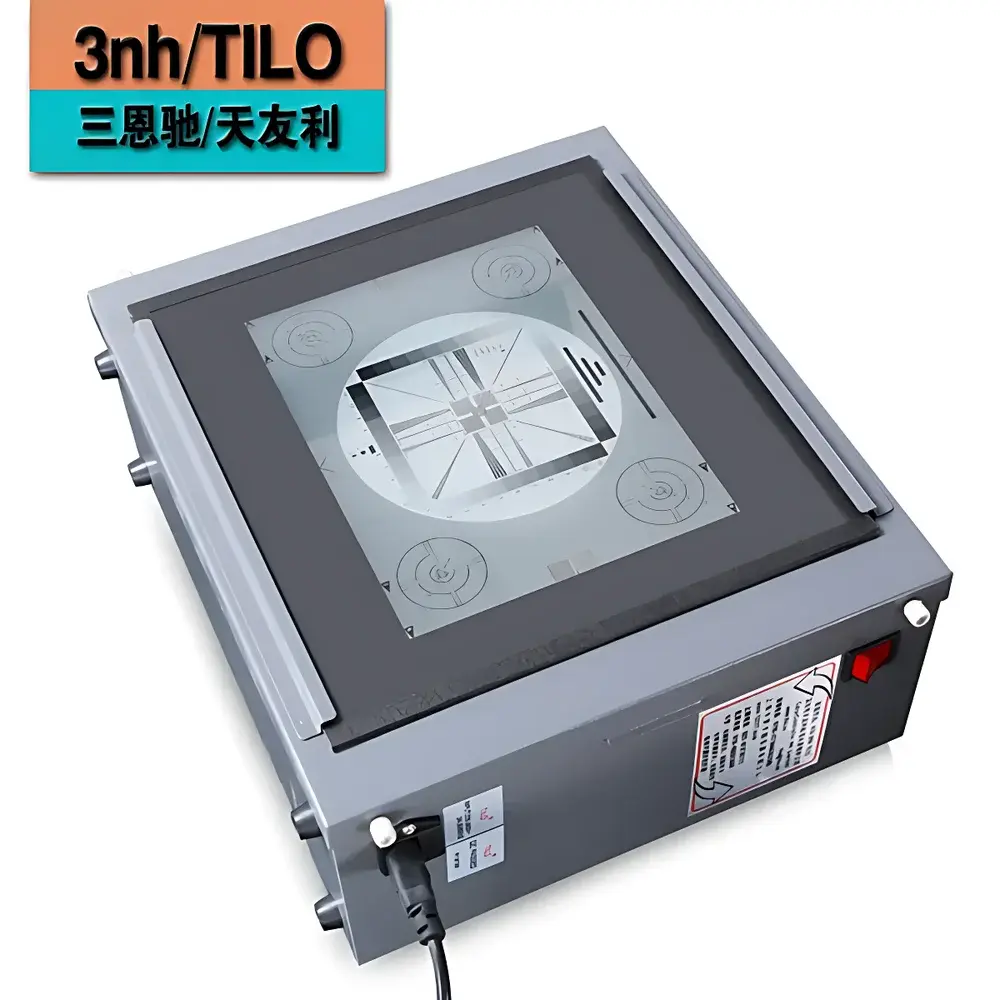
3nh CC5100 Transmissive Camera Color Matching Light Booth
| Brand | 3nh |
|---|---|
| Model | CC5100 |
| Light Source | 4×5100K (±200K) or 4×3100K (±200K), dual-group independent control |
| Uniformity | >90% |
| Luminance Range | 100–4400 cd/m² |
| Illuminance Range | 250–10000 lux |
| High-Frequency Ignition | 20 kHz |
| Power Supply | AC 230 V, 50/60 Hz |
| Operating Temperature | 10–40 °C |
| Operating Humidity | ≤80% RH |
| External Dimensions | 38.5 W × 34 H × 15 D cm |
| Transmissive Aperture | 25 W × 19 H cm |
Overview
The 3nh CC5100 Transmissive Camera Color Matching Light Booth is an engineered optical evaluation system designed specifically for objective, repeatable illumination of camera sensors during image sensor characterization, lens transmission testing, and color reproduction validation. Unlike reflective light booths used in textile or paint assessment, the CC5100 employs a transmissive architecture—light passes uniformly through a calibrated aperture to illuminate test targets placed directly in front of the camera under test. Its core measurement principle relies on controlled spectral irradiance delivery at defined correlated color temperatures (CCT), enabling quantitative assessment of white balance accuracy, chromatic aberration, dynamic range response, and tone mapping behavior under standardized lighting conditions. The booth supports dual CCT configurations—3100K (warm white) and 5100K (neutral daylight)—each with four independently driven fluorescent tubes operating at high-frequency (20 kHz) electronic ballasts to eliminate flicker and ensure stable photometric output over time.
Key Features
- Transmissive optical design optimized for front-illuminated camera module testing, eliminating surface reflection artifacts common in reflective setups.
- Dual independent light groups: Four 3100K ±200K lamps and four 5100K ±200K lamps, each controllable via dedicated dimming circuitry for precise CCT blending or isolated mode operation.
- Photometric uniformity exceeding 90% across the 25 cm × 19 cm transmissive aperture—validated per ISO/CIE spatial uniformity guidelines for imaging metrology.
- Continuous luminance adjustment from 100 to 4400 cd/m² and illuminance from 250 to 10000 lux, enabling simulation of real-world ambient exposure conditions from low-light surveillance to bright daylight scenarios.
- High-frequency electronic ballast (20 kHz) ensures zero perceptible flicker and minimal temporal instability—critical for high-speed auto-exposure calibration and rolling shutter analysis.
- Robust mechanical construction with thermally stable aluminum housing; operating envelope certified for 10–40 °C ambient temperature and ≤80% relative humidity.
Sample Compatibility & Compliance
The CC5100 accommodates standard camera modules up to 25 cm wide and 19 cm tall, supporting both single-sensor and multi-camera array configurations typical in automotive ADAS, smartphone, and industrial machine vision systems. Its aperture geometry aligns with common ISO 12233 resolution chart mounting standards. While not a certified reference standard per CIE S 014 or ASTM E308, the CC5100 is designed to meet functional requirements for internal QC workflows aligned with ISO 9001-compliant manufacturing environments. Its stable CCT and uniform irradiance profile support traceable validation against NIST-traceable photometers when integrated into a documented calibration protocol.
Software & Data Management
The CC5100 operates as a hardware-controlled illumination source without embedded firmware or proprietary software. Brightness and group selection are managed exclusively via analog rotary potentiometers, ensuring deterministic, latency-free control without digital interface dependencies. For automated test integration, users may couple the booth with third-party DAQ systems using external 0–10 V analog control inputs (optional retrofit). All operational parameters—including lamp aging compensation intervals, recalibration schedules, and photometric verification logs—are maintained externally in accordance with GLP documentation practices. No data storage, network connectivity, or FDA 21 CFR Part 11 compliance features are included, consistent with its role as a passive optical stimulus device.
Applications
- Camera sensor white balance convergence testing under multiple CCT conditions.
- Lens transmittance and flare characterization using standardized gray cards and color targets.
- Auto-exposure algorithm validation across luminance gradients (e.g., 100–4400 cd/m² sweep).
- Color fidelity assessment of raw Bayer data pipelines using IT8.7/2 or X-Rite ColorChecker SG targets.
- Manufacturing line pass/fail inspection for mobile phone camera modules prior to final assembly.
- Research-grade evaluation of quantum efficiency (QE) variation across sensor active areas under uniform irradiance.
FAQ
Does the CC5100 include built-in photometric calibration certificates?
No. Calibration must be performed externally using a NIST-traceable spectroradiometer or illuminance/luminance meter prior to first use and at recommended intervals (typically every 6 months or after 2000 lamp-hours).
Can the 3100K and 5100K lamp groups be operated simultaneously?
Yes—both groups can be powered and dimmed independently, enabling custom mixed-CCT illumination for specialized sensor tuning protocols.
Is the CC5100 compliant with ISO 3664:2009 for graphic arts viewing?
No. It is not configured for reflective viewing geometry or D50 spectral power distribution; it is purpose-built for transmissive camera testing.
What is the expected lifetime of the fluorescent lamps?
Rated at ≥6000 hours at nominal drive current; luminous flux depreciation follows IEC 62471 guidelines and should be monitored via periodic photometric verification.
Does the unit support DC power input or battery operation?
No. It requires AC 230 V, 50/60 Hz mains supply only; no DC conversion or UPS compatibility is provided.




