
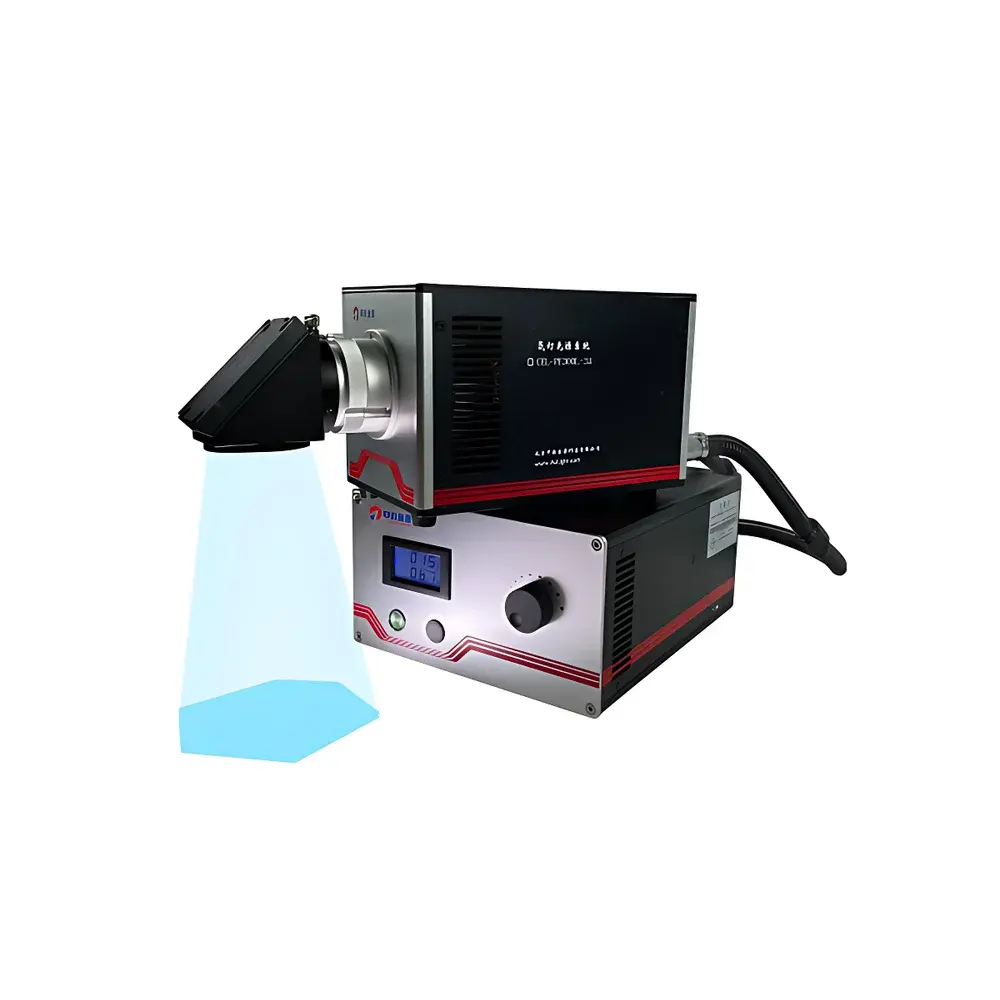
CEL-PE300L-3A Simulated Solar Xenon Light Source
| Brand | CEL (China Education Goldsource) |
|---|---|
| Model | CEL-PE300L-3A |
| Light Source Type | 300 W Ceramic Xenon Arc Lamp (PerkinElmer) |
| Illumination Mode | Internal Irradiation Configuration |
| Spectral Class | ASTM E927-19 Class 3A Solar Simulator |
| Spectral Range (unfiltered) | 300–1100 nm |
| Irradiance Range | 0.1–5 Sun (10–500 mW/cm², adjustable in real time) |
| Uniformity (measured with reference cell) | <5% |
| Beam Shape | Hexagonal (optional square) |
| Beam Diameter | 30–80 mm (distance-dependent) |
| Power Stability | <0.1% (rms, over 8 h) |
| Radiometric Stability | <1% (rms, over 8 h) |
| Filter Mount Compatibility | M52, M62 threaded |
| Control Interface | PHCS300 Dedicated Software + 240×128 DPI LCD Panel |
| Safety Compliance | Dual-grounded chassis, interlocked high-voltage enclosure, thermal cutoff, emergency stop circuit |
| Operating Modes | Manual / Light-Controlled / Automatic / Intelligent / Programmable / Remote (RS232/Ethernet) |
Overview
The CEL-PE300L-3A is a Class 3A solar-simulating xenon light source engineered for high-fidelity photonic experimentation in research and industrial laboratories. It employs a stabilized 300 W ceramic xenon arc lamp (OEM PerkinElmer), delivering broadband spectral irradiance from 300 nm to 1100 nm—closely matching the AM1.5G reference spectrum defined in ASTM E927-19 and IEC 60904-9. Unlike conventional point-source xenon systems, this instrument integrates a precision fly’s-eye homogenizer (hexagonal lens array) to generate spatially uniform irradiance across its output aperture, enabling reproducible photon flux delivery critical for quantum efficiency mapping, photocatalytic kinetics, and photovoltaic device characterization. The system operates in internal irradiation configuration, allowing direct integration into sealed reaction chambers or custom optical benches without beam re-collimation.
Key Features
- Class 3A spectral match per ASTM E927-19: spectral mismatch <±12.5% across 300–1100 nm, validated using calibrated spectroradiometry
- Fly’s-eye homogenizer with hexagonal output profile—optimized for minimal intensity gradient (<5% non-uniformity measured with NIST-traceable silicon reference cell)
- Continuously adjustable irradiance from 0.1 to 5 Sun (10–500 mW/cm²), calibrated against absolute radiometric standards
- Dual-stage stabilization: power supply ripple <0.1% RMS; long-term radiometric drift <1% over 8-hour continuous operation
- Integrated 240×128 DPI monochrome LCD interface with real-time parameter display (voltage, current, lamp hours, irradiance setpoint)
- Multi-layer safety architecture: grounded metal chassis, HV interlock on lamp housing, thermal shutdown at >85°C, and mechanical emergency stop
- Flexible control hierarchy: local manual adjustment, analog light-sensor feedback loop, programmable time-ramped irradiance profiles, and remote command via RS232 or Ethernet
Sample Compatibility & Compliance
The CEL-PE300L-3A supports diverse sample geometries through its variable working distance (30–80 mm beam diameter range) and modular filter mounting system (M52/M62 threads; optional 50 mm × 50 mm square holder). Standard AREF filter (300–1100 nm) provides broadband AM1.5G compliance; optional bandpass, UV-cut, or IR-cut filters enable spectral tailoring for specific photochemical or photobiological protocols. The system meets essential electrical safety requirements per IEC 61010-1 and is designed for GLP-compliant environments—full audit trail logging, user-access levels, and timestamped irradiance records are supported via PHCS300 software. While not certified for clinical or GMP manufacturing use, it conforms to calibration traceability frameworks aligned with ISO/IEC 17025 guidelines for laboratory measurement equipment.
Software & Data Management
PHCS300 is a dedicated Windows-based control application enabling full bidirectional communication with the light source. It provides real-time monitoring of lamp voltage/current, elapsed operating hours, irradiance feedback (when paired with NP2000 radiometer), and thermal status. Users can define multi-step irradiation programs—including ramped intensity transitions, duty-cycle modulation, and sunrise/sunset simulation mimicking diurnal solar variation. All operational parameters and sensor readings are logged in CSV format with millisecond timestamps. The software supports FDA 21 CFR Part 11-compliant electronic signatures (with optional PKI module), role-based access control, and automated report generation for experimental reproducibility documentation.
Applications
- Photocatalytic reaction kinetics under standardized solar illumination (e.g., TiO₂ degradation studies, CO₂ reduction, water splitting)
- Quantum efficiency and external quantum efficiency (EQE) mapping of perovskite, organic, and multijunction solar cells
- Photoelectrochemical cell (PEC) testing under controlled AM1.5G conditions
- UV–Vis–NIR accelerated aging of polymeric materials and coatings
- Photobiomodulation and circadian rhythm studies requiring tunable, uniform visible-NIR irradiance
- Calibration and validation of reference solar cells, pyranometers, and spectroradiometers
FAQ
What spectral standard does the CEL-PE300L-3A meet?
It complies with ASTM E927-19 Class 3A requirements for spectral match, spatial uniformity, and temporal stability—validated using NIST-traceable instrumentation.
Can the system operate without the PHCS300 software?
Yes—basic functions (on/off, intensity preset, timer) are accessible via the front-panel LCD; software is required for advanced programming and data logging.
Is the lamp replaceable by the end user?
The PerkinElmer 300 W ceramic xenon lamp is field-replaceable using standard torque tools; alignment jig and replacement procedure are documented in the technical manual.
What is the expected lifetime of the xenon lamp?
Rated for ≥1,000 hours at nominal power; lifetime decreases with frequent on/off cycling or operation above 4.5 Sun.
Does the system support external trigger synchronization?
Yes—TTL-compatible trigger input/output ports allow synchronization with cameras, lock-in amplifiers, or potentiostats for time-resolved measurements.





