
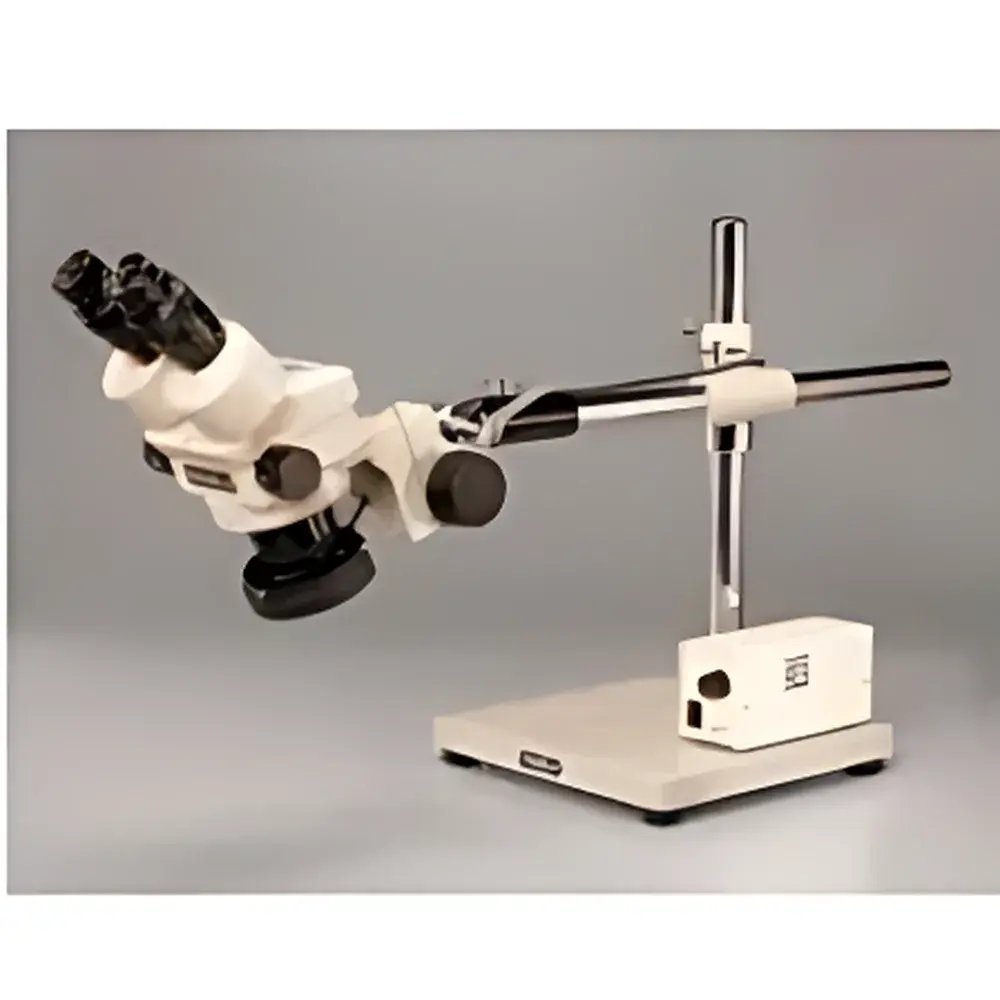
RWD EMZ-II and EMZ-III Desktop Stereo Zoom Microscopes (Imported Optical Components)
| Brand | RWD |
|---|---|
| Origin | Shenzhen, China |
| Manufacturer Type | Original Equipment Manufacturer (OEM) |
| Country of Final Assembly | China |
| Models | EMZ-II (Binocular), EMZ-III (Trinocular) |
| Price Range | USD 5,200–5,800 (FOB Shenzhen) |
| Zoom Ratio | 6.5:1 |
| Magnification Range (Standard) | 0.7×–4.5× |
| Total Magnification (with 10× eyepieces, no auxiliary lens) | 7×–45× |
| Field of View | 32 mm–5.1 mm |
| Working Distance (standard) | 93 mm |
| Eyepiece Tube Tilt | 60° (binocular), 45° (trinocular) |
| Interpupillary Adjustment | 54–75 mm |
| Diopter Adjustment | ±5 D per eyepiece |
| Auxiliary Lens Options | 0.28×, 0.3×, 0.44×, 0.5×, 0.75×, 1.5×, 2.0× |
| Eyepiece Options | 10×, 12.5×, 15×, 20×, 30× (graduated optional) |
| Extended Magnification Range | Binocular: 2.1×–270× |
| Trinocular | 0.98×–203× |
| Extended Working Distance Range | Binocular: 34–251 mm |
| Trinocular | 38–300 mm |
| Compatible Imaging Devices | USB 2.0 CMOS cameras (e.g., DK1000, 2.0 MP), CCD systems |
| Illumination Compatibility | LED annular fluorescent lamps (e.g., MA964), cold light sources, stereotaxic instrument integration |
Overview
The RWD EMZ-II and EMZ-III are precision-engineered desktop stereo zoom microscopes designed for demanding life science and preclinical research applications. Built upon a robust Greenough optical architecture, these instruments deliver true stereoscopic imaging with high depth of field, parfocal stability, and continuous zoom capability—enabling seamless transition between macro- and micro-observation without refocusing. The core optical path incorporates imported achromatic-aplanatic objective lenses and anti-reflective coated prisms to ensure high transmission efficiency (>92%), minimal chromatic aberration, and consistent contrast across the full magnification range. Unlike fixed-magnification systems, the 6.5:1 zoom ratio (0.7×–4.5×) provides flexibility in specimen assessment while maintaining optical fidelity—critical for longitudinal surgical monitoring, neuroanatomical dissection, and developmental biology workflows. Both models comply with ISO 10934-1 (Medical endoscopes — Vocabulary) and IEC 61010-1 safety standards for laboratory equipment.
Key Features
- Greenough-type dual-path optical design ensuring natural 3D perception and minimal eye strain during extended use
- Continuous zoom mechanism with calibrated vernier scale for repeatable magnification recall
- Rotatable binocular or trinocular head (360° rotation) with ergonomic tilt angles (60° for EMZ-II, 45° for EMZ-III) and independent diopter compensation (±5 D)
- Wide interpupillary adjustment range (54–75 mm) accommodating diverse user anthropometry
- Modular auxiliary lens system supporting working distance extension from 34 mm to 300 mm and magnification scaling down to 0.28× or up to 270×
- Integrated mounting interface compatible with stereotaxic frames (e.g., David Kopf Instruments), LED annular illumination (MA964), and cold light sources via fiber-optic coupling
- Stainless-steel mechanical stage with fine-focus coaxial control (0.002 mm resolution) and lateral translation lock
Sample Compatibility & Compliance
The EMZ series accommodates live and fixed biological specimens—including murine brain tissue, zebrafish embryos, insect anatomy, plant meristems, and small vertebrate organs—without requiring vacuum or conductive coating. Its long working distance (93 mm standard) enables simultaneous manipulation with micropipettes, forceps, or electrophysiology probes. All optical components meet RoHS Directive 2011/65/EU material restrictions. The trinocular port (C-mount thread) supports FDA-cleared digital imaging systems compliant with 21 CFR Part 11 when paired with validated acquisition software. Device configuration records—including magnification settings, illumination intensity logs, and accessory usage—are traceable under GLP/GMP audit requirements when integrated into LIMS environments.
Software & Data Management
While the microscope itself is hardware-only, the trinocular variant is fully compatible with industry-standard imaging platforms including Olympus cellSens, Zeiss ZEN Blue, and open-source solutions such as Micro-Manager v2.0. When used with the DK1000 USB 2.0 camera module, real-time streaming, time-lapse capture, multi-channel overlay (brightfield + fluorescence), and pixel-calibrated measurement (µm/pixel) are supported. Metadata embedding (EXIF + custom tags) ensures image provenance for publication-grade documentation. Optional SDKs enable API-driven automation of focus stacking, mosaic stitching, and ROI-based intensity profiling—facilitating reproducible quantitative morphometrics in histopathology and neuroanatomy studies.
Applications
- Neurosurgical training and stereotactic implantation procedures in rodent models
- In vivo imaging support for cranial window preparations and intravital microscopy setup
- Embryonic dissection and organ explant culture monitoring in developmental biology labs
- Quality assurance in microelectronics assembly and solder joint inspection
- Forensic evidence examination (fiber, hair, toolmark analysis) under non-destructive conditions
- Botanical taxonomy workflows requiring dynamic focus tracking across layered floral structures
FAQ
Is the EMZ-III compatible with third-party scientific cameras beyond the DK1000?
Yes—the C-mount port adheres to ANSI/ISO 8539:2021 specifications and supports cameras with sensor sizes up to 1/1.8″, including Hamamatsu ORCA-Fusion BT and Basler ace acA2000-50gm.
Can the microscope be calibrated for metrological traceability?
Yes—optional NIST-traceable stage micrometers (MA540 series) and calibration slides enable ISO/IEC 17025-compliant verification of magnification accuracy and field uniformity.
Does RWD provide application-specific validation documentation?
Upon request, RWD supplies IQ/OQ protocols aligned with ASTM E2919-20 (Standard Practice for Validation of Microscopy Systems) for regulated laboratories.
What is the warranty coverage and service response time?
Standard warranty is 24 months parts-and-labor; extended service contracts include on-site engineer dispatch within 72 business hours in APAC regions.
Are replacement optics available with UV-transmitting coatings for fluorescence work?
Yes—custom quartz-prism assemblies and UV-enhanced objectives (350–400 nm transmission >85%) are available under part numbers MA780x series.





