
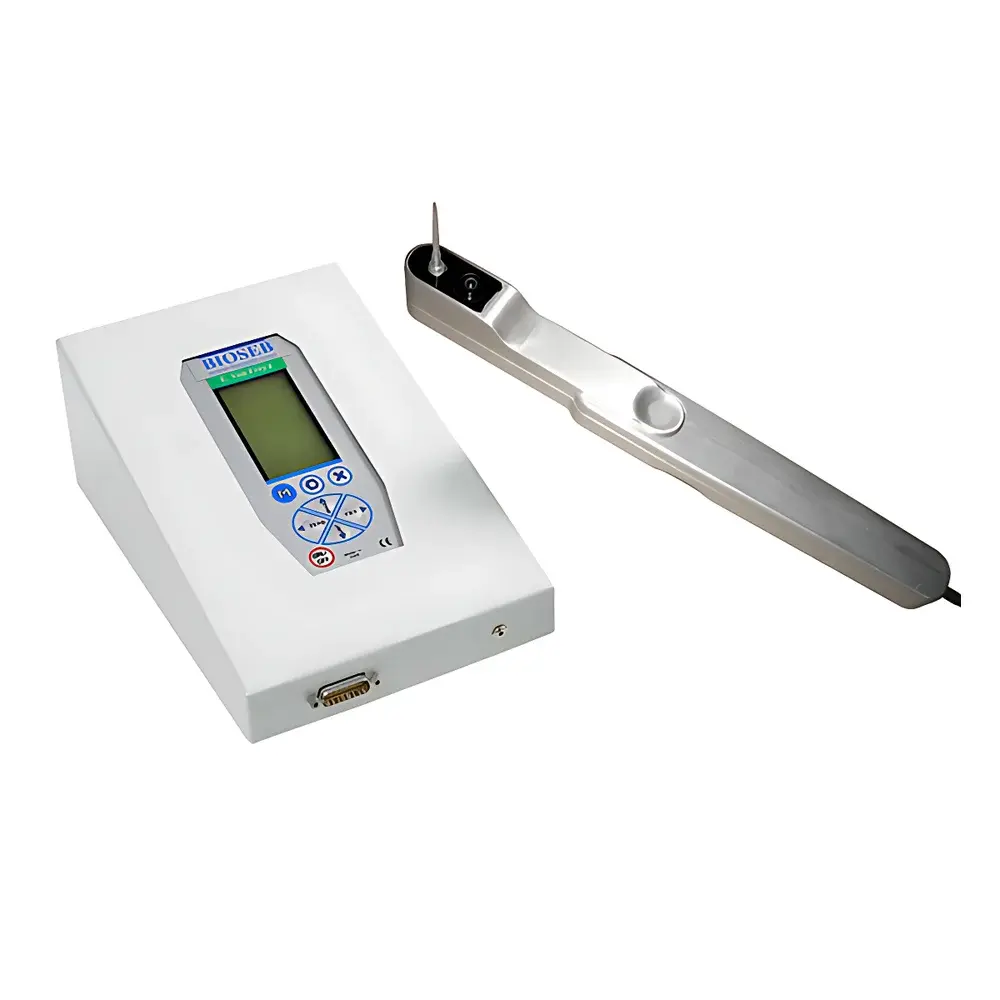
VonFrey Electronic Analgesiometer BIO-EVF4
| Origin | France |
|---|---|
| Manufacturer Type | Distributor |
| Origin Category | Imported |
| Model | BIO-EVF4 (includes 10 disposable plastic filaments + 1 elastic filament) for mice and rats |
| Measurement Range | 0–500 g (0–5 N) |
| Resolution | 0.1 g |
| Accuracy | ±0.2 g |
| Display | Backlit LCD with real-time force and peak hold |
| Data Storage | Up to 100 test records internally |
| Output Interface | RS232 (RSIC software optional) |
| Certifications | COFRAC-accredited calibration (traceable to ISO/IEC 17025), EMC compliant |
Overview
The VonFrey Electronic Analgesiometer BIO-EVF4 is a precision-engineered instrument designed for quantitative assessment of mechanical nociceptive thresholds in rodent models—primarily mice and rats—under controlled preclinical research conditions. It operates on the principle of calibrated monofilament stimulation, applying incremental, quantifiable mechanical force to the plantar surface or dorsal paw to elicit withdrawal reflexes. Unlike thermal or chemical pain assays, this method isolates mechanosensory function without confounding variables such as ambient temperature fluctuations or humidity-dependent filament stiffness. The device implements a validated up-down testing paradigm (Dixon method) or fixed-interval protocols, enabling reproducible determination of 50% paw withdrawal threshold (PWT), a key endpoint in neuropathic, inflammatory, and opioid-induced hyperalgesia studies. Its design adheres to internationally recognized standards for behavioral phenotyping, including recommendations from the International Association for the Study of Pain (IASP) and the NIH Office of Laboratory Animal Welfare (OLAW).
Key Features
- High-resolution digital force transduction with 0.1 g resolution and ±0.2 g accuracy across the full 0–500 g (0–5 N) range—optimized for sensitivity detection in both baseline and pathological states.
- Dedicated set of 10 single-use plastic filaments and one reusable elastic filament, each pre-calibrated to deliver consistent bending force per unit displacement, minimizing inter-test variability and eliminating filament fatigue artifacts.
- Footswitch-controlled operation allows hands-free initiation, zeroing, and data capture—critical for maintaining animal restraint consistency and reducing experimenter-induced stress artifacts.
- Backlit LCD display provides real-time force readout, automatic peak-hold retention, and immediate visual confirmation of response latency and magnitude.
- Onboard statistical engine computes mean, standard deviation, and coefficient of variation for multi-trial datasets—supporting intra- and inter-subject comparisons without external computation.
- Internal memory stores up to 100 complete test sessions, including subject ID, trial sequence, force values, and timestamp metadata—enabling audit-ready data lineage within GLP-compliant workflows.
Sample Compatibility & Compliance
The BIO-EVF4 is validated for use with C57BL/6, BALB/c, Sprague-Dawley, and Wistar strains under standardized housing and acclimation protocols (e.g., 30-min habituation prior to testing). Its filament geometry and force delivery profile comply with ASTM F2985-15 guidelines for tactile sensory testing instrumentation. Calibration is traceable to COFRAC-accredited reference standards (ISO/IEC 17025), ensuring metrological integrity across laboratories. Electromagnetic compatibility (EMC) certification confirms stable operation in shared vivarium environments with concurrent imaging, electrophysiology, or ventilator systems. While not a medical device, its output parameters are routinely accepted in regulatory submissions to EMA and FDA for nonclinical pharmacology modules.
Software & Data Management
Raw force-time series and summary metrics are exportable via RS232 serial interface to Windows-based workstations running the optional RSIC acquisition and analysis software. RSIC supports batch import, automated PWT calculation using Dixon’s up-down algorithm, graphical overlay of longitudinal trends, and export to CSV, Excel, or XML formats compatible with SAS, GraphPad Prism, and R statistical environments. Audit trail functionality logs user ID, session start/end time, calibration status, and any manual overrides—meeting requirements for 21 CFR Part 11 compliance when deployed in GCP- or GLP-regulated studies. Data encryption and role-based access control are configurable within enterprise deployments.
Applications
- Evaluation of analgesic efficacy in opioid, NSAID, and novel biologic candidates during IND-enabling toxicology programs.
- Longitudinal monitoring of mechanical allodynia in chronic constriction injury (CCI), spared nerve injury (SNI), and streptozotocin-induced diabetic neuropathy models.
- Phenotypic screening of genetically modified mouse lines for altered somatosensory processing (e.g., TRP channel knockouts, Nav1.7 mutants).
- Assessment of central sensitization following spinal cord injury or intrathecal drug administration.
- Validation of non-invasive neuromodulation interventions (e.g., tACS, focused ultrasound) on peripheral nociceptor excitability.
FAQ
Is the BIO-EVF4 suitable for both mice and rats?
Yes—the included filament set is optimized for the typical paw thickness and skin compliance of adult mice (18–25 g) and rats (150–300 g); filament selection and application technique must be adjusted per species per IASP guidelines.
Does the device require annual recalibration?
COFRAC-traceable calibration is performed at manufacture; users should verify zero-point stability and linearity semiannually using certified deadweight standards—documentation templates are provided in the operator manual.
Can data be exported directly to LIMS systems?
Via RSIC software, yes—CSV exports support direct ingestion into most laboratory information management systems (LIMS) with configurable field mapping and metadata tagging.
Is the elastic filament reusable, and how is its integrity verified?
Yes—the elastic filament is rated for ≥500 actuations; its performance is verified by periodic force-vs-deflection curve validation using the built-in diagnostic mode.
What environmental conditions are required for optimal operation?
Ambient temperature 15–25°C, relative humidity 30–70%, non-condensing; avoid direct airflow from HVAC vents or laminar flow hoods during testing to prevent filament drift.
Related Products



