
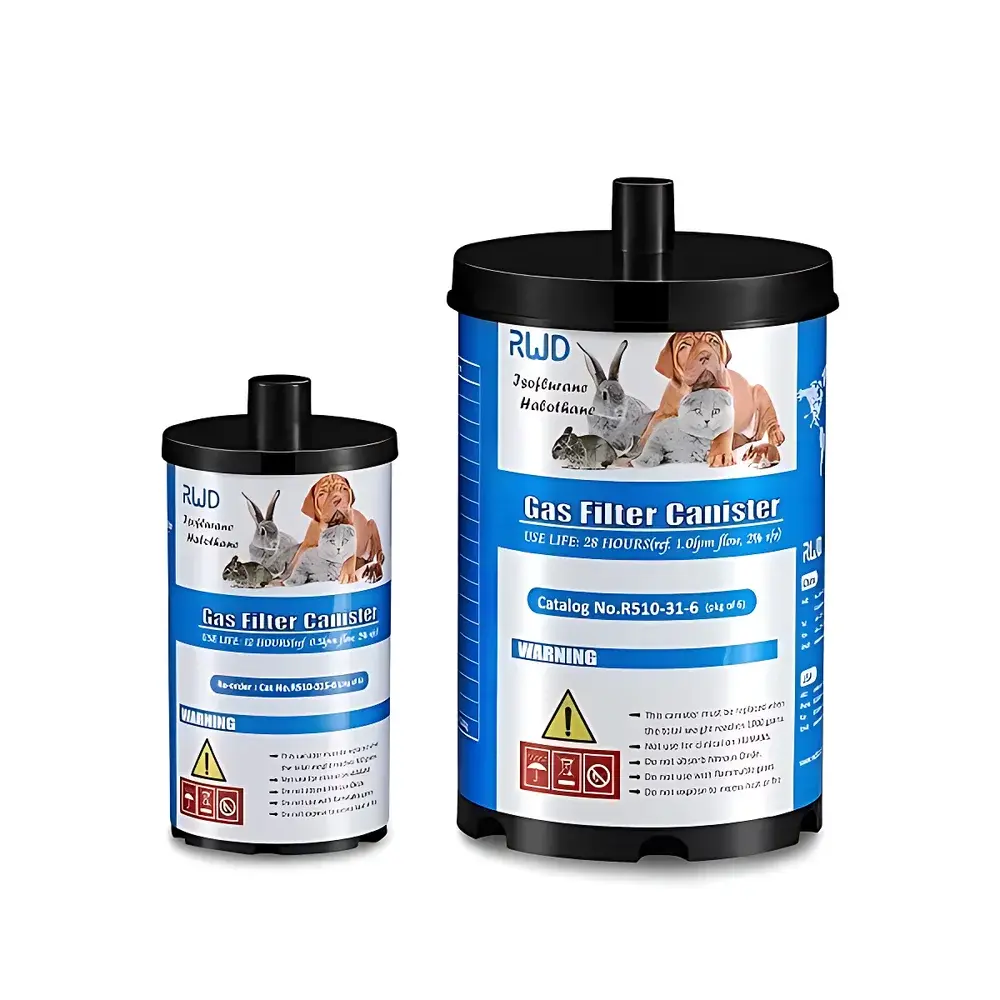
RWD R510-31-6 Disposable Anesthetic Gas Absorption Canister for Isoflurane and Sevoflurane
| Brand | RWD |
|---|---|
| Origin | Shenzhen, China |
| Manufacturer Type | Original Equipment Manufacturer (OEM) |
| Product Origin | Domestic (China) |
| Model | R510-31-6 |
| Pricing | Upon Request |
Overview
The RWD R510-31-6 Disposable Anesthetic Gas Absorption Canister is an engineered safety component designed for controlled removal of volatile anesthetic agents—specifically isoflurane and sevoflurane—from exhaust streams in preclinical anesthesia delivery systems. It operates on the principle of physical adsorption via high-surface-area activated carbon, which provides selective retention of halogenated ether vapors under standard laboratory airflow conditions (typically 0.5–2 L/min). The canister is intended for single-use deployment in closed or semi-closed scavenging circuits, particularly at the induction chamber outlet or mask interface, where unmetabolized anesthetic gas concentrations peak during animal induction and maintenance phases. Its design complies with occupational exposure guidelines outlined in ACGIH TLV® and OSHA permissible exposure limits (PELs) for halogenated anesthetics, supporting institutional compliance with laboratory biosafety and chemical hygiene plans.
Key Features
- Activated carbon media optimized for high-capacity adsorption of isoflurane (C3H2ClF5O) and sevoflurane (C4H3F7O), with verified saturation capacity of 200 g per unit (net adsorptive gain)
- Pre-weighed baseline mass (800 g ± 5 g) enables field verification of saturation via gross weight monitoring—no additional instrumentation required
- Robust polypropylene housing rated for continuous negative-pressure operation up to −30 kPa, compatible with standard vacuum-driven gas recovery units
- Integrated pressure-drop indicators and optional interface for third-party overpressure/overweight alarm modules when used with RWD-compatible scavenging controllers
- Two standardized form factors: R510-31-6 (large, 200 g capacity) and R510-31S-6 (small, 50 g capacity), enabling scalable deployment across rodent, rabbit, and non-human primate workstations
Sample Compatibility & Compliance
The R510-31-6 canister is validated for use with isoflurane and sevoflurane only; it is not suitable for nitrous oxide, desflurane, or halothane due to differences in vapor pressure, polarity, and carbon affinity. It meets ISO 8573-1:2010 Class 4 purity requirements for compressed air system components and conforms to IEC 61000-6-3 electromagnetic compatibility standards for auxiliary medical devices. While not classified as a medical device under FDA 21 CFR Part 820, its deployment supports adherence to GLP Annex 11 (data integrity in environmental monitoring) and NIH OLAW-recommended waste gas management practices. Institutions conducting AAALAC-accredited research may reference this unit in their Standard Operating Procedures for inhalant anesthetic waste control.
Software & Data Management
As a passive hardware component, the R510-31-6 does not incorporate embedded firmware or digital interfaces. However, it integrates seamlessly with RWD’s R500 Series Anesthesia Workstations, which support audit-trail-enabled usage logging—including timestamped canister installation, cumulative runtime tracking, and manual saturation status flagging. When paired with optional load-cell–equipped scavenging cabinets, weight-based saturation alerts may be logged into LIMS-compatible CSV or HL7-compliant outputs for retrospective exposure assessment and regulatory reporting.
Applications
- Exhaust gas capture at induction chambers for mice, rats, and guinea pigs in neuroscience and oncology studies
- Downstream filtration for face-mask–based anesthesia delivery in surgical recovery stations
- Secondary adsorption stage in multi-stage scavenging systems where primary condensation or catalytic oxidation is employed
- Field-deployable containment for mobile veterinary anesthesia units requiring portable, low-maintenance gas abatement
- Compliance scaffolding for institutions undergoing OSHA or university EHS inspections related to volatile organic compound (VOC) emissions
FAQ
How do I determine when the R510-31-6 canister is saturated?
Saturation is confirmed when the total unit mass reaches ≥1000 g (i.e., 800 g tare + 200 g adsorbed load). Weighing must be performed on a calibrated scale with ±1 g resolution prior to each use cycle.
Can the canister be regenerated or reused after saturation?
No. Activated carbon loaded with halogenated ethers undergoes irreversible binding and potential off-gassing upon thermal or pressure cycling. Regeneration is prohibited per RWD Safety Bulletin R510-SB-2023.
Is the R510-31-6 compatible with non-RWD anesthesia machines?
Yes—provided the host system delivers stable negative pressure (−10 to −25 kPa) and uses 1/4″ NPT or ISO 594-1 tapered fittings. Adapters are available upon request.
What disposal protocol applies to spent canisters?
Spent units must be treated as hazardous chemical waste per local regulations (e.g., EPA D001/D002 in the U.S.; EU Waste Code 14 06 03*). Do not incinerate or landfill without prior stabilization assessment.
Does RWD provide documentation for institutional biosafety committee submissions?
Yes. Technical datasheets, material safety data summaries (MSDS), and ISO-compatibility statements are available via RWD’s Regulatory Support Portal (access granted upon institutional registration).




