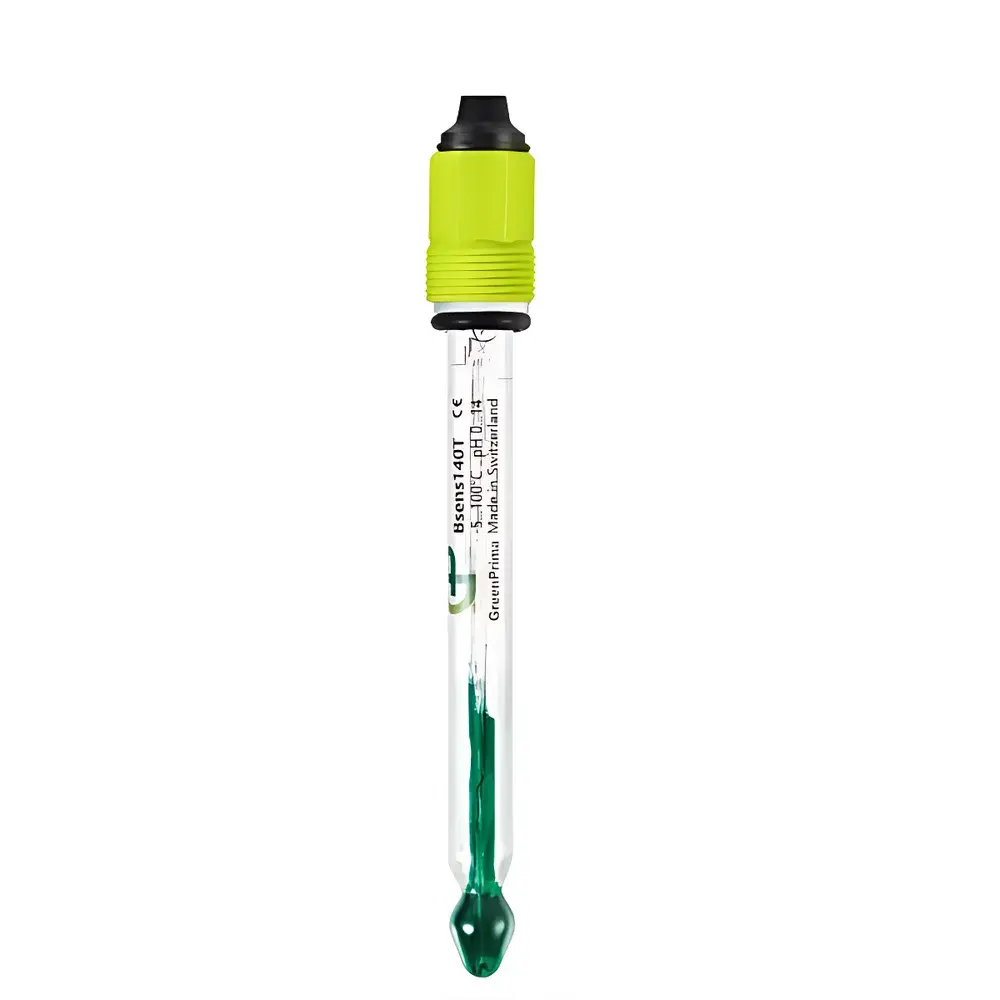
GreenPrima Bsens140T Ultra-Pure Water pH Sensor
| Brand | GreenPrima |
|---|---|
| Origin | Switzerland |
| Manufacturer Type | Manufacturer |
| Origin Category | Imported |
| Model | Bsens140T |
| Measuring Range | 0–14 pH |
| Operating Temperature | −5 to 100 °C |
| Reference Electrode | Ag/AgCl Cartridge |
| Temperature Sensor | PT1000 |
| Max. Pressure | 6 bar |
| Electrode Body Material | Glass |
| Electrolyte | Gel Electrolyte |
| Junction | Triple Ceramic Porous Junction |
| Glass Membrane | S-Glass |
| Minimum Immersion Depth | 20 mm |
| Zero Point | 0 ± 20 mV |
| Sensitivity | 57–59 mV/pH at 25 °C |
| Minimum Sample Conductivity | 0.1 µS/cm |
| Response Time (pH 4–7) | < 30 s |
| Thread Size | PG13.5 |
| Cable Length | 5 m |
Overview
The GreenPrima Bsens140T is a high-stability, low-drift pH sensor engineered specifically for continuous in-line monitoring of ultra-pure water systems—such as those found in semiconductor manufacturing, pharmaceutical water-for-injection (WFI) loops, power plant boiler feedwater, and laboratory-grade ultrapure water (UPW) distribution networks. Unlike conventional pH electrodes, the Bsens140T employs a specialized S-glass membrane with enhanced hydrogen ion selectivity and reduced alkaline error, enabling reliable measurements in solutions with conductivity as low as 0.1 µS/cm. Its measurement principle relies on the Nernstian potential difference generated across the hydrated glass membrane in response to H⁺ activity, referenced against a stable Ag/AgCl cartridge system with triple ceramic junctions that minimize electrolyte leakage and clogging under low-conductivity conditions. The integrated PT1000 temperature sensor ensures automatic, high-fidelity temperature compensation in real time—critical for accurate pH calculation in thermally variable UPW streams.
Key Features
- S-glass membrane formulation optimized for minimal sodium error and extended stability in ultra-low ionic strength environments
- Triple ceramic porous junction design ensuring consistent electrolyte outflow while resisting fouling and blockage in pure water applications
- Gel-filled electrolyte system eliminating liquid refill requirements and reducing maintenance frequency
- Robust borosilicate glass body rated for continuous operation up to 6 bar pressure and −5 to 100 °C temperature range
- Precision-matched Ag/AgCl reference cartridge with low thermal drift and high reproducibility over extended service life
- PG13.5 process thread interface compatible with standard sanitary and industrial mounting fixtures
- 5-meter shielded, low-noise cable with IP68-rated connector for reliable signal integrity in humid or splash-prone environments
Sample Compatibility & Compliance
The Bsens140T is validated for use in Type I (ASTM D1193), ASTM E2657 (pharmaceutical purified water), and ISO 3696 Grade 1 water systems. It meets functional requirements for continuous pH monitoring under current Good Manufacturing Practice (cGMP) and FDA 21 CFR Part 11-compliant data acquisition workflows when paired with GreenPrima PM8200P controllers. Its design conforms to IEC 61511 for functional safety in basic process control systems and supports GLP audit trails via timestamped calibration logs and event-triggered diagnostics. The sensor does not require flow cell installation and maintains accuracy even under static or low-flow conditions typical of recirculating UPW loops.
Software & Data Management
When interfaced with the GreenPrima PM8200P controller, the Bsens140T enables full digital configuration via RS485 Modbus RTU protocol. The controller provides dual 4–20 mA analog outputs (pH and temperature), relay outputs for dosing pump control, and configurable alarm thresholds with hysteresis. All calibration events—including two-point (4.01/7.00/10.01) and slope/offset verification—are stored with date/time stamps and user ID tags. Data export is supported via USB or SD card in CSV format, compatible with LIMS integration and electronic batch record systems. Firmware updates preserve calibration history and maintain traceability per ISO/IEC 17025 requirements.
Applications
- Real-time pH monitoring in semiconductor fab UPW distribution skids (e.g., pre- and post-UV treatment stages)
- Continuous verification of neutralization efficiency in pharmaceutical WFI storage and distribution loops
- Feedwater pH control in high-pressure steam generation systems to prevent corrosion and silica scaling
- In-line validation of reverse osmosis (RO) and electrodeionization (EDI) unit performance
- Research-grade ultrapure water systems in analytical laboratories requiring sub-0.02 pH unit repeatability
- Environmental monitoring of deionized water used in precision cleaning and coating processes
FAQ
What is the minimum water conductivity required for stable readings with the Bsens140T?
The sensor is validated for continuous operation at conductivities ≥ 0.1 µS/cm—making it suitable for Type I ultrapure water per ASTM D1193.
Can the Bsens140T be used in pressurized RO or EDI loop applications?
Yes—its 6 bar maximum pressure rating allows direct insertion into pressurized lines without external pressure relief or bypass manifolds.
How often does the sensor require calibration in ultra-pure water service?
Under stable operating conditions, quarterly verification is typical; however, daily automated zero checks via PM8200P are recommended for critical GMP applications.
Is the S-glass membrane susceptible to hydrofluoric acid exposure?
No—HF-containing solutions will rapidly degrade the glass membrane; the Bsens140T is strictly intended for non-HF aqueous matrices.
Does the triple ceramic junction require periodic cleaning or replacement?
Unlike single-junction designs, the triple ceramic structure resists crystallization and requires no routine mechanical cleaning; replacement is only necessary after >24 months of continuous use or if offset drift exceeds ±15 mV.
Related Products