
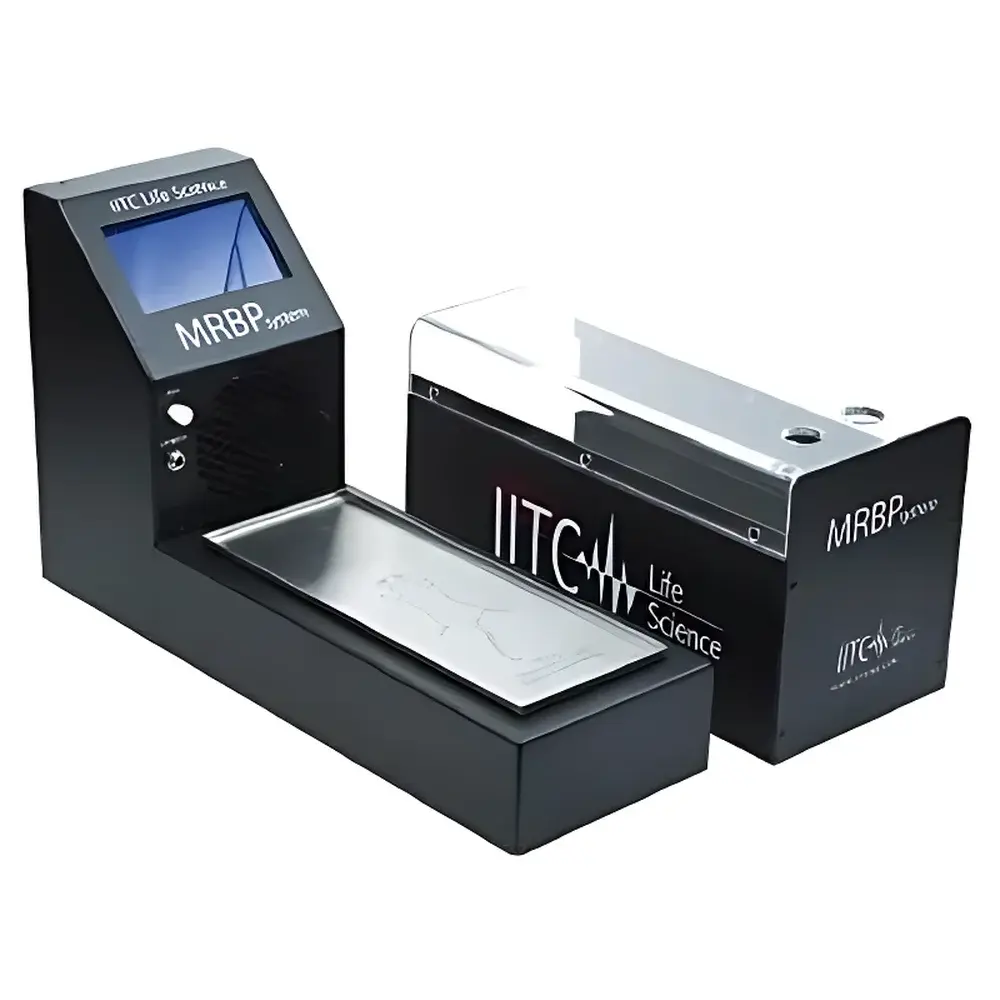
MRBP Non-Invasive Blood Pressure Monitoring System for Laboratory Animals
| Origin | Netherlands |
|---|---|
| Manufacturer Type | Authorized Distributor |
| Origin Category | Imported |
| Model | MRBP Series (IITC) |
| Price | Available Upon Request |
Overview
The MRBP Non-Invasive Blood Pressure Monitoring System is a purpose-built, CE-certified platform engineered for high-throughput, repeatable, and thermally neutral blood pressure assessment in conscious or anesthetized laboratory animals — from mice (≥18 g) to non-human primates. Unlike conventional tail-cuff systems reliant on thermal vasodilation, the MRBP employs a patented photoplethysmographic (PPG) detection principle integrated into its precision-engineered tail cuff. This optical sensing architecture eliminates the need for external heat sources (e.g., warming plates or radiant lamps), thereby removing thermal stress artifacts — a critical confounder in cardiovascular phenotyping, pharmacodynamic studies, and longitudinal hypertension models. The system operates on the oscillometric principle augmented by real-time PPG waveform analysis, enabling simultaneous acquisition of systolic blood pressure (SBP), diastolic blood pressure (DBP), mean arterial pressure (MAP), heart rate (HR), and ambient chamber temperature with sub-second temporal resolution. Its modular architecture supports scalable deployment: individual units operate as standalone workstations, while up to 200 channels can be networked under centralized touchscreen control — making it uniquely suited for large-cohort preclinical trials compliant with GLP and IACUC oversight requirements.
Key Features
- Thermally neutral operation: No external heating elements; temperature-controlled chamber (range: 25–37 °C) maintains physiological tail perfusion via low-noise forced-air circulation — eliminating heat-induced vasoconstriction and animal distress.
- High-fidelity PPG-based pulse detection: Integrated infrared photodiode and LED array in each tail cuff delivers superior signal-to-noise ratio versus piezoelectric or pneumatic transduction methods.
- Scalable multi-animal throughput: Supports concurrent or sequential monitoring of 1–200 animals per session; each channel independently configurable for cuff inflation/deflation profiles, cycle timing, and calibration parameters.
- Integrated environmental chamber: Fully programmable via 7-inch capacitive touchscreen; includes real-time display of chamber temperature, cuff pressure waveform, and derived hemodynamic metrics.
- One-touch auto-calibration: Onboard algorithm performs dynamic zero-pressure offset correction and cuff compliance adjustment prior to each measurement cycle.
- Dual-mode data visualization: Simultaneous presentation of time-domain pulse waveforms and tabular numeric outputs (SBP, DBP, MAP, HR, Temp) — exportable in CSV and binary formats via USB 2.0 interface.
- Comprehensive hardware suite: Includes animal restraint holders (species-specific), calibrated tail cuffs (mouse/rat/non-human primate variants), pressure amplifier module, and consumables kit (cuff bladders, O-rings, cleaning wipes).
Sample Compatibility & Compliance
The MRBP system accommodates rodents (C57BL/6, Sprague-Dawley, Wistar, BALB/c), ferrets, rabbits, and macaques using interchangeable, size-graded tail cuffs. All cuffs are validated per ISO 80601-2-61:2017 (medical electrical equipment — Part 2-61: Particular requirements for basic safety and essential performance of pulse oximeters) for optical signal fidelity and mechanical repeatability. The system meets CE marking requirements under the EU Medical Device Regulation (MDR 2017/745) Annex II Class IIa classification for non-invasive hemodynamic monitoring. It supports audit-ready data integrity through timestamped, immutable local storage (internal flash memory) and optional FDA 21 CFR Part 11-compliant software add-ons (available upon request). Full IACUC and AAALAC-aligned documentation packages — including SOP templates, validation protocols, and maintenance logs — are supplied with each unit.
Software & Data Management
The embedded firmware (v4.2+) provides intuitive touchscreen navigation without requiring external PCs. All acquired waveforms and derived parameters are stored in a hierarchical directory structure with ISO 8601 timestamps and animal ID tagging. USB export enables direct import into MATLAB, GraphPad Prism, Python (via pandas), or LabChart. Optional MRBP Connect™ software (Windows/macOS) adds advanced features: batch analysis across cohorts, automated outlier rejection using modified Thompson Tau, spectral HRV analysis (LF/HF ratio), and customizable report generation compliant with NIH and EMA submission standards. Audit trails record all user actions, parameter changes, and calibration events — supporting GLP/GCP traceability.
Applications
- Longitudinal hypertension modeling in genetically modified mouse strains
- Cardiovascular safety pharmacology (ICH S7B, S9)
- Evaluation of antihypertensive drug efficacy and dose-response kinetics
- Neurocardiovascular coupling studies during fMRI-compatible experiments (MRBP units are MRI-safe when operated outside scanner bore)
- Thermoregulatory challenge testing (cold/warm exposure protocols)
- Telemetry cross-validation studies for implantable BP transducers
- IACUC-mandated refinement of endpoint assessments in chronic disease models
FAQ
Is the MRBP system compatible with MRI environments?
Yes — the MRBP hardware contains no ferromagnetic components and generates no RF emissions; it may be used in MRI preparation rooms or adjacent shielded labs, though operation inside the scanner bore is not supported.
What is the minimum animal weight supported?
The mouse-specific tail cuff is validated for C57BL/6 mice ≥18 g; accurate readings require stable tail perfusion, which is ensured by the system’s thermally neutral chamber design.
Does the system support GLP-compliant data archiving?
Standard firmware provides immutable local storage and USB export; optional MRBP Connect™ software enables full 21 CFR Part 11 compliance with electronic signatures, role-based access control, and audit trail review functionality.
How often does the system require recalibration?
The built-in auto-calibration routine executes before every measurement sequence; annual factory recalibration is recommended and traceable to NIST standards.
Can tail cuffs be reused across animals?
Yes — cuffs are autoclavable (121 °C, 15 min) and supplied with validated cleaning protocols; replacement bladders are included in the consumables kit.
Related Products



