
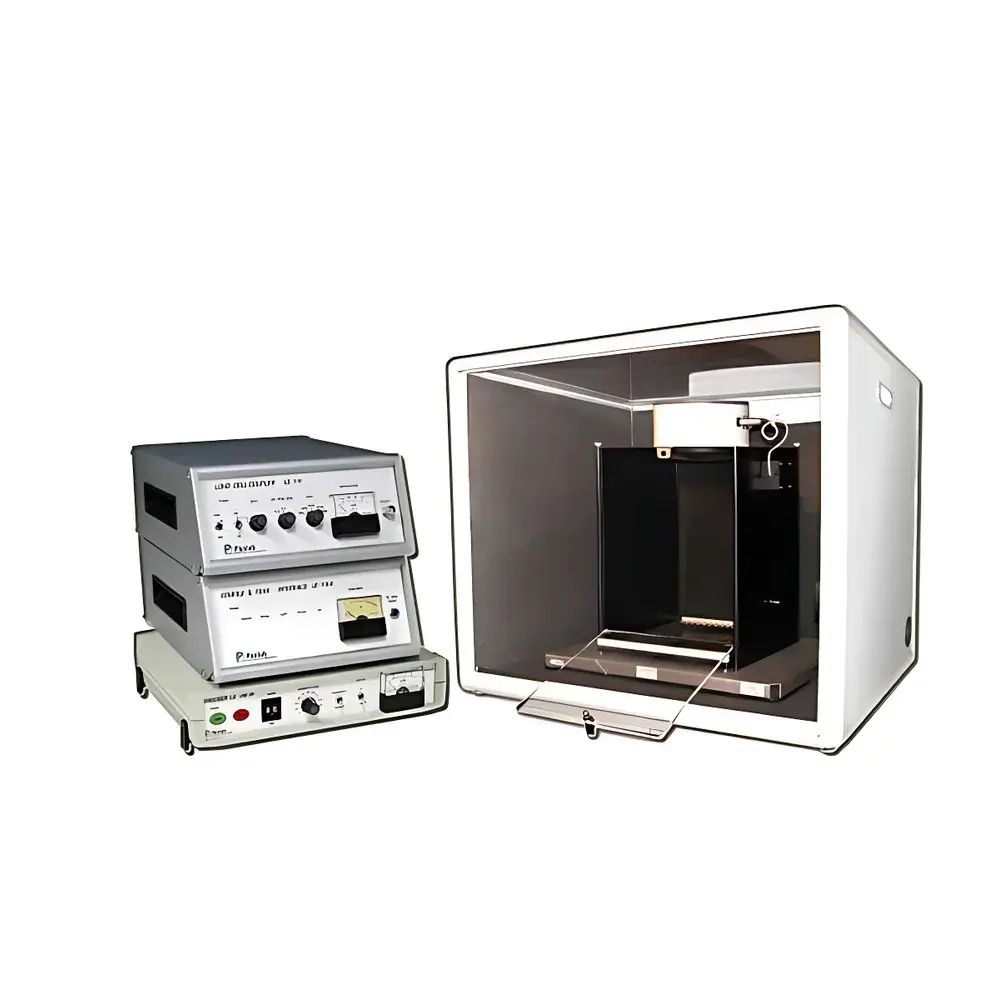
Panlab LE116 Fear Conditioning and Acoustic Startle Response System with Prepulse Inhibition (PPI)
| Origin | Spain |
|---|---|
| Manufacturer Type | Authorized Distributor |
| Origin Category | Imported |
| Model | LE116 |
| Price | USD 14,000 (approx.) |
| Sensor Sensitivity | 10 mg – 2 kg |
| Chamber Dimensions | 250 × 250 × 250 mm (W×D×H) |
| Sound Frequency Range | 200–10,000 Hz |
| Sound Intensity | Up to 120 dB SPL |
| White Noise Range | 60–120 dB SPL |
| Max Channels per PC | 8 |
| Floor Grid Options | 6 mm or 10 mm spacing |
| Construction Materials | Sandwiched acrylic, aluminum alloy, stainless steel |
| Compliance | CE Marked |
| Power Supply | 110/220 V, 50/60 Hz |
| Animal Weight Range | 15–500 g |
| Software | PACKWIN V2.0 with STARTLE and FREEZING modules |
| Optional Hardware | Pneumatic startle (LE119), electric shock generator (LE10026), environmental configuration kits (LE115), species-specific restraints (LE117 series), stimulus interface modules (LE118 / LE1188) |
Overview
The Panlab LE116 Fear Conditioning and Acoustic Startle Response System with Prepulse Inhibition (PPI) is a fully integrated, modular platform engineered for high-fidelity behavioral phenotyping in rodent models. It combines two foundational paradigms—classical fear conditioning and acoustic startle response measurement—within a single, acoustically isolated chamber architecture. The system operates on the principle of quantifying motor suppression (freezing) as an index of associative learning and memory consolidation, and measuring amplitude modulation of the acoustic startle reflex to assess sensorimotor gating integrity. These endpoints are grounded in well-established neurobehavioral constructs: freezing behavior reflects amygdala-hippocampal-prefrontal circuit engagement during contextual or cued fear memory retrieval, while PPI is a robust translational biomarker of pre-attentive information filtering, widely validated in studies of schizophrenia, autism spectrum disorders, Huntington’s disease, and age-related cognitive decline. The LE116 employs high-resolution gravimetric transduction—via a calibrated load cell with 10 mg detection threshold—to capture minute postural shifts and immobility episodes without optical occlusion or tethering artifacts, ensuring compatibility with longitudinal, low-stress experimental designs.
Key Features
- Unified chamber design supporting both fear conditioning and startle/PPI protocols without hardware reconfiguration
- High-sensitivity gravity-based motion detection system (10 mg–2 kg dynamic range), eliminating reliance on video tracking or infrared beam interruption
- Software-controlled auditory stimulation: precise frequency (200–10,000 Hz) and intensity (up to 120 dB SPL) adjustment for pulse, prepulse, and background white noise delivery
- Modular stimulus delivery: programmable integration of visual (LED), tactile (pneumatic air puff via LE119), and aversive (electric foot shock via LE10026) modalities
- Configurable environmental geometry: interchangeable floor grids (6 mm or 10 mm spacing), wall panels, and optional cylindrical enclosures (via LE115 kit) for context discrimination assays
- Multi-species adaptability: validated for mice (15–50 g) and rats (100–500 g) using dedicated restraint fixtures (LE117M, LE117R, LE117RR)
- Eight-channel scalability: synchronized acquisition across up to eight independent chambers via USB-connected LE118 or LE1188 stimulus interface modules
- CE-compliant electromagnetic and acoustic shielding; integrated sound-dampening enclosure (670 × 530 × 550 mm)
Sample Compatibility & Compliance
The LE116 accommodates rodents within a physiologically relevant weight range (15–500 g), supporting developmental, aging, and disease-model cohorts. Its non-invasive gravimetric sensing ensures minimal handling stress and avoids interference from fur pigmentation, ambient lighting, or cage bedding variability—common confounds in video-based freezing analysis. All hardware components meet EU Directive 2014/30/EU (EMC) and 2014/35/EU (LVD), bearing the CE mark for laboratory use. Experimental protocols align with NIH Guide for the Care and Use of Laboratory Animals and OECD Test Guideline 426 (Neurotoxicity Study). Data acquisition and parameter logging support GLP-compliant workflows when used with PACKWIN’s audit-trail-enabled configuration, including user authentication, timestamped protocol versions, and immutable raw signal archiving.
Software & Data Management
PACKWIN V2.0 serves as the central control and analysis environment, offering native support for both STARTLE and FREEZING experiment modules. The software features a graphical protocol editor enabling precise temporal sequencing of stimuli (e.g., inter-trial intervals, prepulse–pulse onset asynchrony, shock–tone contingencies), with real-time waveform visualization and offline event annotation. Raw force transducer signals are sampled at ≥1 kHz and stored in HDF5 format for interoperability with MATLAB, Python (via h5py), or R. Built-in algorithms compute freezing duration (defined as <0.5 g force variance over 1 s windows), startle amplitude (peak force deviation within 100 ms post-pulse), %PPI [(pulse-alone − prepulse+pulse)/pulse-alone × 100], and habituation slopes. Export options include CSV, Excel, and XML metadata files compliant with MIAME and BIDS-BEH extensions for multisite data harmonization.
Applications
- Translational neuroscience: evaluation of sensorimotor gating deficits in genetic, pharmacological, or lesion-based models of psychiatric and neurological disorders
- Drug discovery: dose–response characterization of NMDA antagonists (e.g., MK-801), dopamine D2 modulators, GABAergic agents, and novel cognitive enhancers
- Aging research: longitudinal assessment of hippocampal-dependent contextual memory decay and striatal-mediated habituation deficits
- Toxicology screening: detection of subtle neurobehavioral perturbations following subchronic exposure to environmental neurotoxicants
- Behavioral genetics: high-throughput phenotyping of knockout/knockin lines for anxiety-, learning-, or attention-related endophenotypes
- Method validation: benchmarking against gold-standard assays such as Morris water maze or elevated plus maze in cross-paradigm correlation studies
FAQ
Can the LE116 be used for both mice and rats in the same experimental session?
Yes—the system supports concurrent multi-species operation via channel-specific calibration and restraint selection (e.g., LE117M for juvenile mice, LE117RR for adult rats), with independent parameter sets per channel.
Is PACKWIN software compatible with Windows 10/11 and MATLAB-based custom analysis pipelines?
Yes—PACKWIN V2.0 runs natively on 64-bit Windows 10/11 and exports time-stamped, channel-synchronized HDF5 datasets readable by MATLAB, Python, and R without proprietary runtime dependencies.
How is data integrity ensured during long-duration fear conditioning experiments (e.g., 24-h retention tests)?
The system logs all hardware events (stimulus onset/offset, door actuation, sensor saturation flags) with microsecond precision; raw force traces are continuously buffered to SSD storage with automatic crash recovery.
Does the LE116 meet regulatory requirements for preclinical contract research organization (CRO) submissions?
When deployed under validated SOPs—including daily sensor calibration checks, environmental monitoring (temperature/humidity logs), and electronic signature-enabled protocol approval—the system satisfies FDA 21 CFR Part 11 and ISO/IEC 17025 documentation expectations for regulated studies.
Can third-party stimuli (e.g., custom audio files or TTL-triggered external devices) be integrated?
Yes—LE1188 supports TTL input/output synchronization, and PACKWIN accepts WAV-formatted auditory stimuli imported at user-defined sampling rates (up to 192 kHz) with frame-accurate playback scheduling.





