
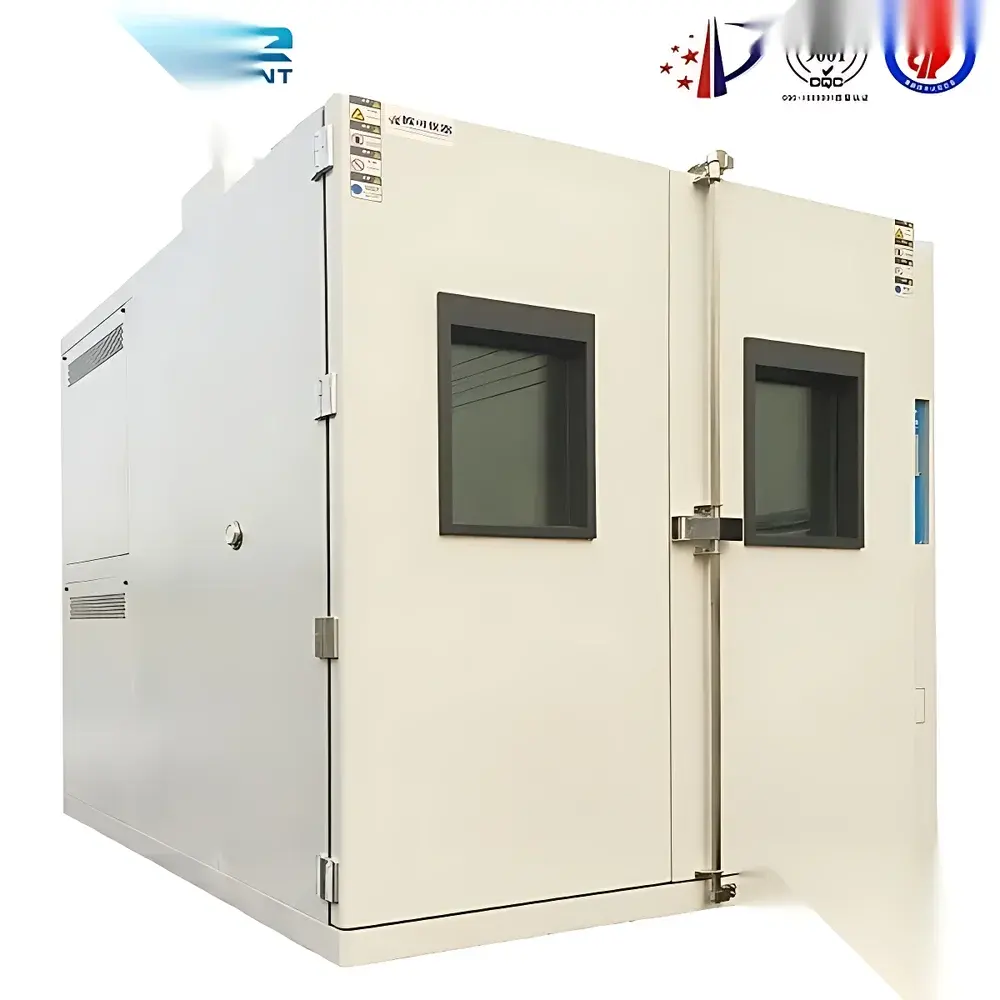
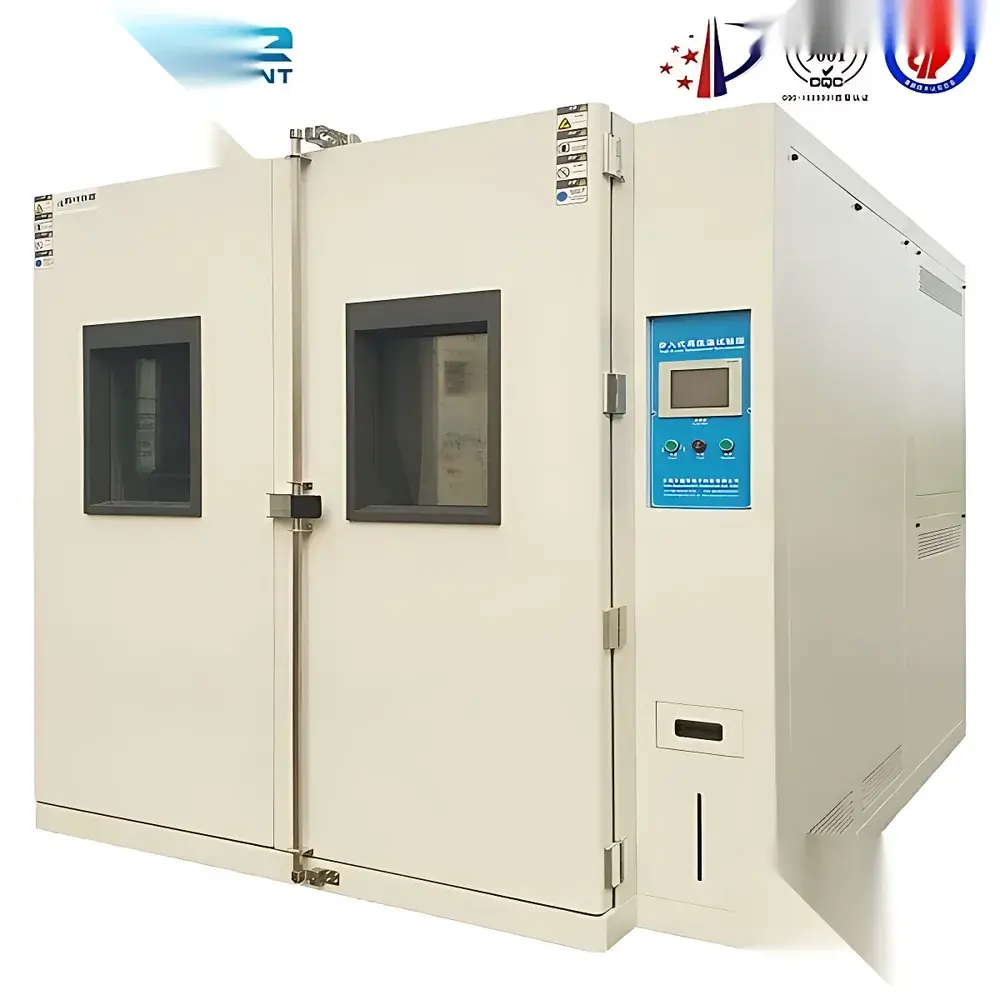
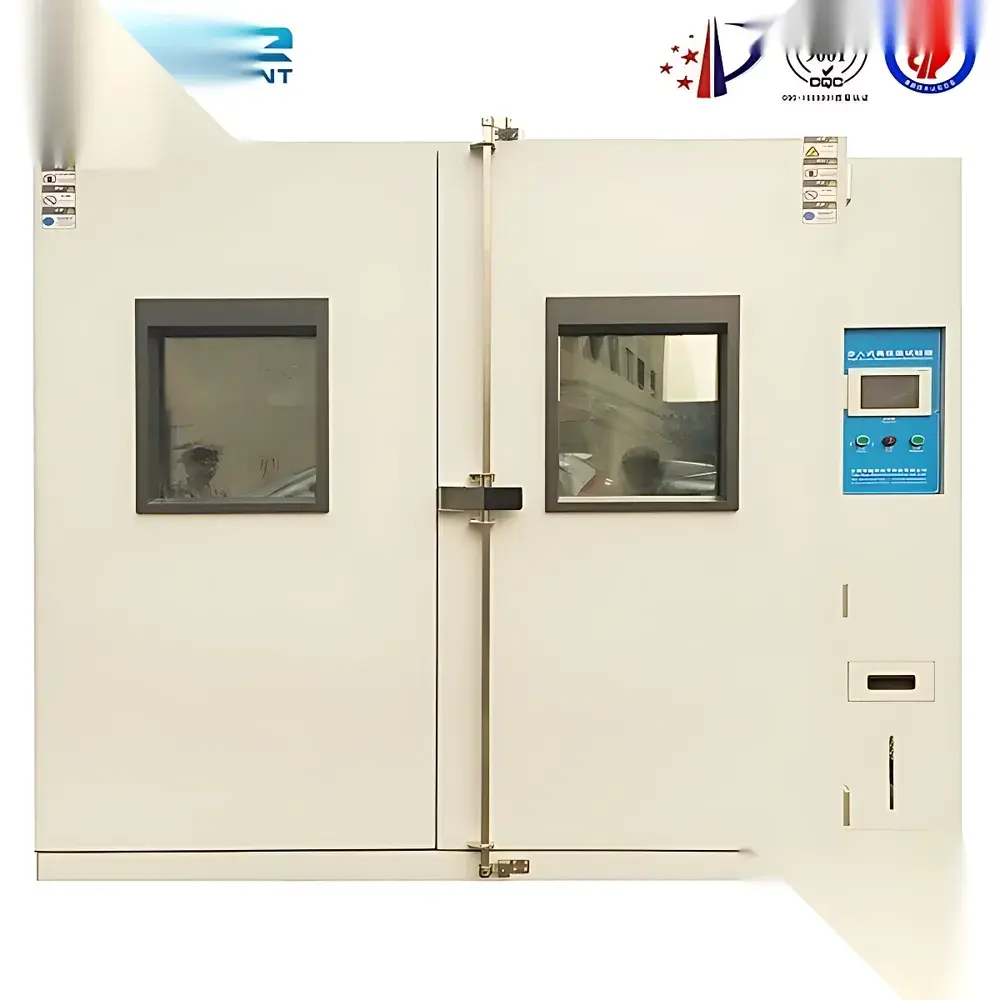
OK-TH Series Full-Vehicle Environmental Simulation Chamber (Temperature & Humidity Controlled)
| Brand | OK |
|---|---|
| Model Range | OK-TH-100, OK-TH-225, OK-TH-500, OK-TH-800, OK-TH-1000 |
| Internal Dimensions (W×H×D) | 1000×1000×1200 mm (OK-TH-1000) |
| External Dimensions (W×H×D) | 2140×1430×1490 mm (OK-TH-1000) |
| Construction | Interior – Mirror-finish SUS#304 stainless steel |
| Insulation | 100 mm polyurethane rigid foam + glass wool composite |
| Door | Single left-hinged door with dual-layer silicone gasket seal |
| Viewing Window | Triple-layer vacuum-insulated glass (300×400×40 mm) with anti-condensation heater |
| Lighting | High-luminance LED interior lamp |
| Test Ports | Two Ø100 mm ports on left side with stainless steel covers and silicone plugs |
| Mobility | Casters with locking bolts |
| Power Supply | AC 380 V, 20.0 kW (OK-TH-1000) |
| Communication Interface | RS-232C (9-pin D-sub) |
Overview
The OK-TH Series Full-Vehicle Environmental Simulation Chamber is an industrial-grade climatic test system engineered for comprehensive thermal and humidity performance evaluation of complete automotive assemblies, including passenger vehicles, EV powertrain modules, ADAS sensor housings, and battery enclosures. Unlike component-level chambers, this series is specifically designed to accommodate full-scale vehicle geometries—enabling real-world thermal stress mapping, condensation analysis, HVAC validation, and cold-start reliability testing under controlled ISO 16750-4, SAE J2344, and IEC 60068-2 environmental profiles. The chamber employs a dual-refrigeration cascade system coupled with precision PID-controlled steam humidification and electric heating elements to achieve stable temperature ranges from −70 °C to +150 °C and humidity control from 10% to 98% RH (at ≥20 °C), with ramp rates programmable up to 10 °C/min. Its structural architecture integrates thermal inertia management via 100 mm high-density insulation and a patented isothermal cavity design that minimizes thermal bridging and eliminates ceiling condensation—critical for long-duration soak tests where dew-point stability directly impacts sensor calibration integrity.
Key Features
- Full-vehicle footprint compatibility: Standard models support internal volumes up to 1.2 m³ (OK-TH-1000), accommodating compact EVs or multi-axis test rigs with integrated data acquisition harnesses.
- Triple-vacuum observation window (300×400×40 mm): Provides distortion-free optical access while maintaining thermal isolation; integrated anti-fog heater ensures uninterrupted visual monitoring during sub-zero transitions.
- Dual-seal door assembly: Stainless steel frame with dual-silicone compression gaskets (SUS#304) achieves ≤0.5 K/m²·K thermal transmittance (U-value), verified per EN 12567-1.
- Modular test port configuration: Two Ø100 mm pass-throughs on the left wall—equipped with removable stainless steel flanges and high-compliance silicone plugs—facilitate integration with external power supplies, CAN bus analyzers, or thermocouple arrays without compromising chamber integrity.
- RS-232C serial interface (9-pin D-sub): Enables bidirectional communication with LabVIEW, MATLAB, or custom SCADA systems for automated profile execution, real-time parameter logging, and compliance-ready audit trails.
- Mobile base with locking casters: Allows precise repositioning within production labs or validation bays; includes adjustable leveling feet for vibration-isolated operation adjacent to shaker tables or dynamometers.
Sample Compatibility & Compliance
The OK-TH chamber accommodates full-size automotive platforms—including hatchbacks, SUVs, and light commercial vehicles—with unobstructed floor clearance and overhead height sufficient for roof-mounted LiDAR or camera arrays. Its interior mirror-finish SUS#304 stainless steel surfaces resist corrosion from salt fog, brake fluid vapors, and battery electrolyte off-gassing. All thermal profiles comply with ASTM D4332 (conditioning of plastics), ISO 16750-4 (road vehicles—environmental conditions), and MIL-STD-810H Method 502.7 (low temperature) and Method 507.6 (humidity). Optional validation packages support IQ/OQ documentation aligned with FDA 21 CFR Part 11 requirements for GxP-regulated R&D environments.
Software & Data Management
The embedded controller supports up to 100 programmable test cycles with nested step-ramp-soak sequences, each storing setpoints, actual readings, and alarm logs with timestamped UTC metadata. Data export is available in CSV or Excel-compatible formats via USB or RS-232C. For enterprise integration, optional Ethernet-enabled firmware (OK-TH-Net) adds Modbus TCP and OPC UA support—enabling traceability across LIMS and MES platforms. Audit trail functionality records all user actions (e.g., profile edits, manual overrides, calibration events) with operator ID and IP address—meeting GLP/GMP electronic record retention mandates.
Applications
- Automotive thermal management validation: Battery pack thermal runaway propagation studies, cabin HVAC airflow optimization, and power electronics cooling efficiency assessment under combined hot/humid and cold/dry extremes.
- ADAS sensor environmental robustness: Radar lens fogging resistance, camera module focus drift quantification, and ultrasonic transducer signal attenuation analysis across temperature gradients.
- EV drivetrain endurance: Motor winding insulation aging under cyclic thermal stress, inverter IGBT junction temperature hysteresis, and DC-DC converter efficiency mapping at −40 °C startup.
- Regulatory conformance testing: ISO 16750-4 cold soak verification, SAE J1739 thermal shock qualification, and UN ECE R100 battery safety certification pre-testing.
- Materials development: Polymer shrinkage/swelling behavior in sealed vehicle interiors, adhesive bond strength degradation at elevated humidity, and coating delamination kinetics under UV-thermal cycling (when paired with optional UV lamp modules).
FAQ
What is the maximum vehicle width supported by the OK-TH-1000 chamber?
The internal width is 1000 mm, but with optimized positioning and removal of non-essential interior fixtures, vehicles up to 950 mm wide (e.g., Toyota Yaris, BYD Atto 3) can be accommodated while preserving required air circulation margins.
Does the chamber meet ISO 17025 calibration traceability requirements?
Yes—the standard configuration includes NIST-traceable PT100 sensors (Class A tolerance) and factory calibration certificates. Optional on-site verification by ISO/IEC 17025-accredited third parties is available upon request.
Can the RS-232C interface support real-time data streaming to Python-based analytics platforms?
Yes—ASCII protocol documentation and sample PySerial scripts are provided. Baud rate is configurable from 9600 to 115200, with CRC-16 error checking enabled by default.
Is remote monitoring possible without physical PC connection?
Not in base configuration; however, the optional OK-TH-Net upgrade enables secure HTTPS web interface access and SNMP v3 alerts via standard Ethernet infrastructure.
What maintenance intervals are recommended for the refrigeration system?
Compressor oil and filter replacement every 24 months; annual inspection of cascade stage pressure differentials and refrigerant charge verification per ASHRAE Guideline 3-2021.
Related Products



