
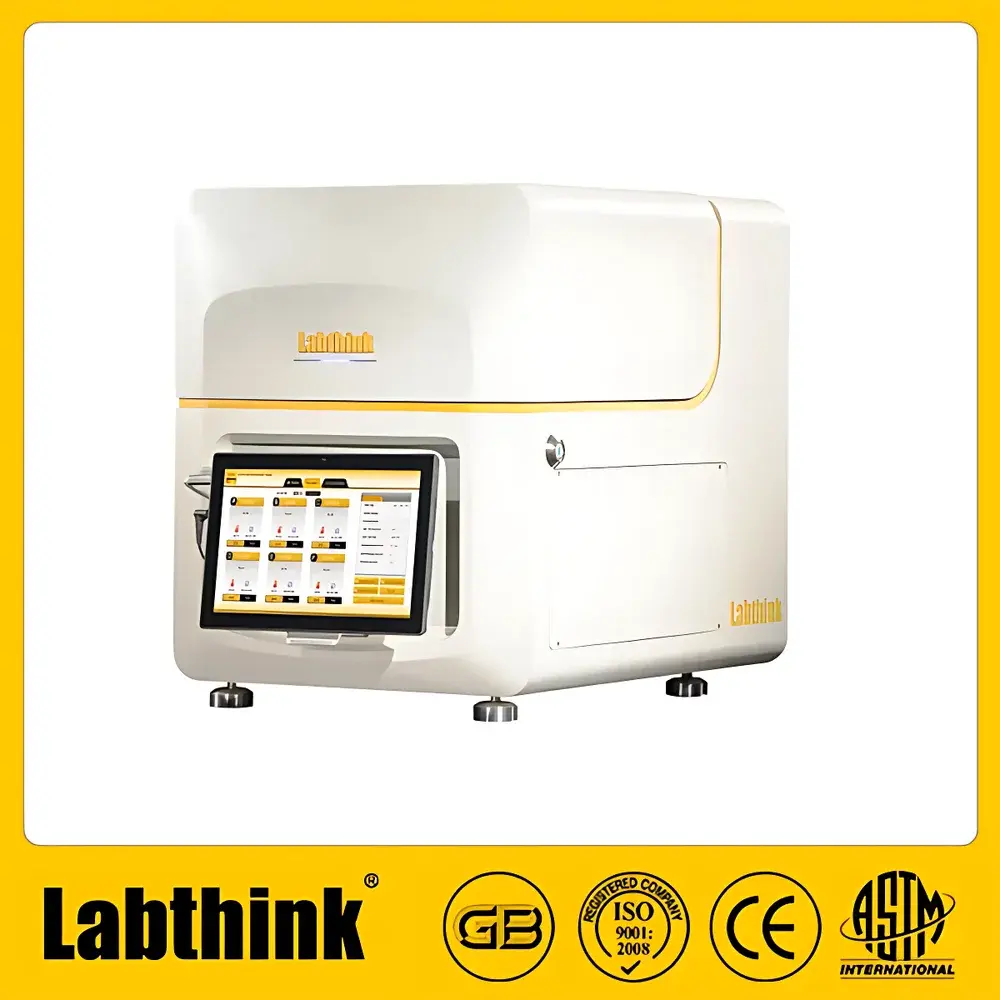
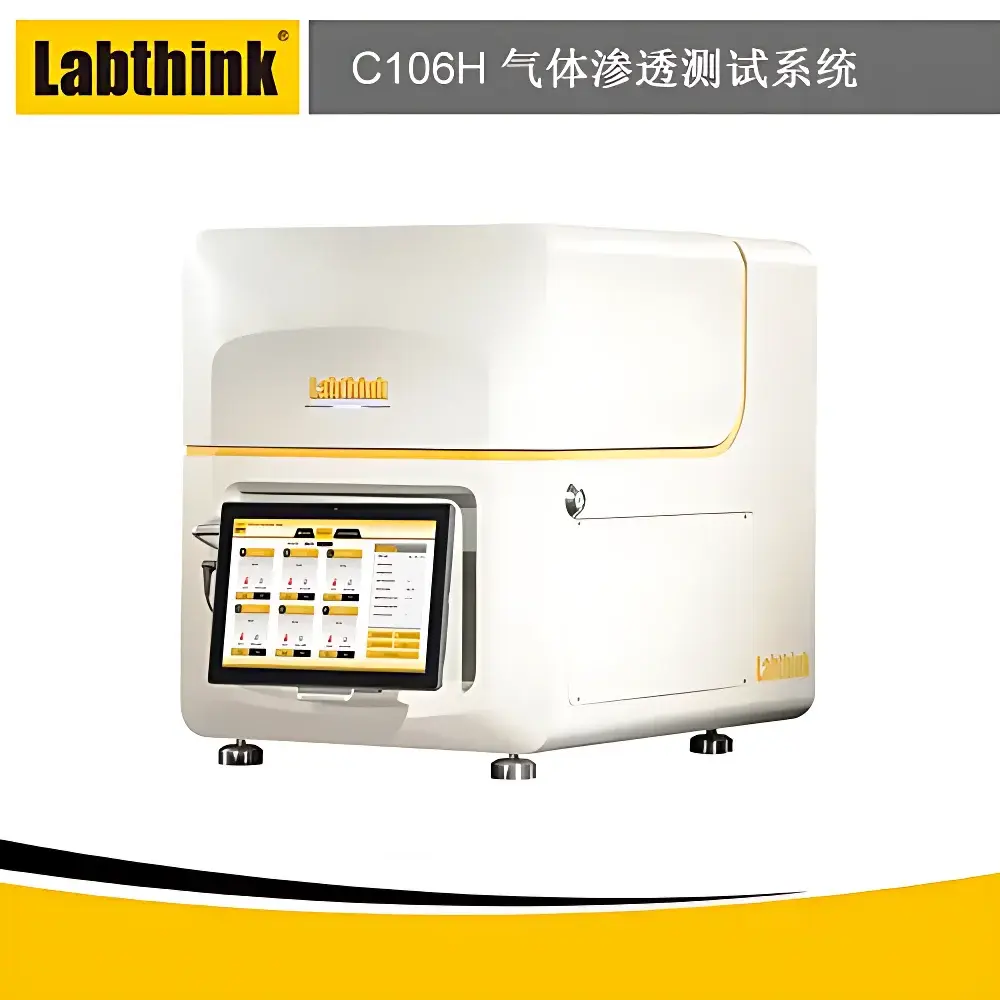
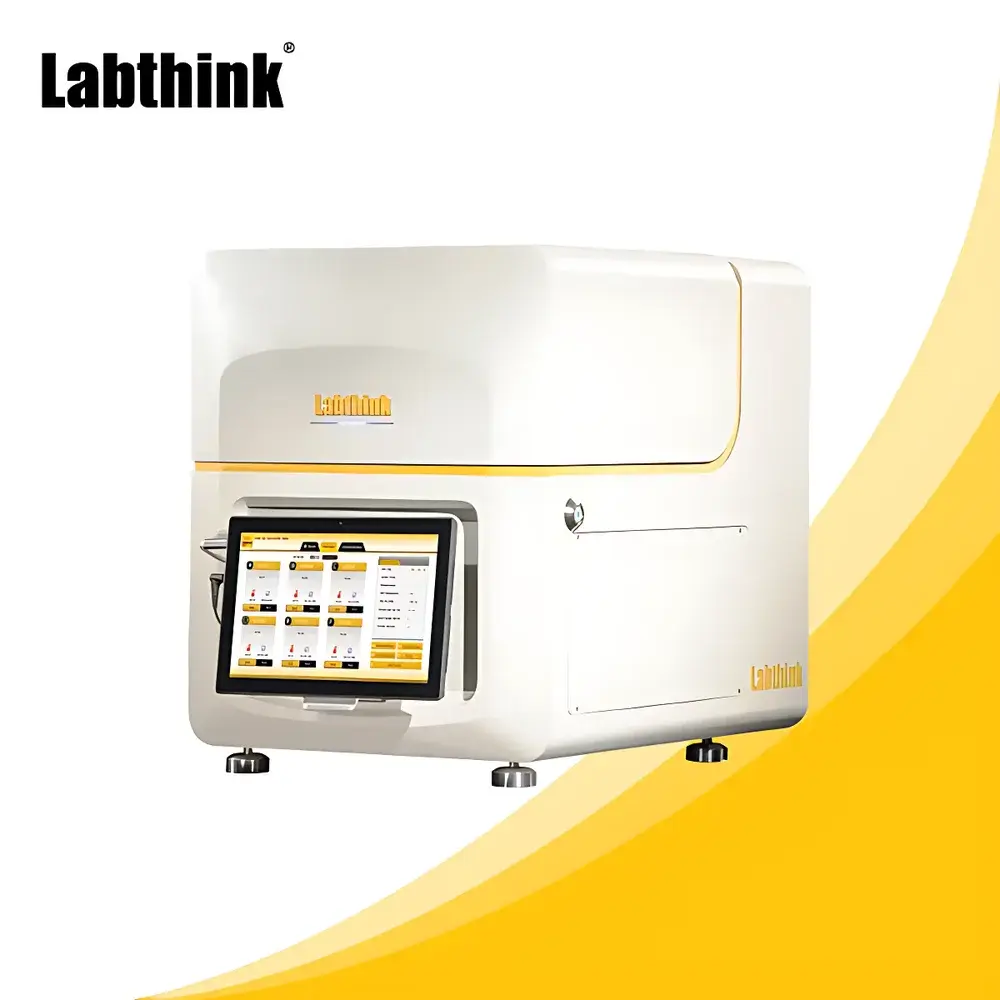
Labthink C106H Gas Permeability Tester for Pharmaceutical Foil Packaging and Thin-Film Barrier Evaluation
| Brand | Labthink |
|---|---|
| Model | C106H |
| Principle | Differential Pressure Method (ISO 15105-1, ASTM D1434) |
| Test Range | 0.01–50,000 cm³/m²·24h·0.1MPa |
| Resolution | 0.001 cm³/m²·24h·0.1MPa |
| Temperature Range | 15–50 °C (5–60 °C optional) |
| Temp. Stability | ±0.15 °C |
| Vacuum Resolution | 0.01 Pa |
| Vacuum Accuracy | ±0.2% of reading (1–100% of sensor span) |
| Test Chamber Vacuum Level | ≤10 Pa |
| Chamber Count | 6 independent cavities |
| Standard Test Area | 38.48 cm² |
| Sample Size | 11.2 cm × 11.2 cm |
| Max. Sample Thickness | 3 mm |
| Test Gases | O₂, N₂, CO₂ (H₂/CH₄ available on custom configuration) |
| Test Pressure | 10–150 kPa (adjustable, ΔP stability <0.2 kPa) |
| Power Supply | 120 VAC ±10% 60 Hz / 220 VAC ±10% 50 Hz |
| Net Weight | 100 kg |
| Dimensions | 600 × 490 × 660 mm |
Overview
The Labthink C106H Gas Permeability Tester is an engineered differential pressure–based barrier characterization system designed for precise quantification of gas transmission rates (GTR), permeability coefficients (P), diffusion coefficients (D), and solubility coefficients (S) in flexible packaging materials—particularly pharmaceutical-grade aluminum foil laminates, high-barrier polymer films, and composite sheets. Operating in strict accordance with ISO 15105-1, ISO 2556, ASTM D1434, GB/T 1038-2000, JIS K7126-1, and YBB 00082003, the instrument delivers metrologically traceable results essential for regulatory submissions, shelf-life modeling, and packaging qualification under ICH Q5C and USP <671>. Its core measurement principle relies on establishing a stable, user-defined partial pressure gradient across a conditioned specimen sealed between two isolated chambers: a high-pressure test gas chamber (upper) and a vacuum-evacuated detection chamber (lower). Real-time monitoring of pressure rise in the low-pressure side—via calibrated, imported vacuum transducers—enables calculation of steady-state gas flux using Fick’s first law of diffusion, corrected for temperature, pressure, and specimen geometry.
Key Features
- Six independently controlled test chambers—triple the throughput of conventional single- or dual-cavity systems—enabling concurrent evaluation of six specimens under identical environmental conditions, with full data independence and statistical reproducibility.
- Rainbow Bridge™ test chamber architecture with 360° circumferential air circulation and PID-controlled thermal management ensures uniform temperature distribution (±0.15 °C stability) across all cavities, critical for low-drift, high-precision measurements of ultra-high-barrier materials (e.g., AlOx-coated PET, SiOx-laminated foils).
- Imported high-resolution vacuum sensors (0.01 Pa resolution) and ultra-low-leakage pneumatic actuation system guarantee long-term seal integrity and measurement fidelity down to 0.01 cm³/m²·24h·0.1MPa—validated per ISO 5725 for repeatability and intermediate precision.
- Automated pressure compensation algorithm maintains constant upstream test pressure (10–150 kPa range) with deviation <0.2 kPa throughout the test cycle, eliminating manual intervention and minimizing operator-induced variability.
- Integrated 12-inch Windows-based touch interface enables one-touch initiation of standardized test protocols—including automatic sample clamping, vacuum ramping, gas charging, and real-time curve plotting—reducing operator training time and procedural error.
- Modular hardware design supports optional CFR 21 Part 11–compliant audit trail, electronic signatures, and DataShield™ secure data archiving—fully aligned with GMP/GLP documentation requirements for pharmaceutical packaging validation.
Sample Compatibility & Compliance
The C106H accommodates flat, non-porous sheet and film specimens up to 3 mm thick and 11.2 cm × 11.2 cm in dimension—including aluminum foil composites, PVDC-coated substrates, metallized polypropylene, glassine-laminated papers, rubber gaskets, and silicon wafers used in medical device packaging. It meets mandatory testing criteria outlined in FDA Guidance for Industry: Container Closure Systems for Packaging Human Drugs and Biologics (2022), EMA CHMP Reflection Paper on Quality of Inhalation and Nasal Products (2021), and ISO 11607-1:2019 for sterile barrier systems. All firmware and calibration routines are documented per ISO/IEC 17025:2017 and support third-party verification against NIST-traceable pressure and temperature standards.
Software & Data Management
The embedded Labthink Permeation Suite v4.2 provides ISO 17025–aligned data acquisition, visualization, and reporting. It generates time-resolved permeation curves (pressure vs. time), calculates derived parameters (P, D, S) with uncertainty propagation, and exports raw and processed data in CSV, PDF, and XML formats compliant with ALCOA+ principles. Optional CFR 21 Part 11 add-on enables role-based access control, electronic signatures, immutable audit trails, and automated backup to network-attached storage—fully supporting FDA inspection readiness and internal quality audits. Calibration logs, maintenance records, and instrument qualification reports (IQ/OQ/PQ templates included) are stored within the same secure framework.
Applications
- Quantitative validation of nitrogen purge efficacy in blister foil lidding for moisture- and oxygen-sensitive APIs (e.g., biologics, peptides, nitroglycerin tablets).
- Comparative assessment of alternative barrier coatings (e.g., SiOₓ vs. AlOₓ) during packaging material development for extended-shelf-life injectables.
- Accelerated aging correlation studies linking accelerated permeation at elevated temperatures (per ASTM F1980) to real-time stability data.
- Root cause analysis of package failure events—e.g., unexpected discoloration or potency loss—by correlating measured O₂ transmission rates with headspace gas chromatography results.
- Supporting regulatory filings for combination products requiring ISO 11607-2:2019-compliant barrier performance evidence.
FAQ
What gases can be tested with the C106H system?
Standard configurations support O₂, N₂, and CO₂. Custom modifications enable safe operation with H₂ and CH₄ under validated engineering controls—subject to site-specific risk assessment and local safety authority approval.
Is the system suitable for testing multi-layer laminates with adhesive interlayers?
Yes. The C106H has demonstrated reliable performance on complex structures including PET/Al/PE, CPP/Al/PVC, and paper-Al-PE laminates, provided surface flatness and dimensional stability meet ISO 15105-1 specimen preparation guidelines.
How does the system ensure compliance with FDA 21 CFR Part 11?
When equipped with the optional CFR 21 Part 11 module, the system enforces electronic signature workflows, automated audit trails covering all data modifications, and secure user authentication—fully auditable during FDA pre-approval inspections.
Can test temperature be varied during a single run?
No. Each test executes at a fixed, user-specified temperature. However, sequential tests across a defined temperature gradient (e.g., 25 °C → 40 °C → 50 °C) can be scheduled automatically to generate Arrhenius plots for activation energy determination.
What maintenance is required to sustain measurement accuracy?
Routine tasks include quarterly vacuum sensor recalibration using certified reference standards, annual vacuum pump oil replacement, and biannual verification of chamber seal integrity via helium leak testing—procedures fully documented in the included Maintenance Manual and supported by Labthink’s global service network.




