
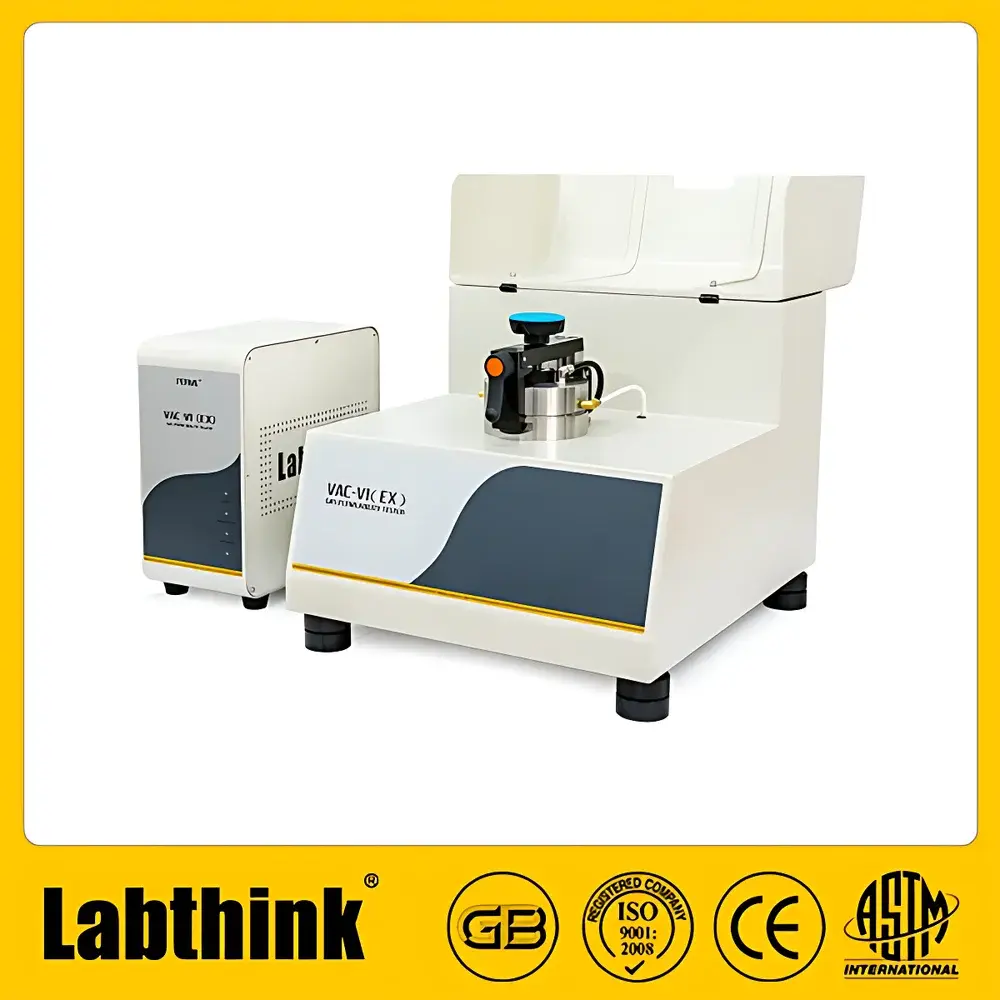
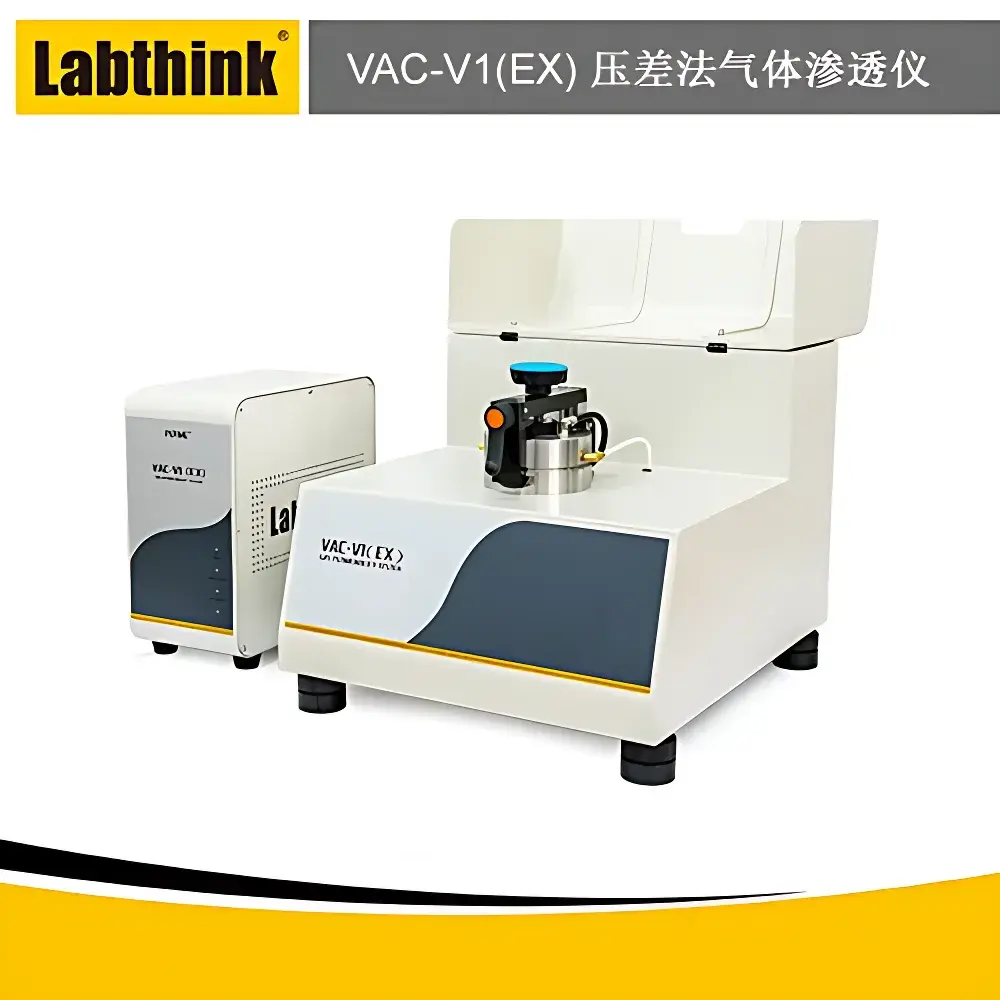
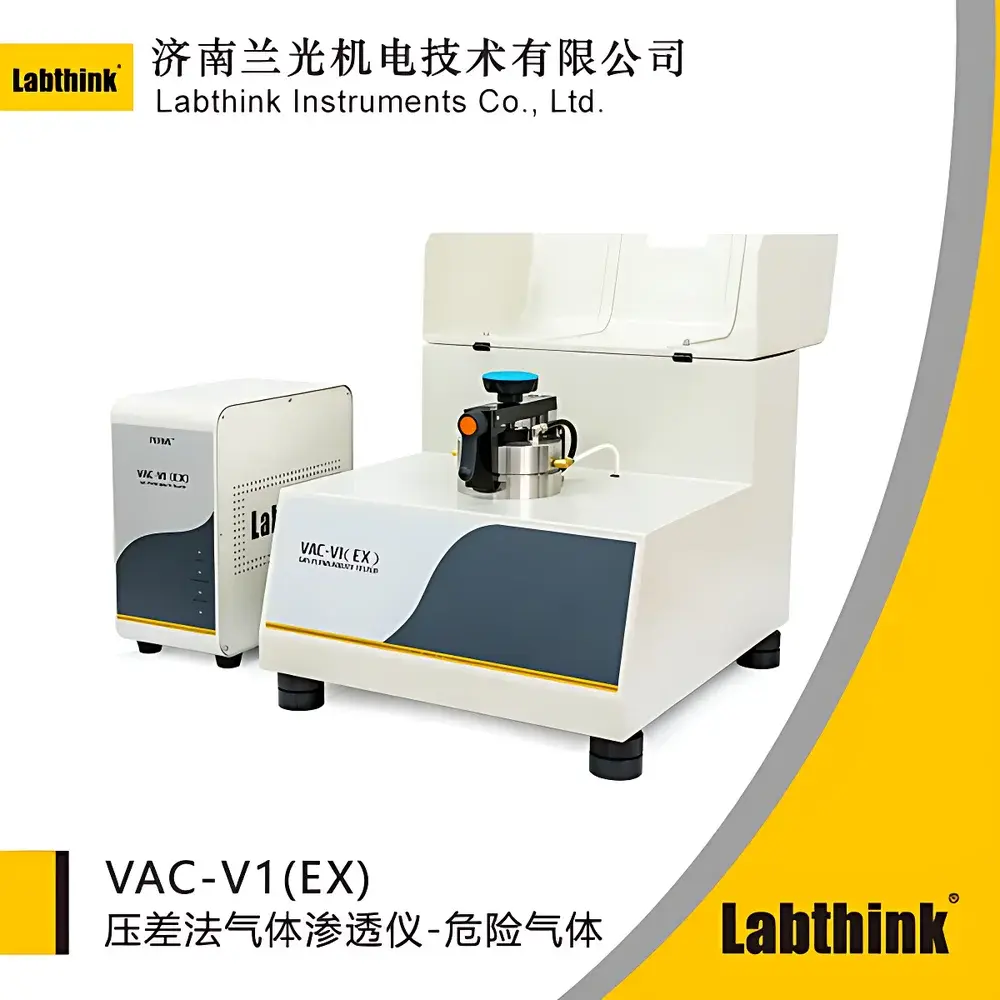
Labthink VAC-V1(EX) Differential Pressure Gas Permeability Analyzer for IV Bags and Pharmaceutical Packaging Films
| Brand | Labthink |
|---|---|
| Origin | Shandong, China |
| Manufacturer Type | Direct Manufacturer |
| Country of Origin | China |
| Model | VAC-V1(EX) |
| Price Range | USD 14,000 – 70,000 |
| Testing Principle | Differential Pressure (Manometric) Method |
| Compliance | ISO 15105-1, ISO 2556, ASTM D1434, GB/T 1038-2000, JIS K7126-1, YBB 00082003 |
| Temperature Control Range | 5–95 °C (±0.1 °C stability) |
| Vacuum Resolution | 0.1 Pa |
| Test Chamber Vacuum Level | ≤10 Pa |
| Sample Area | 38.48 cm² (Ø97 mm) |
| Gas Permeation Range | 0.05–50,000 cm³/m²·24h·0.1MPa (extendable to ≥500,000 cm³/m²·24h·0.1MPa) |
| Test Gases | O₂, N₂, CO₂, H₂, air, He |
| Operating Pressure Differential | 10–200 kPa |
| Gas Inlet | Ø6 mm polyurethane tubing |
| Power Supply | AC 220 V, 50 Hz |
| Dimensions | 500 × 575 × 450 mm (L×W×H) |
| Net Weight | 50 kg |
Overview
The Labthink VAC-V1(EX) Differential Pressure Gas Permeability Analyzer is an engineered solution for precise, traceable, and safe measurement of gas transmission rates—particularly oxygen transmission rate (OTR) and nitrogen transmission rate (NTR)—in flexible pharmaceutical packaging materials. Designed specifically for regulatory-grade evaluation of large-volume intravenous (IV) bags, infusion films, and high-barrier laminates, the instrument operates on the differential pressure (manometric) principle per ISO 15105-1 and ASTM D1434. In this method, a conditioned specimen is sealed between two isolated chambers; the lower chamber is evacuated to high vacuum (≤10 Pa), while the upper chamber is pressurized with test gas (e.g., O₂ or N₂) at a precisely controlled differential pressure (10–200 kPa). Gas permeating through the film increases pressure in the low-pressure chamber, which is monitored via high-resolution capacitance manometers (0.1 Pa resolution). Real-time pressure rise data are used to calculate OTR, NTR, permeability coefficient (P), diffusion coefficient (D), and solubility coefficient (S) using Fickian transport models.
Key Features
- Explosion-safe, fully isolated architecture: Separated control unit and test host eliminate electrical hazards during testing of flammable gases (e.g., H₂, CH₄) or toxic media—critical for GLP-compliant labs handling Class I/II hazardous atmospheres.
- Dual-mode process logic: Integrates proportional control and fuzzy logic algorithms to dynamically stabilize test conditions and minimize drift during long-duration measurements (up to 168 h).
- High-stability thermal management: Liquid-circulated temperature controller maintains ±0.1 °C uniformity across 5–95 °C, enabling Arrhenius-based modeling of temperature-dependent barrier performance.
- Modular range extension: Optional high-capacity sensor modules support extended permeation ranges up to ≥500,000 cm³/m²·24h·0.1MPa—essential for low-barrier materials such as PE monolayers or biodegradable starch films.
- Automated calibration workflow: Pre-characterized standard reference membranes (certified per ISO 15105-2) enable rapid system verification and inter-laboratory data harmonization.
- Full digital audit trail: All test parameters, environmental logs, operator IDs, and raw pressure-time datasets are timestamped and stored in immutable format compliant with FDA 21 CFR Part 11 requirements.
Sample Compatibility & Compliance
The VAC-V1(EX) accommodates flat, flexible specimens up to Ø97 mm (38.48 cm² effective area), including multilayer coextrusions, AlOx/SiOx-coated PET, PVDC-laminated films, foil composites, and elastomeric IV bag substrates (e.g., PVC, TPE, polyolefin blends). It meets the physical and procedural requirements of pharmacopoeial standards including YBB 00082003 (Chinese Pharmacopoeia), USP , and EP 2.9.17. Data generated satisfy ICH Q5C stability protocol requirements for primary packaging qualification. Instrument validation documentation supports IQ/OQ/PQ execution per ASTM E2500 and ISO/IEC 17025:2017 accreditation frameworks.
Software & Data Management
Lystem™ v3.0 software provides full instrument control, real-time curve visualization, multi-parameter regression fitting (e.g., Arrhenius, van’t Hoff), and automated report generation in PDF/A-1b and CSV formats. Integrated Lystem Cloud enables centralized data governance across distributed QC laboratories, with role-based access control, electronic signatures, and version-controlled SOP linking. Raw datasets retain native time-stamped pressure readings (10 Hz sampling), supporting retrospective reprocessing and uncertainty analysis per GUM (JCGM 100:2008). Export interfaces include RS232, Ethernet TCP/IP, and OPC UA for MES/ERP integration.
Applications
- Pharmaceutical packaging: OTR/NTR quantification for IV bags, pre-filled syringe blisters, and cold-chain pouches under accelerated aging conditions (e.g., 40 °C/75% RH).
- Regulatory submission support: Generation of stability-indicating barrier data for ANDA, NDA, and MAA dossiers requiring demonstration of container closure integrity.
- Material development: Diffusion/permeability coefficient profiling of novel barrier coatings (e.g., graphene oxide nanocomposites) and bio-based films (PLA, PHA, starch blends).
- Aerospace & specialty packaging: Helium permeation testing of inflatable structures (e.g., stratospheric balloon envelopes) and hydrogen barrier assessment for fuel cell membrane substrates.
- Quality control: Routine release testing of incoming roll stock against AQL-based acceptance criteria per ISO 2859-1.
FAQ
What gas sources are required for operation?
Users must supply regulated, oil-free, and particle-filtered gas (O₂, N₂, CO₂, H₂, or air) at 0.5–0.6 MPa inlet pressure via Ø6 mm polyurethane tubing. Compressed air or lab-grade gas cylinders with dual-stage regulators are recommended.
Is distilled water needed during testing?
Yes—distilled water is used in the liquid temperature bath circuit. It must be deionized and replaced periodically to prevent scaling and ensure thermal stability.
Can the instrument perform simultaneous multi-gas testing?
No—each test run is gas-specific. However, sequential tests (e.g., O₂ → N₂ → CO₂) can be scheduled automatically with gas-line purging protocols to prevent cross-contamination.
Does the system support 21 CFR Part 11 compliance out-of-the-box?
Yes—Lystem™ v3.0 includes electronic signature workflows, audit log encryption, and user permission tiers validated per Annex 11 and ALCOA+ principles.
What maintenance intervals are recommended?
Vacuum pump oil replacement every 500 operating hours; O-rings and sealing gaskets inspected quarterly; annual recalibration with certified reference membranes and NIST-traceable pressure standards.





