
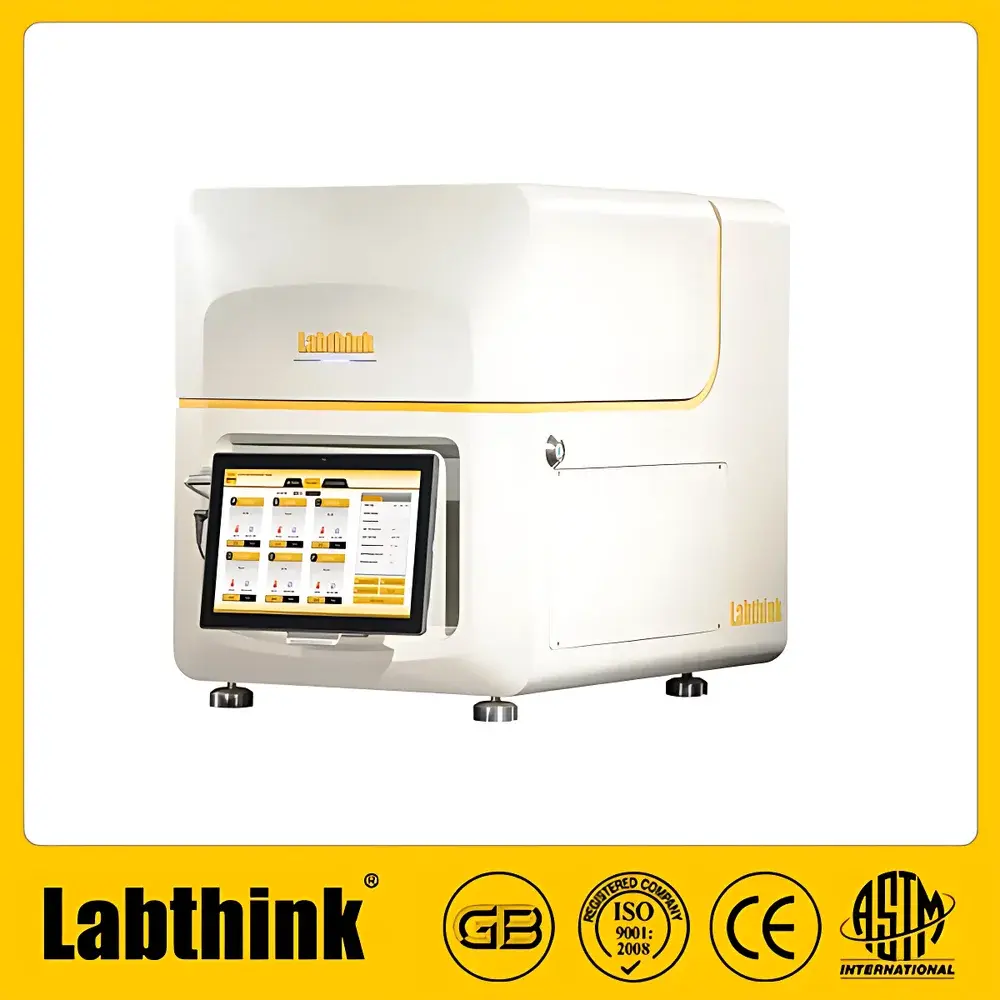
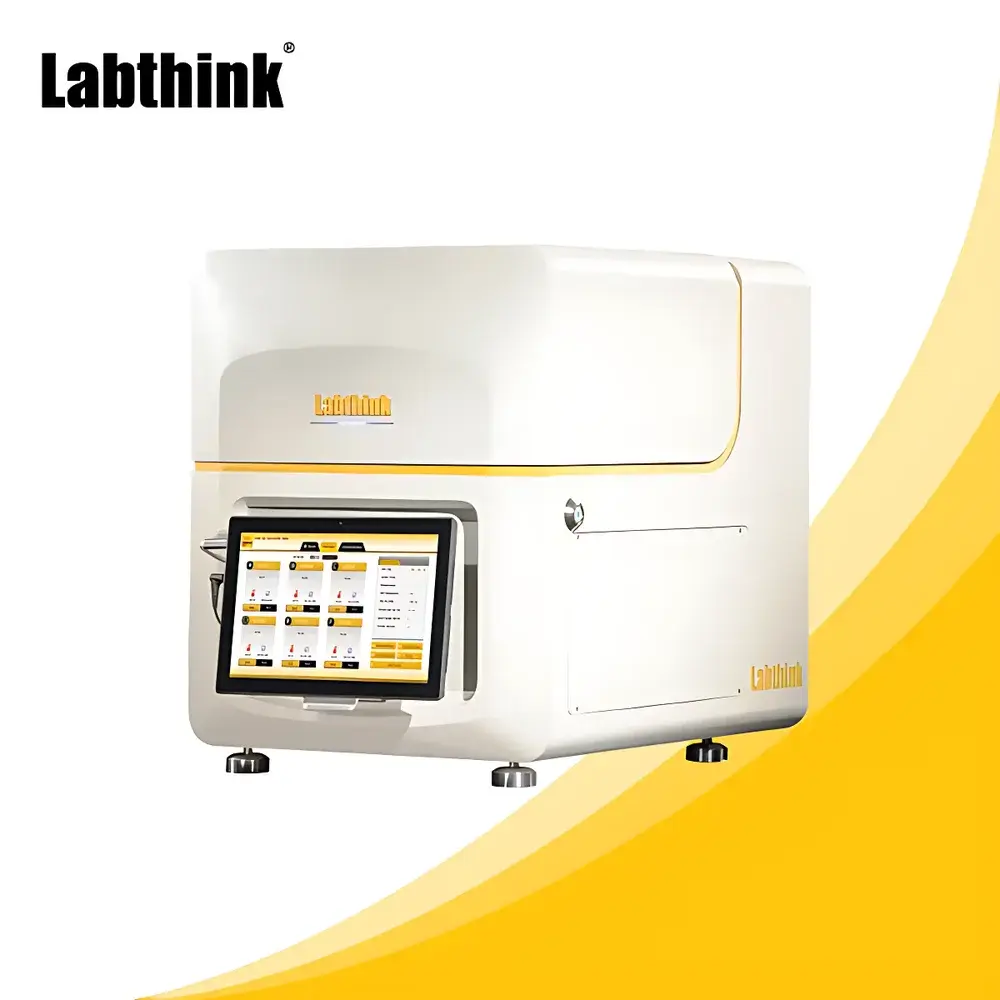
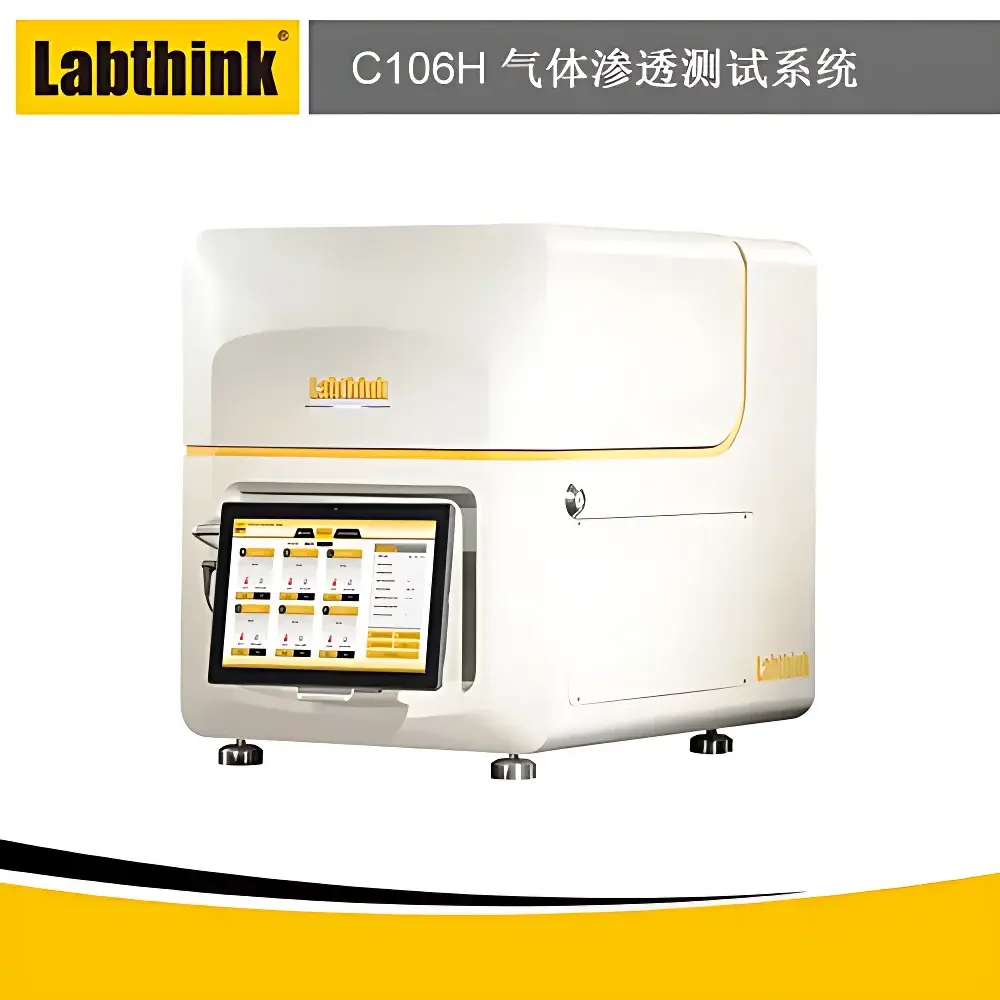
Labthink C106H Differential-Pressure Gas Permeability Analyzer
| Brand | Labthink |
|---|---|
| Model | C106H |
| Measurement Principle | Differential-Pressure (Manometric) Method |
| Test Gases | O₂, N₂, CO₂ |
| Test Range | 0.01–50,000 cm³/m²·24h·0.1MPa |
| Resolution | 0.001 cm³/m²·24h·0.1MPa |
| Temperature Range | 15–50 °C (standard), 5–60 °C (optional) |
| Temp. Stability | ±0.15 °C |
| Vacuum Capability | ≤10 Pa base pressure, 0.01 Pa resolution, ±0.2% accuracy (1–100% of sensor span) |
| Test Area | 38.48 cm² |
| Specimen Size | 11.2 cm × 11.2 cm |
| Max. Thickness | 3 mm |
| Pressure Control Range | 10–150 kPa (adjustable), ±0.2 kPa stability |
| Humidity Control | 0% RH or 5–90% RH ±2% (optional) |
| Test Stations | 6 independent chambers |
| Power Supply | 120 VAC±10% 60 Hz / 220 VAC±10% 50 Hz |
| Dimensions | 600 mm × 490 mm × 660 mm |
| Weight | 100 kg |
Overview
The Labthink C106H Differential-Pressure Gas Permeability Analyzer is an engineered solution for precise, traceable determination of gas transmission rates (GTR) through polymeric films, laminates, foils, and rigid packaging materials under controlled temperature and pressure conditions. It operates on the manometric differential-pressure principle—compliant with the fundamental thermodynamic framework of Fick’s first law and the solution-diffusion model of gas permeation. In this method, a conditioned specimen is sealed between two isolated test chambers: a high-pressure upstream cavity (gas supply side) and a low-pressure downstream cavity (vacuum side). A stable, user-defined transmembrane pressure gradient drives molecular diffusion; real-time monitoring of pressure rise in the evacuated downstream chamber enables calculation of gas permeability (P), diffusion coefficient (D), solubility coefficient (S), and ultimately oxygen/nitrogen/carbon dioxide transmission rate (OTR/NTR/CTR) per ISO 15105-1, ASTM D1434, and GB/T 1038-2000. Designed for routine QC labs and R&D facilities in packaging, pharmaceutical, and food industries, the C106H delivers high reproducibility across extended test durations and multi-sample throughput.
Key Features
- Six independent, parallel test stations enable concurrent evaluation of up to six specimens—significantly reducing batch testing time while maintaining inter-channel calibration integrity.
- High-resolution vacuum measurement system (0.01 Pa resolution, ±0.2% full-scale accuracy) ensures reliable quantification of ultra-low permeation rates down to 0.01 cm³/m²·24h·0.1MPa—critical for evaluating high-barrier structures such as AlOx-coated PET or SiOx-laminated films.
- Microprocessor-controlled thermal management provides ±0.15 °C temperature stability across the standard 15–50 °C range (extended to 5–60 °C with optional cooling module), supporting Arrhenius-based activation energy analysis per ISO 2556 Annex B.
- Modular gas handling architecture accepts O₂, N₂, CO₂, and other non-corrosive test gases via standardized Φ6 mm polyurethane tubing; pressure regulation maintains ±0.2 kPa setpoint fidelity during dynamic permeation events.
- Robust mechanical design includes stainless-steel test cavities, precision-machined sealing fixtures, and automated leak-check routines compliant with ASTM F2338 for verification of system integrity prior to each test sequence.
Sample Compatibility & Compliance
The C106H accommodates flat, non-porous sheet materials up to 3 mm thick and 11.2 cm × 11.2 cm in dimension—including monolayer plastics (LDPE, PP, PET), metallized films (Al-PET, Al-OPP), multilayer coextrusions, aluminum foil laminates, and pharmaceutical blister lidding materials. It excludes porous substrates (e.g., paperboard, nonwovens) and liquid-filled or heat-sealed pouches unless destructively prepared as flat coupons. All measurements adhere to internationally recognized standards: ISO 15105-1 (plastics—determination of gas transmission rate—part 1: differential pressure method), ISO 2556 (plastics—determination of gas transmission rate—manometric method), ASTM D1434 (standard test method for determining gas permeability characteristics), JIS K7126-1, and YBB 00082003 (Chinese pharmaceutical packaging standard). Data outputs support GLP/GMP audit readiness with timestamped metadata, operator ID logging, and electronic signature capability when integrated with Labthink’s certified software suite.
Software & Data Management
The instrument is operated via Labthink’s proprietary PermeationSuite™ v3.2 software—a Windows-based application validated for 21 CFR Part 11 compliance. It provides full control over test parameters (temperature, pressure, duration, sampling interval), real-time graphical visualization of pressure vs. time curves, automatic baseline correction, and nonlinear regression fitting for D, S, and P derivation. Raw data files (.lps) are stored in encrypted binary format with SHA-256 hash integrity verification; export options include CSV, PDF reports, and XML for LIMS integration. Audit trails record all user actions—including method modifications, result overrides, and calibration events—with immutable timestamps and role-based access permissions (administrator, analyst, reviewer). Software validation documentation (IQ/OQ/PQ protocols) is available upon request for regulated environments.
Applications
- Quality assurance of barrier films used in medical device sterile packaging (ISO 11607-1), where OTR < 1 cm³/m²·24h·0.1MPa at 23 °C/0% RH is often required.
- Accelerated shelf-life modeling of food packaging by measuring temperature-dependent permeability and calculating activation energy (Eₐ) for predictive modeling per ASTM F1249 guidance.
- Comparative evaluation of alternative barrier coatings (e.g., SiOₓ vs. AlOₓ) under identical environmental conditions to quantify relative performance improvements.
- Regulatory submission support for pharmaceutical primary packaging dossiers, including demonstration of container closure integrity against moisture and oxygen ingress per ICH Q5C and Q1A(R2).
- Supplier qualification and incoming material inspection for flexible packaging converters, ensuring conformance to contractual OTR specifications across production lots.
FAQ
What gases can be tested with the C106H?
The system supports O₂, N₂, CO₂, and other non-reactive, non-condensable gases supplied externally at regulated pressure (79.7 PSI / 550 kPa max inlet). Gas purity ≥99.9% is recommended to avoid sensor contamination.
Is humidity control built-in or optional?
Relative humidity control (5–90% RH ±2%) is available as a factory-installed option; standard configuration operates at 0% RH (dry condition) or ambient humidity only.
Can the C106H measure water vapor transmission rate (WVTR)?
No—the C106H is designed exclusively for gas permeation (O₂, N₂, CO₂). For water vapor, Labthink offers the W3/030 or W3/330 series instruments based on infrared detection or coulometric sensors.
How is system leakage verified before testing?
An automated leak-integrity check performs a 60-minute vacuum hold test on both chambers; deviation exceeding 0.5 Pa/min invalidates the sequence and triggers an alert.
Does the instrument support custom test methods beyond published standards?
Yes—PermeationSuite™ allows creation and saving of user-defined protocols, including non-standard temperature/pressure profiles, variable sampling intervals, and multi-step conditioning sequences.





