
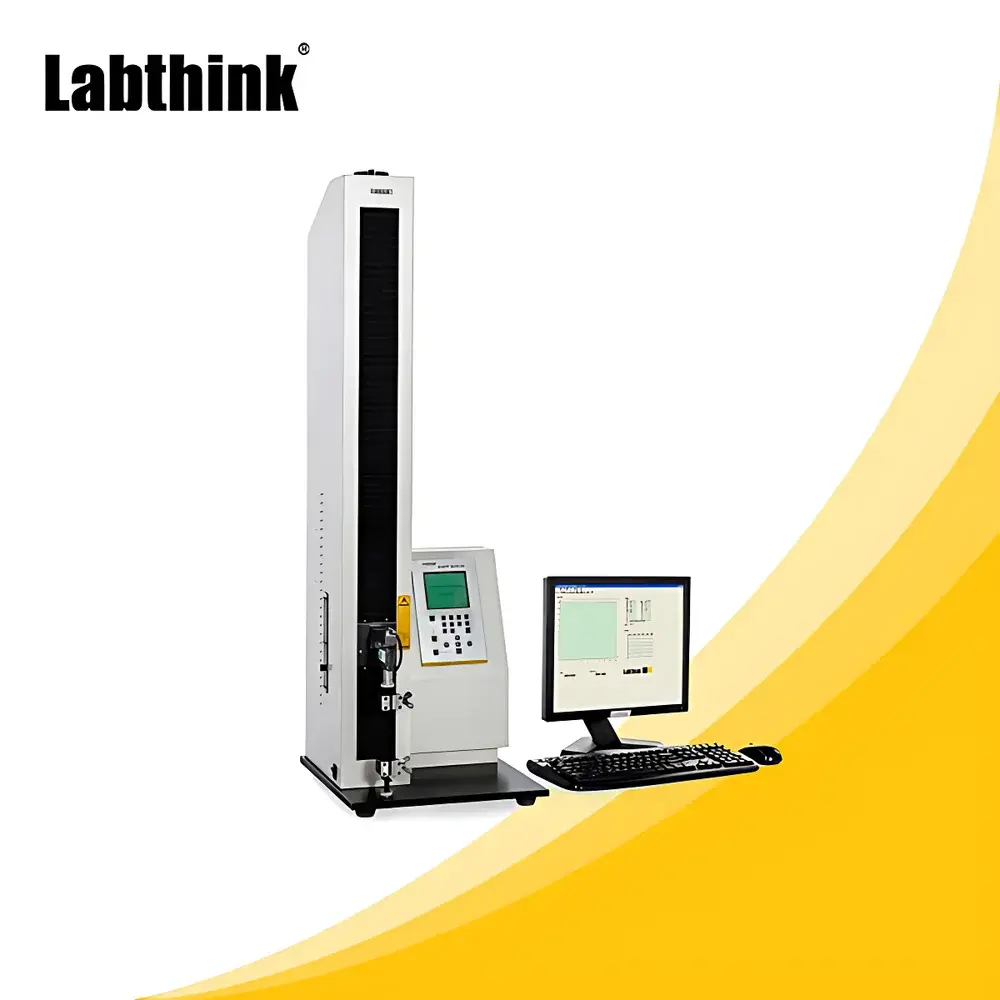
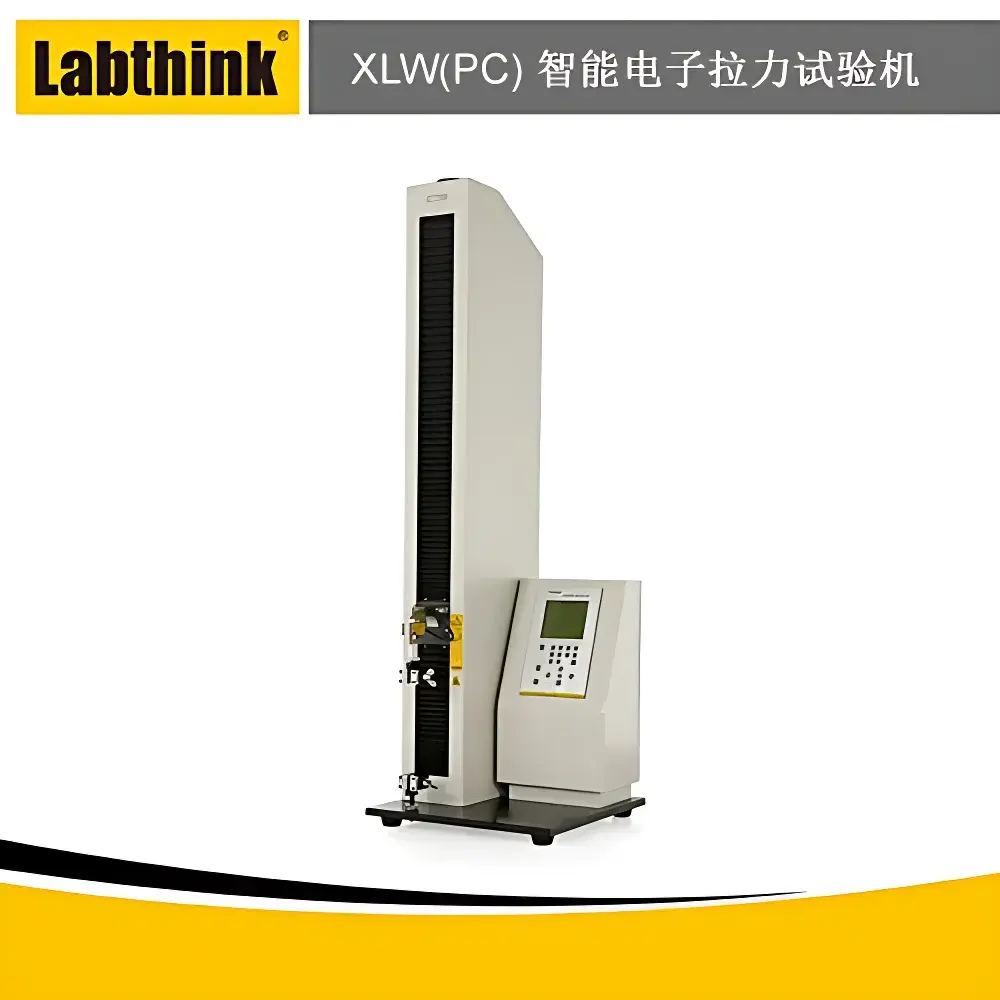
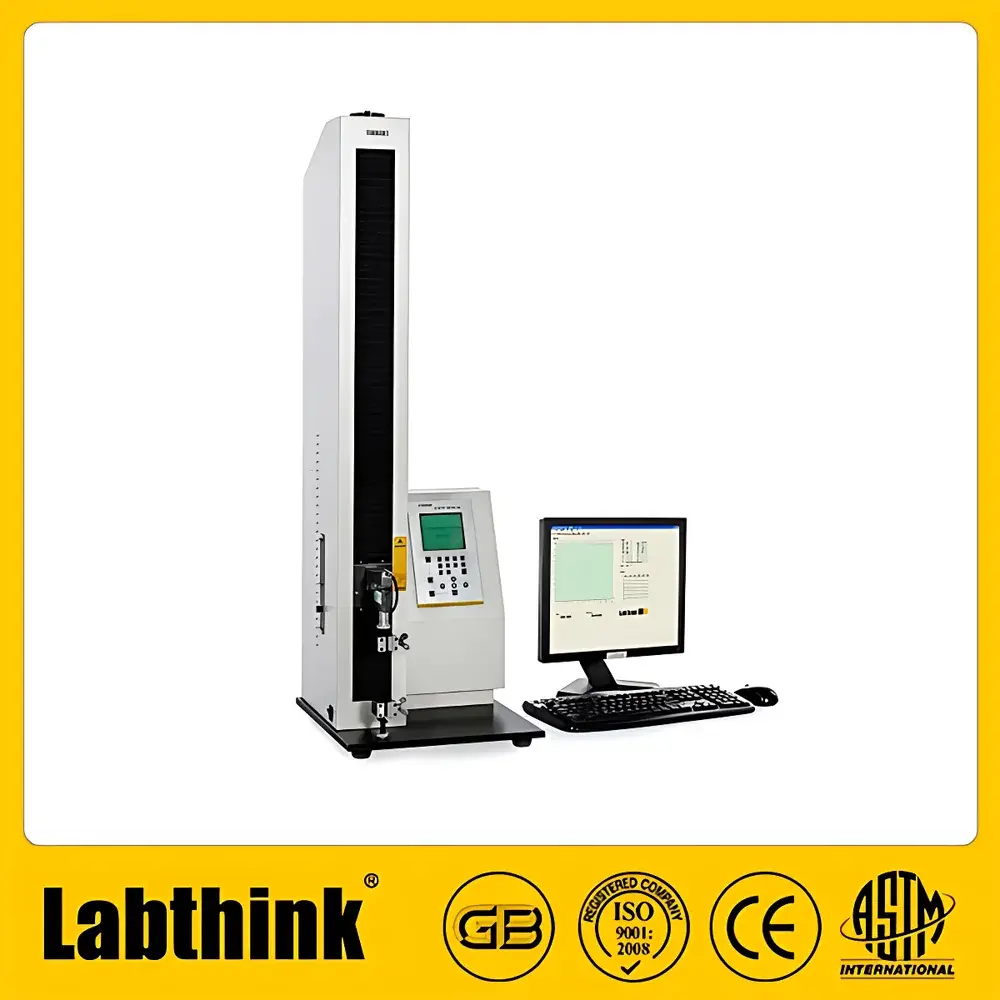
Labthink XLW(PC) Intelligent Electronic Tensile Tester
| Brand | Labthink |
|---|---|
| Model | XLW(PC) |
| Application | Tensile Strength, Elongation at Break, and Elastic Modulus Testing for Flexible Packaging Films and Soft Materials |
| Standards Compliance | ISO 37, ASTM D882, GB/T 1040.1–1040.5, GB/T 8808, ASTM F88, JIS P8113 |
| Load Capacity | 500 N (standard) |
| optional ranges | 50 N, 100 N, 250 N, 750 N, 1000 N |
| Accuracy Class | 0.5 |
| Test Speeds | 50, 100, 150, 200, 250, 300, 500 mm/min |
| Maximum Travel | 1000 mm |
| Sample Width | 30 mm (standard clamp), 50 mm (optional) |
| Power Supply | 220 VAC 50 Hz / 120 VAC 60 Hz |
| Dimensions (L×W×H) | 450 × 450 × 1410 mm |
| Net Weight | 68 kg |
| Software | Lystem™ Laboratory Data Sharing System, GLP/GMP-compliant audit trail, multi-sample statistical analysis, curve overlay, historical data comparison |
Overview
The Labthink XLW(PC) Intelligent Electronic Tensile Tester is a precision-engineered universal testing machine designed specifically for mechanical property characterization of thin, flexible polymeric materials used in packaging, medical device assembly, and industrial laminates. Operating on the fundamental principle of uniaxial tensile loading under controlled displacement, the instrument applies axial force to standardized specimens clamped between two motor-driven grips while synchronously measuring load (via high-stability strain-gauge transducers) and displacement (via linear encoder-based position sensing). This dual-signal acquisition enables accurate derivation of critical mechanical parameters—including tensile strength at break, elongation at break (%), Young’s modulus (elastic modulus), yield point, and stress–strain curve linearity—according to internationally recognized test methodologies. Its architecture conforms to the metrological requirements of Class 0.5 accuracy per ISO 7500-1 and ASTM E4, ensuring traceable, repeatable, and inter-laboratory comparable results essential for quality control, R&D validation, and regulatory submissions.
Key Features
- Class 0.5 force measurement accuracy certified per ISO 7500-1 and ASTM E4, guaranteeing high reproducibility across repeated tests and laboratories.
- Seven pre-programmed test modes: tensile, peel, tear, shear, puncture, heat seal strength, and adhesion—each with independent parameter presets and real-time feedback.
- Adjustable crosshead speed across seven discrete settings (50–500 mm/min), enabling compliance with both static and dynamic test protocols defined in ASTM D882 and ISO 37.
- 1000 mm maximum travel distance accommodates highly extensible materials such as elastomeric films, hydrogels, and nonwovens without mechanical interference or stroke limitation.
- Modular load cell configuration: standard 500 N capacity with optional 50 N, 100 N, 250 N, 750 N, and 1000 N transducers—allowing optimal signal-to-noise ratio across diverse material stiffness ranges.
- Integrated safety systems: electromechanical limit switches, overload cutoff, automatic return-to-start, and power-loss memory retention ensure operator protection and test integrity.
- Intuitive human–machine interface: PVC membrane keypad, backlit LCD display, and menu-driven navigation minimize training time and reduce operational errors.
Sample Compatibility & Compliance
The XLW(PC) is validated for use with a broad spectrum of low-thickness, high-ductility substrates including biaxially oriented polypropylene (BOPP), polyester (PET), polyethylene (PE), polyamide (PA), aluminum foil laminates, pressure-sensitive adhesives (PSAs), medical-grade silicone-coated release liners, surgical tapes, and spunbond/meltblown nonwovens. Its standardized 30 mm wide jaw configuration meets specimen geometry requirements of ASTM D882 and GB/T 1040.3, while optional 50 mm jaws support wider samples per ISO 1184 and EN 1392. All test routines are fully aligned with global regulatory frameworks: FDA 21 CFR Part 11–compliant software audit trails; GLP/GMP-ready documentation workflows; and direct traceability to national standards bodies including CNAS (China), UKAS (UK), and DAkkS (Germany).
Software & Data Management
The embedded Lystem™ Laboratory Data Sharing System provides comprehensive test lifecycle management—from method definition and calibration logging to raw data export and report generation. It supports automated calculation of elastic modulus from the initial linear region of the stress–strain curve, secant modulus at specified strain offsets, and area-under-curve metrics for toughness evaluation. Statistical tools include group-wise mean/SD/COV computation, outlier detection (Grubbs’ test), confidence interval estimation (95%), and graphical overlay of up to 12 curves for comparative trend analysis. Data files comply with ASTM E1447 and ISO/IEC 17025 requirements for digital record integrity, with encrypted local storage, user-level access controls, and seamless integration into enterprise LIMS or ERP platforms via TCP/IP or USB.
Applications
- Quality assurance of food and pharmaceutical packaging films—verifying seal integrity, barrier layer cohesion, and puncture resistance prior to sterilization.
- R&D evaluation of biodegradable polymers (e.g., PLA, PHA) under varying humidity and temperature conditioning per ISO 22081.
- Validation of adhesive bond strength in transdermal patch assemblies per USP and ISO 15378.
- Mechanical benchmarking of battery separator membranes for lithium-ion cells, focusing on tensile stability during electrode calendaring.
- Regulatory submission support for ISO 10993–part 5 cytotoxicity test specimen preparation, where consistent film handling and dimensional uniformity are mandatory.
- Process optimization of blown-film extrusion lines through real-time correlation of melt index, draw ratio, and final tensile anisotropy.
FAQ
What standards does the XLW(PC) support for tensile testing of plastic films?
ASTM D882, ISO 37, GB/T 1040.1–1040.5, GB/T 8808, and JIS P8113—all implemented with full parameter configurability and pass/fail threshold logic.
Can the instrument perform peel and tear tests in addition to tensile measurements?
Yes. Seven independent test programs are built-in: tensile, 90° peel (ASTM D3330), 180° peel (GB/T 2792), trouser tear (ASTM D1938), Elmendorf tear (ISO 1974), heat seal strength (ASTM F88), and puncture (ASTM F1306).
Is the software compliant with FDA 21 CFR Part 11 requirements?
Yes. Lystem™ includes electronic signatures, audit trail logging with immutable timestamps, role-based permissions, and data encryption—fully validated for regulated environments.
What is the maximum sample thickness the standard夹具 can accommodate?
Standard pneumatic clamps accept specimens up to 2.5 mm thick; custom fixtures are available for thicker composites or multi-layer laminates.
Does the system support automated calibration verification?
Yes. Built-in reference weight checks and zero-balance diagnostics are scheduled via software, with calibration certificates traceable to NIST or equivalent national metrology institutes.



