
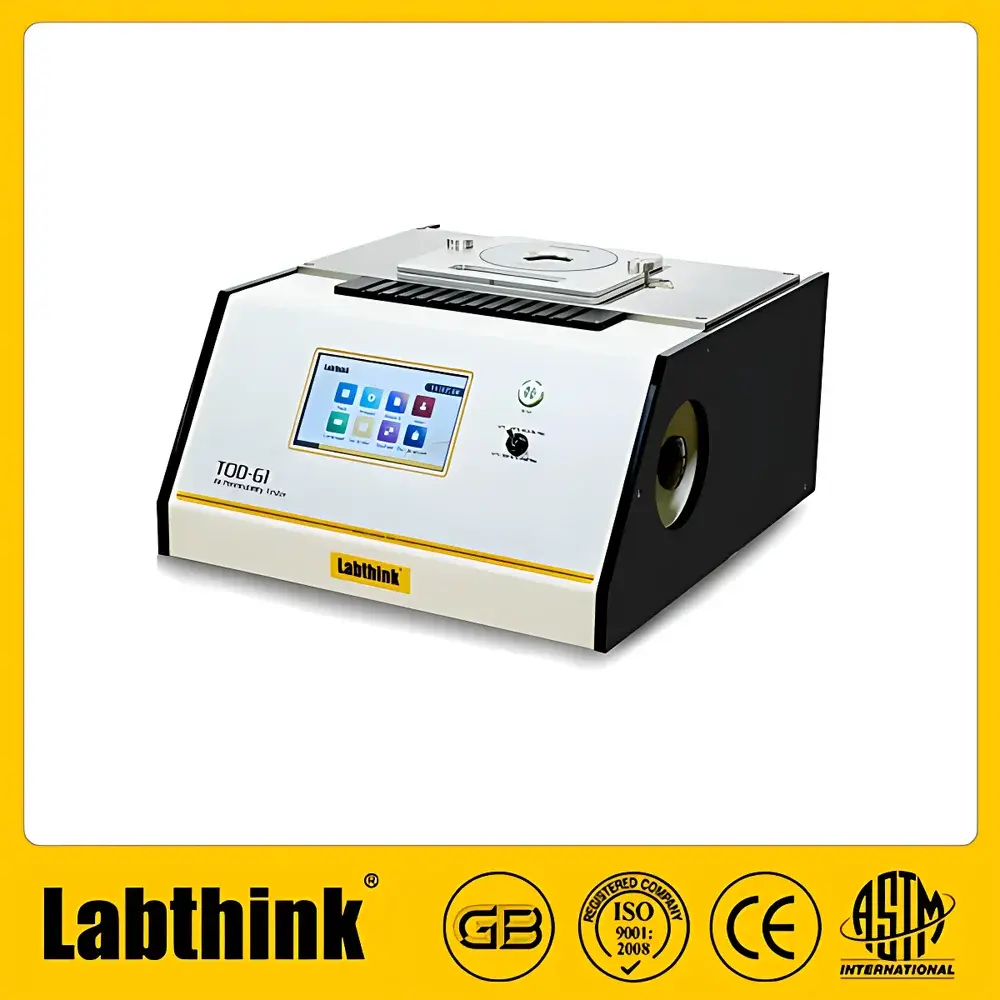
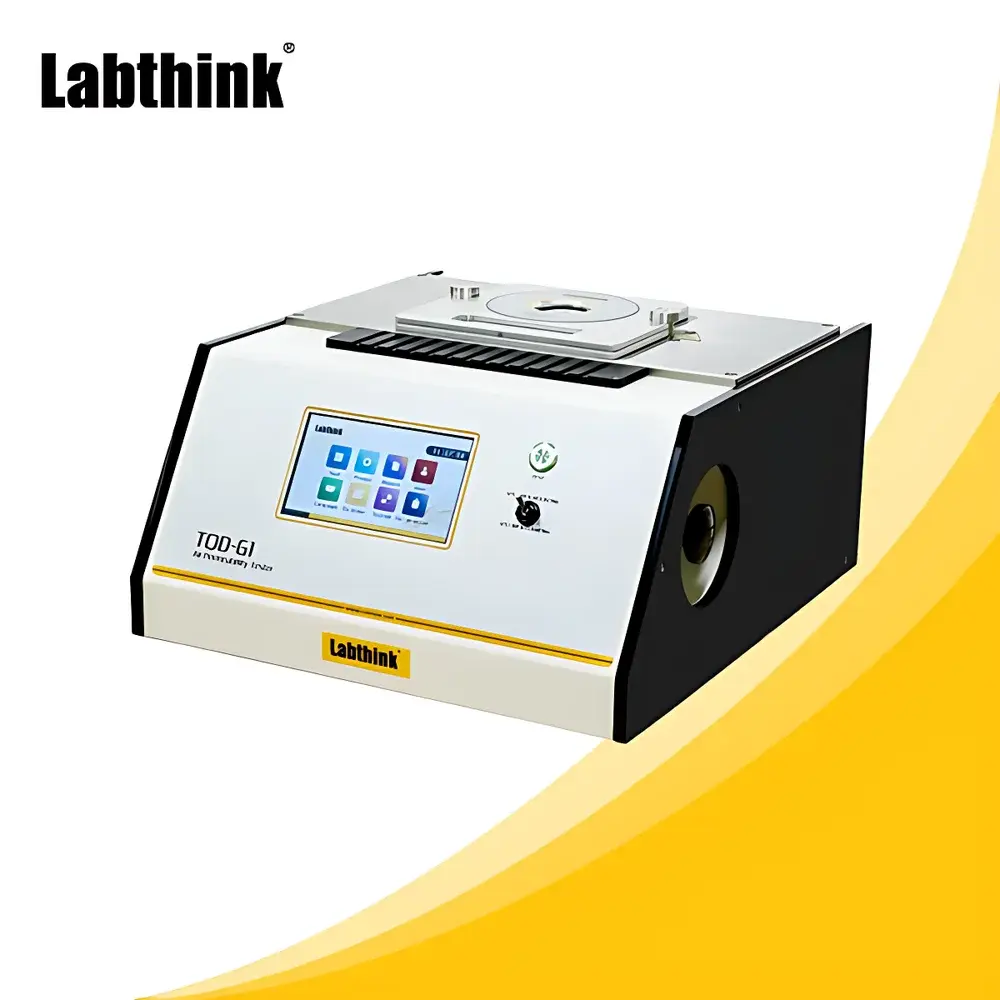
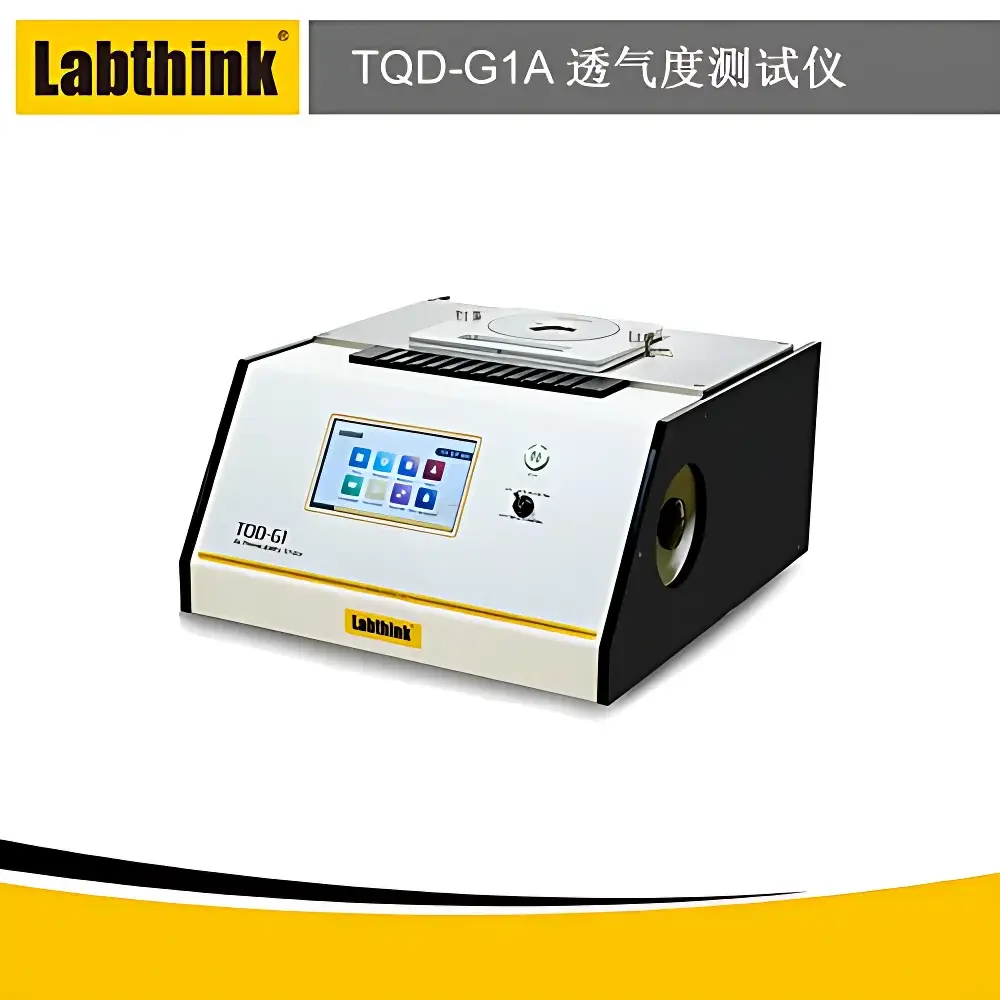
Labthink TQD-G1A Air Permeability Tester
| Brand | Labthink |
|---|---|
| Origin | Shandong, China |
| Manufacturer Type | OEM/ODM Manufacturer |
| Country of Origin | China |
| Model | TQD-G1A |
| Price Range | USD 14,000 – 70,000 |
| Pressure Drop Range | 0–1000 Pa |
| Pressure Resolution | 0.1 Pa |
| Pressure Accuracy | ±0.25% FS |
| Flow Rate Range | 0–30 L/min |
| Flow Resolution | 0.1 L/min |
| Flow Accuracy | ±2% FS |
| Test Area | 20 cm² (standard, customizable) |
| Sample Size | 50 mm × 50 mm |
| Max Sample Thickness | 1 mm |
| Gas Supply | Clean compressed air (user-supplied, ≥550 kPa, >120 L/min) |
| Power | 120 VAC ±10%, 60 Hz OR 220 VAC ±10%, 50 Hz |
| Dimensions (W×D×H) | 300 × 460 × 520 mm |
| Net Weight | 25 kg |
| Interface | RS232 serial port |
| Display | 7-inch industrial color touch screen |
| Compliance Standards | ISO 9237, ISO 4638, ISO 5636, GB/T 5453, GB/T 10655, ASTM D737, TAPPI T460, JIS P8117 |
Overview
The Labthink TQD-G1A Air Permeability Tester is a precision-engineered instrument designed for quantitative evaluation of gas transmission behavior through porous and elastic sheet materials under controlled differential pressure or constant flow conditions. It operates on two standardized physical principles: Method A (constant airflow mode), where volumetric flow is held steady while the resulting pressure differential across the specimen is measured; and Method B (constant pressure mode), where a fixed pressure gradient is applied and the volumetric airflow rate through a defined test area is quantified over time. These dual-mode capabilities enable comprehensive characterization of both air resistance (Pa·s/m) and air permeability (µm² or L/m²·s·Pa), critical parameters for functional performance validation in automotive interiors, filtration media, personal protective equipment (PPE), and packaging substrates. The system employs high-stability, factory-calibrated electronic pressure and mass flow sensors traceable to NIST-equivalent reference standards, ensuring metrological integrity across repeated measurements.
Key Features
- Dual-test methodology compliant with ISO 9237 and ASTM D737 — supports both constant-flow (Method A) and constant-pressure (Method B) operation for full regulatory alignment
- High-resolution sensing architecture: 0.1 Pa pressure resolution and ±0.25% full-scale accuracy; 0.1 L/min flow resolution with ±2% full-scale accuracy
- Integrated maintenance-free vacuum generation module ensures stable, pulse-free airflow without external pump dependency
- Pneumatically actuated clamping mechanism delivers consistent compressive force (±3% repeatability) across all sample types, eliminating operator-induced variability
- 7-inch industrial-grade capacitive touchscreen interface with embedded real-time OS — supports multi-language UI (English, Chinese, Spanish, French), calendar-based audit logging, and three-tier user permission management (Operator, Supervisor, Administrator)
- Standard RS232 serial interface enables seamless integration with LIMS or custom QA/QC software platforms; optional PC-based data acquisition and report generation software available
- Modular test chamber design accommodates standard 50 mm × 50 mm specimens (20 cm² effective area); custom test areas (e.g., 10 cm², 50 cm²) available upon request for specialized compliance testing
Sample Compatibility & Compliance
The TQD-G1A is validated for use with low-to-medium density porous planar materials up to 1 mm thickness, including polyurethane foams, PVC laminates, synthetic and natural leathers, nonwovens, woven and knitted textiles, filter papers, medical mask layers (e.g., melt-blown PP), carpet backings, and coated release liners. Its mechanical and pneumatic architecture meets the dimensional and sealing requirements specified in ISO 9237 Annex A for textile permeability testing and ASTM D737 Section 7 for air resistance measurement. All firmware and calibration protocols are structured to support GLP and GMP environments: timestamped test records include operator ID, environmental temperature/humidity metadata (when interfaced with optional external sensors), raw sensor outputs, and final calculated values. Audit trails comply with FDA 21 CFR Part 11 requirements when used with validated software modules.
Software & Data Management
Raw sensor data — including real-time pressure differentials, volumetric flow rates, elapsed test duration, and ambient temperature — are logged at 10 Hz and stored internally with date/time stamps. The embedded system supports CSV export via USB flash drive or direct RS232 transmission. Optional Labthink PermeaSoft™ software provides advanced post-processing: automatic calculation of Gurley numbers, Frazier units, and ISO-defined air permeability coefficients; statistical analysis (mean, SD, CV%, min/max) across batched tests; and PDF/Excel report generation with configurable headers, logos, and signature fields. All digital records maintain immutable revision history and support electronic signatures per ALCOA+ principles (Attributable, Legible, Contemporaneous, Original, Accurate).
Applications
- Automotive Interior Validation: Quantification of airflow resistance in PU foam seat cushions, PVC trim panels, and headliner composites to meet OEM specifications (e.g., Ford WSS-M99P1111-A, GMW14872)
- Medical PPE Certification: Measurement of ΔP (pressure drop) and breathability (L/min/cm² at 125 Pa) for surgical masks, N95 respirators, and isolation gowns per ISO 13485 and ASTM F2100
- Packaging Barrier Assessment: Evaluation of air permeation through paperboard laminates, metallized films, and breathable medical packaging substrates per ISO 5636-5
- Industrial Filtration QA: Batch-to-batch consistency verification of nonwoven filter media used in HVAC, vacuum cleaner bags, and liquid pre-filters
- Textile R&D: Correlation of weave density, fiber denier, and coating weight with air permeability for sportswear, upholstery, and technical fabrics
FAQ
What compressed air specifications are required for reliable operation?
The TQD-G1A requires clean, oil-free compressed air at ≥550 kPa (80 psi) supply pressure and minimum flow capacity of 120 L/min. A refrigerated dryer and 0.01 µm particulate filter are strongly recommended upstream of the Φ8 mm PU inlet tubing.
Can the instrument be used for testing layered composites or laminates?
Yes — provided total thickness does not exceed 1 mm and interfacial delamination does not occur under pneumatic clamping pressure (typically 150–200 kPa). For multilayer systems, users should validate seal integrity using blank runs prior to formal testing.
Is calibration traceable to national standards?
All pressure and flow sensors are calibrated using primary standards traceable to CNAS-accredited laboratories (equivalent to ISO/IEC 17025). Certificate of Calibration includes uncertainty budgets and is supplied with each unit.
Does the system support automated pass/fail decision logic based on user-defined limits?
When operated with PermeaSoft™ software, configurable acceptance criteria can be assigned per material type; results are automatically flagged as “PASS”, “FAIL”, or “RETEST” with visual alerts and log entries.
What maintenance intervals are recommended for long-term stability?
No routine maintenance is required for the vacuum module or sensors. Annual verification of zero-point drift and span accuracy is advised; Labthink offers certified field service and remote diagnostic support globally.





