
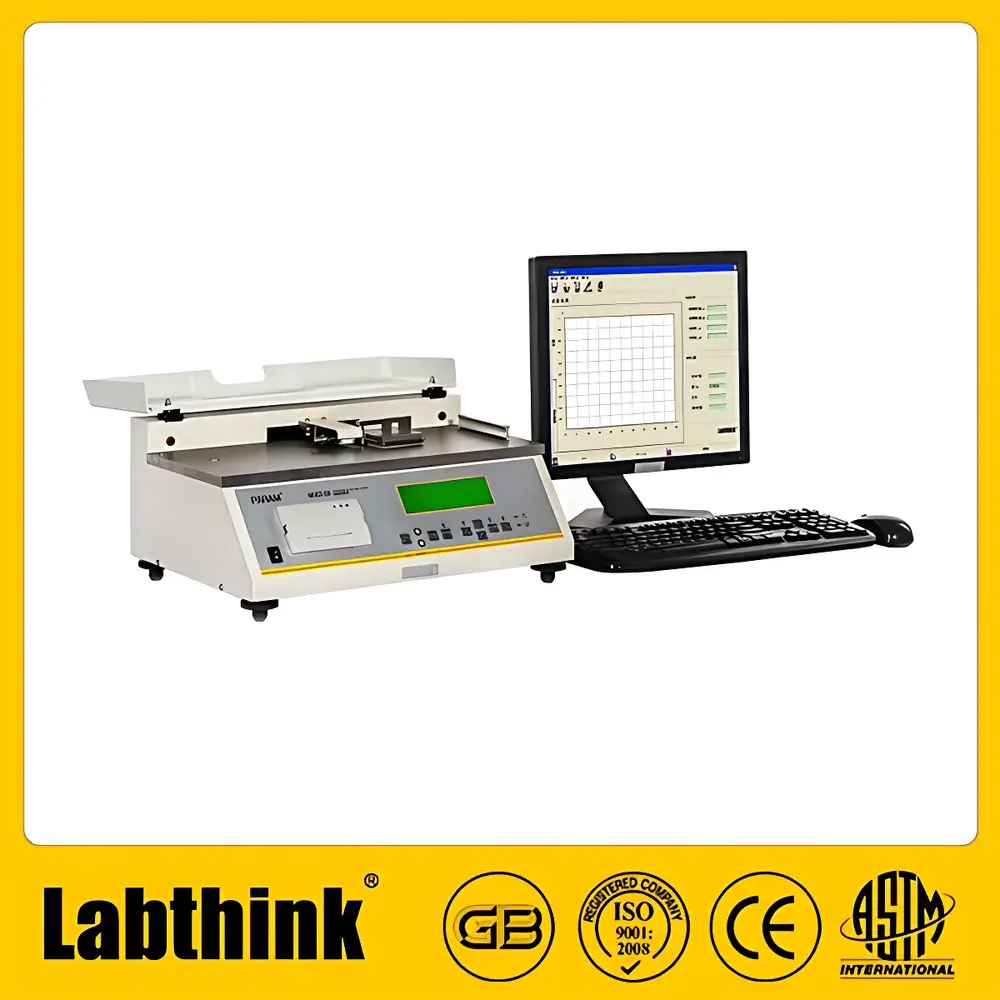
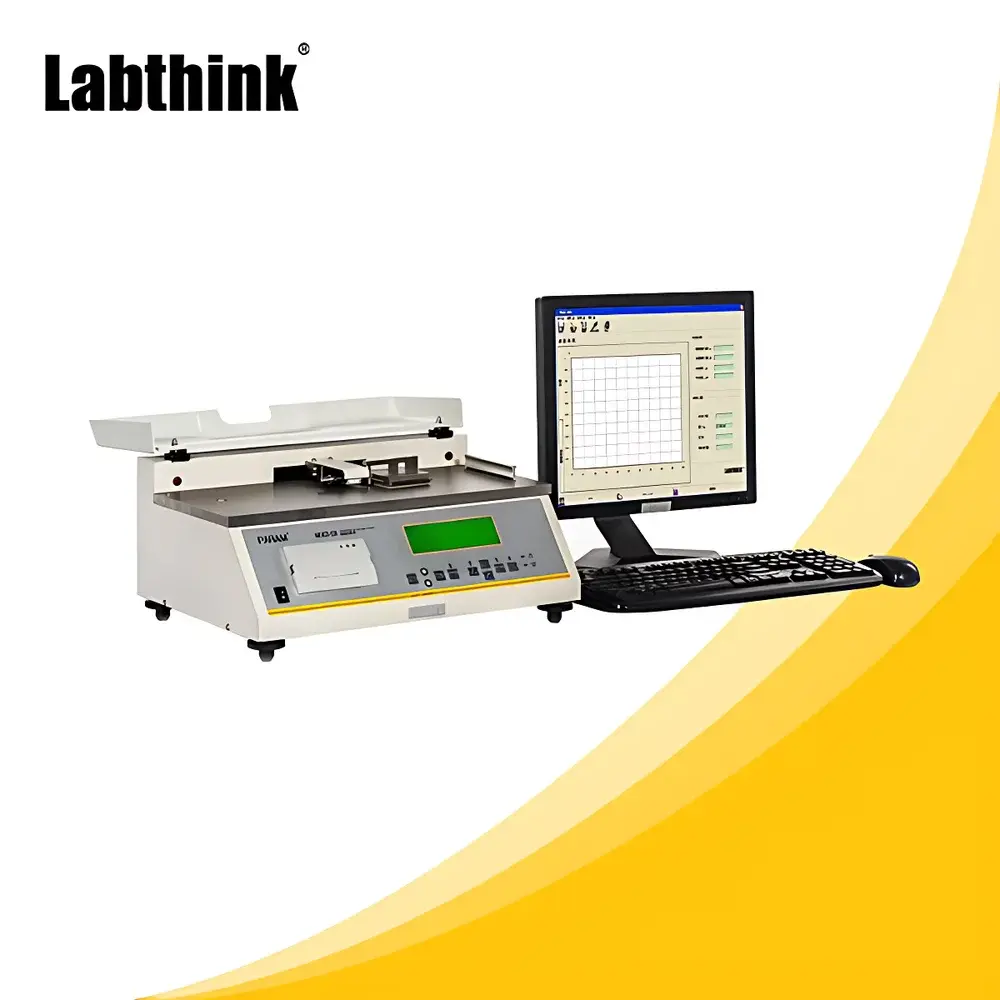
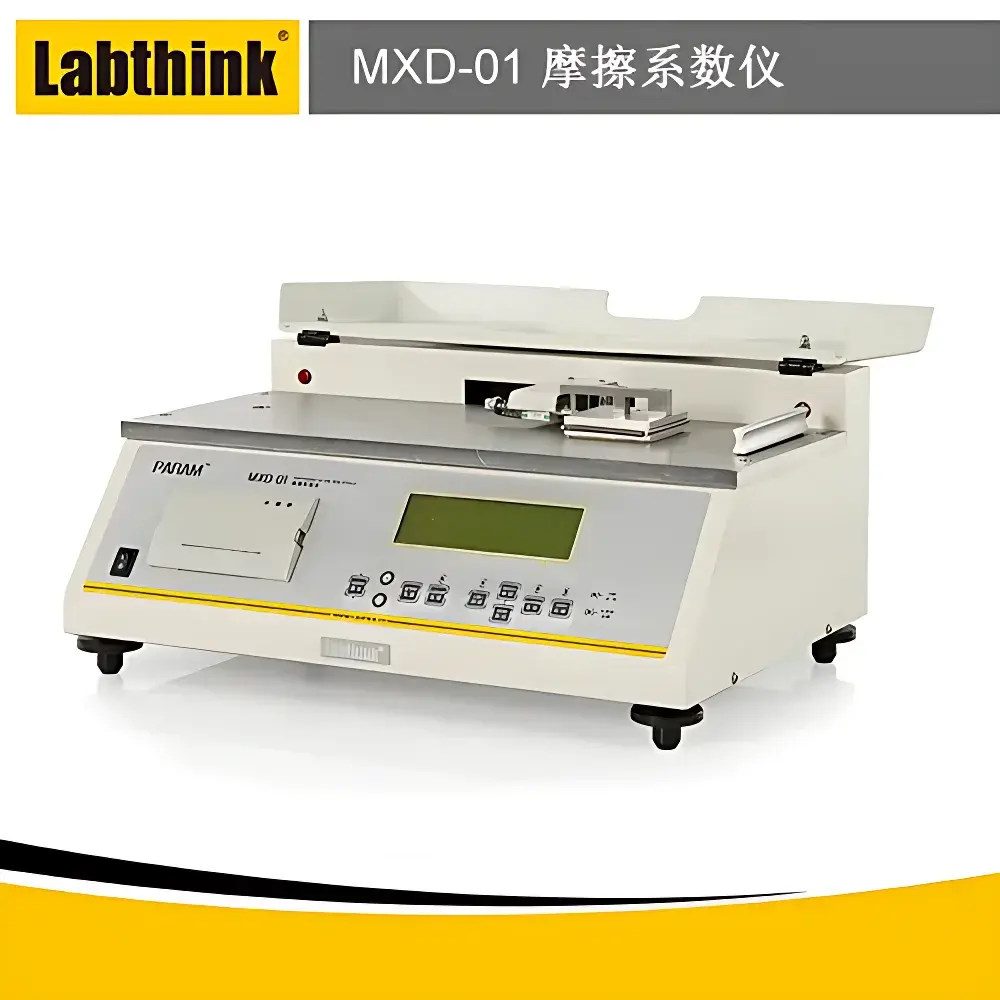
Labthink MXD-01 Coefficient of Friction Tester for Nonwovens and Packaging Materials
| Brand | Labthink |
|---|---|
| Origin | Shandong, China |
| Manufacturer | Labthink Instruments Co., Ltd. |
| Model | MXD-01 |
| Load Range | 0–5 N |
| Accuracy Class | Class 1 |
| Travel Distance | 10 mm + 60 mm |
| Slider Mass Options | 200 g, 500 g (1000 g optional) |
| Test Speed | 100 mm/min |
| Operating Environment | 10–40 °C, 20–70 %RH |
| Standards Compliance | GB 10006–1988, ISO 8295 |
| Interface | RS232 |
| Data Output | Built-in thermal printer, Lystem™ Lab Data Management System |
Overview
The Labthink MXD-01 Coefficient of Friction Tester is an electromechanical instrument engineered for precision measurement of static and kinetic coefficients of friction (COF) in flexible sheet materials used across packaging, nonwoven, paper, rubber, and polymer industries. It operates on the fundamental principle of horizontal sliding resistance measurement: a standardized slider is placed atop a stationary test specimen, then drawn at a controlled linear velocity (100 mm/min) while force transducers record peak (static) and sustained (kinetic) frictional resistance. The resulting forces are normalized against the normal load to yield dimensionless COF values—critical parameters for evaluating surface slipperiness, web handling stability, packaging line efficiency, and interlayer compatibility in multilayer laminates.
Key Features
- Simultaneous dual-mode measurement: automatic detection and separation of static COF (μs) and kinetic COF (μk) within a single test cycle
- Programmable dwell time control with auto-timer functionality prior to initiation of motion, ensuring consistent surface contact stabilization
- Zero-force calibration sequence executed automatically before each test to eliminate residual mechanical bias and guarantee baseline integrity
- Demagnetized test platform and stainless-steel sliders validated for residual magnetism (<0.2 mG), minimizing electromagnetic interference with force sensor output
- Microprocessor-based control system featuring an intuitive PVC membrane keypad and backlit LCD display for real-time parameter monitoring and manual operation
- Imported high-stability load cells and precision linear motion actuators ensure long-term repeatability and compliance with Class 1 accuracy per GB/T 2689.1
- Modular slider mass configuration: standard 200 g and 500 g weights; 1000 g available as optional accessory; custom masses accommodated upon request for application-specific normal force requirements
Sample Compatibility & Compliance
The MXD-01 is validated for use with planar, flexible substrates up to 1 mm thickness and minimum dimensions of 80 mm × 200 mm. Common test specimens include spunbond/meltblown nonwovens, BOPP/BOPET films, aluminum foil laminates, corrugated board liners, vulcanized rubber sheets, and coated papers. Its mechanical architecture and test protocol align rigorously with ISO 8295:1995 (Plastics — Film and sheeting — Determination of the coefficient of friction) and GB 10006–1988 (Determination of coefficient of friction for plastic films and sheets). The instrument supports quality assurance frameworks requiring documented traceability, including GLP-compliant environments where audit trails for calibration, operator ID, and environmental logs are maintained via Lystem™ integration.
Software & Data Management
Bundled Lystem™ Laboratory Data Management Software provides automated analytical functions beyond raw COF calculation. It performs quantitative assessment of stick-slip behavior by analyzing force-time curve morphology, calculates confidence intervals (95% CI) for group test datasets using Student’s t-distribution, and generates comparative statistical summaries (mean, SD, CV%, min/max) across multiple batches or material variants. All test records—including metadata (temperature, humidity, slider mass, operator), raw analog force traces, and annotated COF values—are timestamped and stored with immutable digital signatures. Export formats include CSV, PDF, and XML, compatible with enterprise LIMS platforms. The system supports FDA 21 CFR Part 11 readiness through electronic signature capture, role-based access control, and full audit trail logging of all data modifications.
Applications
- Optimizing silicone or fluoropolymer release coatings on nonwoven medical fabrics to achieve target slip thresholds for surgical gown donning
- Validating consistency of anti-block additives in polyolefin cast films used in high-speed form-fill-seal packaging lines
- Assessing frictional mismatch between inner liner and outer carton board to prevent jamming in pharmaceutical blister packaging equipment
- Comparing surface energy modification efficacy (e.g., corona treatment) on PET films via pre- and post-treatment COF shifts
- Supporting ASTM D1894–20 compliance verification for conveyor belt interface testing in food processing facilities
- Generating reference data for finite element modeling of web tension distribution in roll-to-roll converting processes
FAQ
What standards does the MXD-01 comply with?
It fully implements GB 10006–1988 and ISO 8295:1995. Optional firmware modules support ASTM D1894–20 and TAPPI T815 om upon customer request.
Can the instrument measure both static and kinetic COF in one test run?
Yes. The system captures the maximum breakaway force (static COF) and the average plateau force during steady-state sliding (kinetic COF) without manual intervention.
Is environmental monitoring integrated into the test sequence?
Ambient temperature and relative humidity sensors are external but supported via Lystem™; real-time environmental metadata is embedded in every test report when connected.
How is traceability ensured for regulatory audits?
Lystem™ enforces ALCOA+ principles: attributable, legible, contemporaneous, original, accurate, complete, consistent, enduring, and available—meeting GMP/GLP documentation requirements.
Are calibration certificates provided with the instrument?
Each unit ships with a factory-issued calibration certificate traceable to CNAS-accredited national standards; annual recalibration services are available through Labthink’s global service network.





