
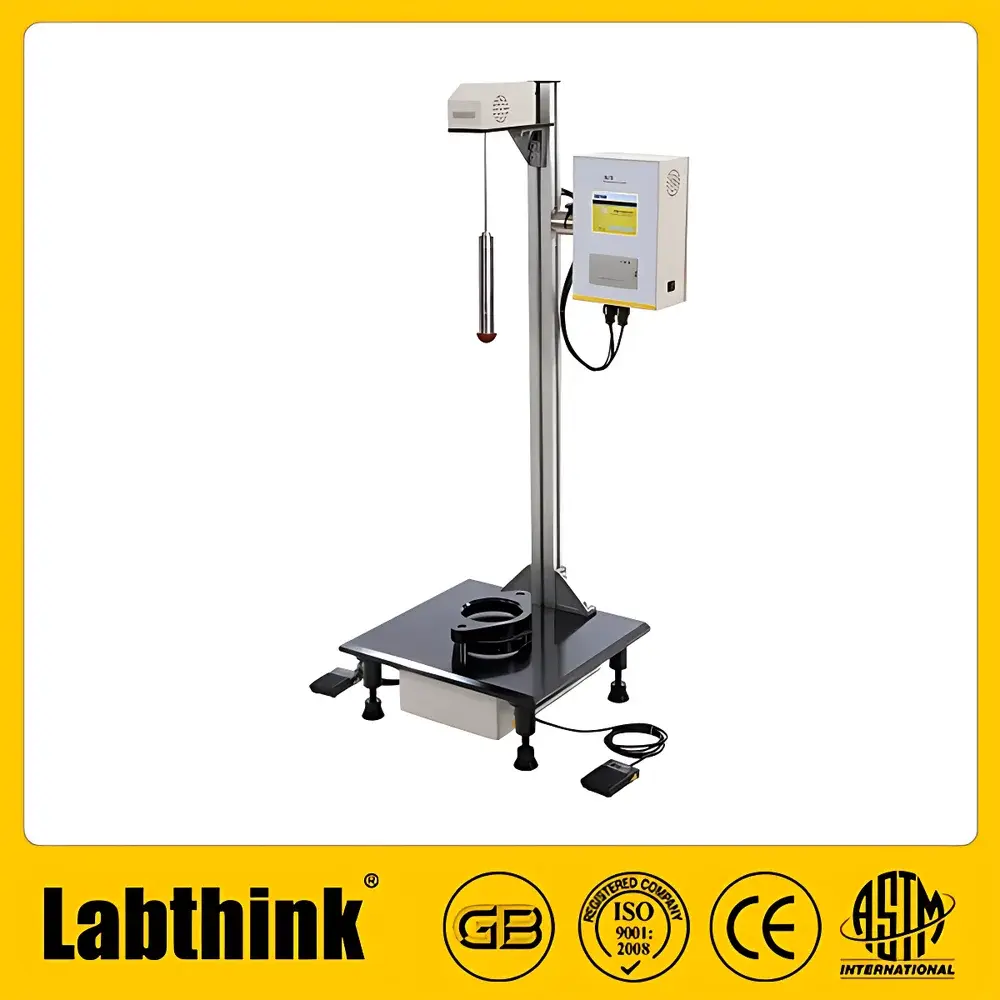
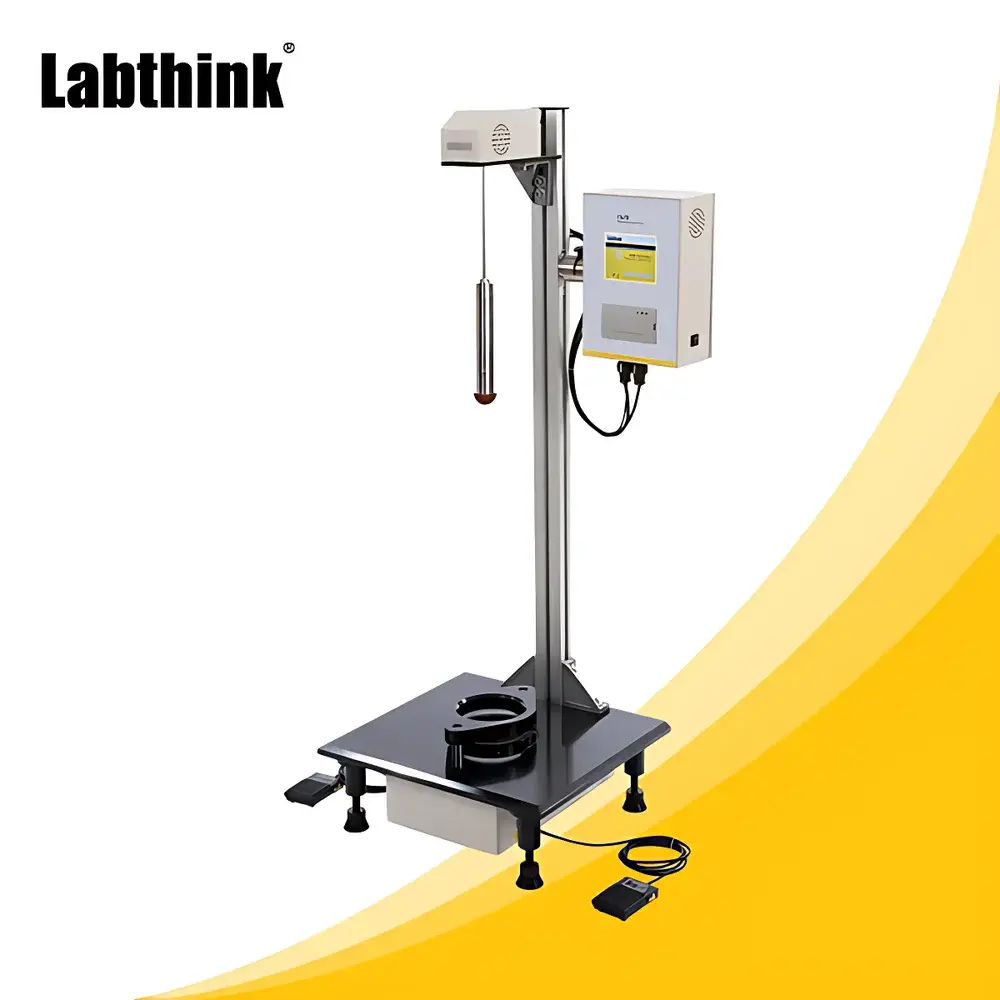
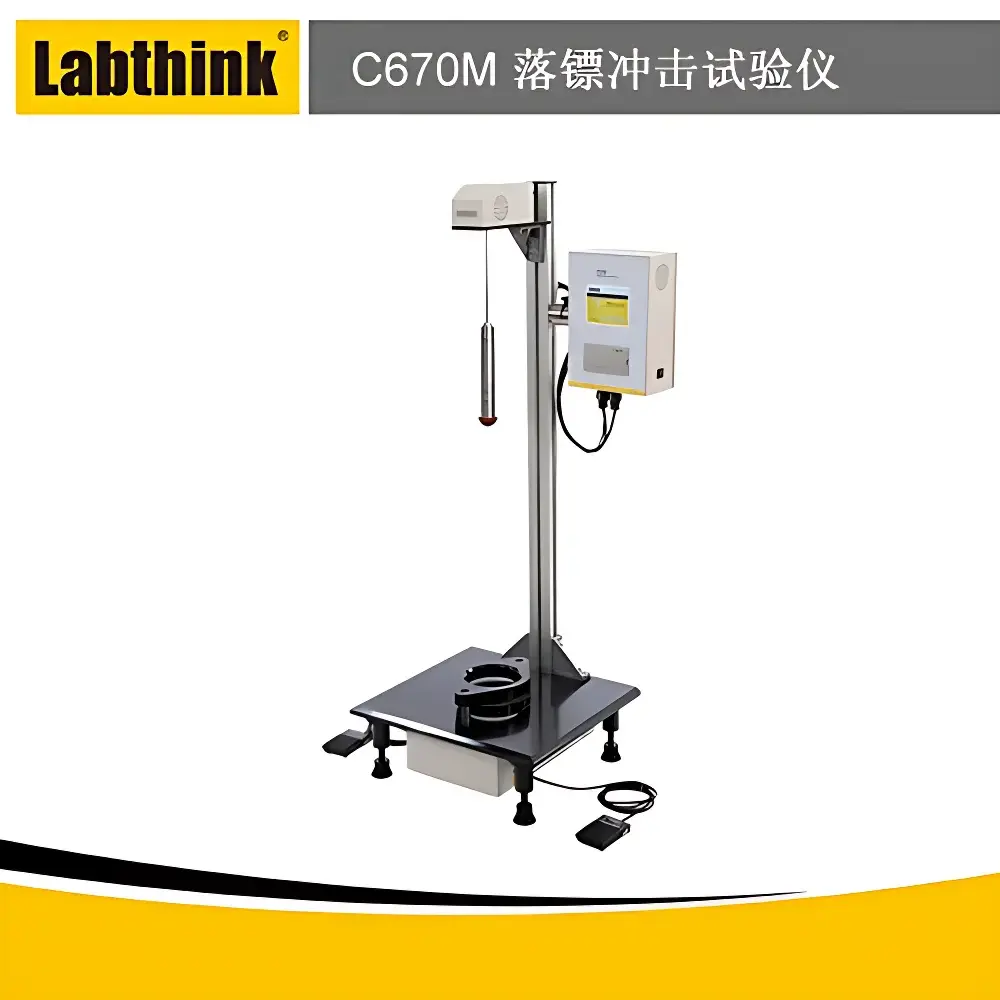
Labthink C670M Dart Impact Tester for Packaging Films and Thin Sheets
| Brand | Labthink |
|---|---|
| Origin | Shandong, China |
| Manufacturer | Labthink Instruments Co., Ltd. |
| Model | C670M |
| Type | Electromagnetic Release Dart Impact Testing System |
| Standards Compliance | ISO 7765-1:1988, ASTM D1709, GB/T 9639.1–2008, JIS K7124-1 |
| Test Methods | Method A (50–2000 g), Method B (300–2000 g) |
| Mass Resolution | ±0.5% |
| Specimen Clamp | Pneumatic (0.6 MPa required, Φ8 mm polyurethane tubing interface) |
| Specimen Size | ≥150 mm × 150 mm |
| Power Supply | 220 VAC 50 Hz / 120 VAC 60 Hz |
| Net Weight | 70 kg |
| Dimensions (A-method) | 500 × 450 × 1320 mm (L×W×H) |
| Dimensions (B-method) | 500 × 450 × 2160 mm (L×W×H) |
| Interface | RS232 serial port, built-in thermal printer |
Overview
The Labthink C670M Dart Impact Tester is an electromagnetically actuated, precision instrument engineered for the quantitative determination of impact resistance in flexible packaging materials—including plastic films, thin sheets, laminates, aluminum foils, paperboard, and coated papers. It operates on the principle of free-fall impact testing, where a standardized dart (with variable mass) is released from a fixed height onto a horizontally clamped specimen. The test determines the critical impact mass at which 50% of specimens fail—commonly reported as the “impact energy” or “dart impact strength.” This method is grounded in classical energy transfer mechanics and statistical endpoint estimation, ensuring high reproducibility across laboratories. Designed for compliance with international standard protocols, the C670M supports both Method A (low-mass range) and Method B (high-mass range), enabling broad applicability across thin-gauge polymers (e.g., PE stretch film, PET thermoformable sheet), multilayer food packaging structures, and rigid-to-flexible composites.
Key Features
- Electromagnetic dart release mechanism eliminates mechanical trigger variability and ensures consistent drop initiation timing and zero pre-stress on the specimen.
- Full-color capacitive touchscreen interface with intuitive menu navigation enables rapid parameter setup—including initial mass, mass increment (Δm), test method selection, and specimen count configuration.
- Pneumatic specimen clamping system delivers uniform, repeatable holding force (operating pressure: 0.6 MPa); dual activation modes (manual button and foot switch) enhance operator safety and workflow efficiency.
- Integrated LED observation lamp illuminates the impact zone during setup and post-test evaluation, reducing visual ambiguity in damage assessment.
- Automated pass/fail logic and real-time trial sequencing ensure adherence to ASTM D1709 and ISO 7765-1 termination criteria—i.e., continuation until exactly 10 failures (or 10 non-failures) are recorded among up to 30 total trials.
- Modular hardware architecture allows field-upgradeable integration of Method B configuration, expanding test range without requiring full system replacement.
Sample Compatibility & Compliance
The C670M accommodates specimens ≥150 mm × 150 mm, suitable for flat, non-porous, and dimensionally stable materials with thickness ≤1 mm. Validated applications include polyolefin-based wraps (LDPE, LLDPE), biaxially oriented polyesters (BOPET), metallized films, foil-laminates, wax-coated board, and cellulose-based barrier layers. All test procedures conform to regulatory expectations for physical testing under GLP-aligned quality systems. The instrument’s deterministic mass calibration (±0.5%), traceable via NIST-traceable weights, satisfies metrological requirements for audit readiness per ISO/IEC 17025. Data integrity is reinforced through timestamped test logs and immutable result records—supporting alignment with FDA 21 CFR Part 11 when paired with Labthink’s validated software suite (optional).
Software & Data Management
The optional Labthink SmartTest™ software provides comprehensive data acquisition, visualization, and reporting capabilities. It captures real-time force-mass progression curves, tabulates individual trial outcomes (pass/fail, mass applied), and computes final impact mass using standardized interpolation algorithms per ASTM D1709 Annex A1. Results are exportable in CSV, PDF, and XML formats; graphical overlays enable comparative analysis across material lots or processing conditions. The RS232 interface supports bidirectional communication with LIMS or MES platforms. Audit trails—including user login, parameter changes, and print events—are retained with digital signatures and time stamps, fulfilling documentation requirements for GMP and ISO 9001 environments.
Applications
- Primary Use: Quantification of impact toughness for food, pharmaceutical, and industrial packaging films—critical for shelf-life validation, seal integrity verification, and transportation simulation.
- Laminate Evaluation: Assessment of delamination resistance in coextruded or adhesive-bonded structures under dynamic loading.
- Process Optimization: Correlation of impact strength with extrusion parameters (e.g., melt temperature, draw ratio) or coating weight variations.
- Quality Control Screening: High-throughput batch release testing with automated pass/fail thresholds and SPC charting support.
- Regulatory Submissions: Generation of test reports compliant with USP , ISO 11607-1, and EU Directive 94/62/EC for packaging performance dossiers.
FAQ
What standards does the C670M support?
It natively complies with ISO 7765-1:1988, ASTM D1709 (both A and B methods), GB/T 9639.1–2008, and JIS K7124-1. Custom protocol implementation is possible upon request.
Is compressed air supply included?
No—the unit requires an external clean, dry air source at 0.6 MPa, connected via standard Φ8 mm polyurethane tubing (fittings not supplied).
Can the instrument be integrated into a networked QA lab environment?
Yes—via RS232 serial interface and optional Ethernet adapter; compatible with Labthink’s centralized test management platform for multi-instrument synchronization and centralized data archiving.
How is measurement uncertainty addressed?
Mass calibration uncertainty is ±0.5% of reading, verified using certified reference weights. Height repeatability is maintained within ±0.5 mm via guided linear drop path and optical position sensing.
Does the system support GLP-compliant electronic signatures?
When used with SmartTest™ v3.2+ and configured with role-based access control, it supports 21 CFR Part 11-compliant user authentication, electronic signature capture, and immutable audit logs.






