
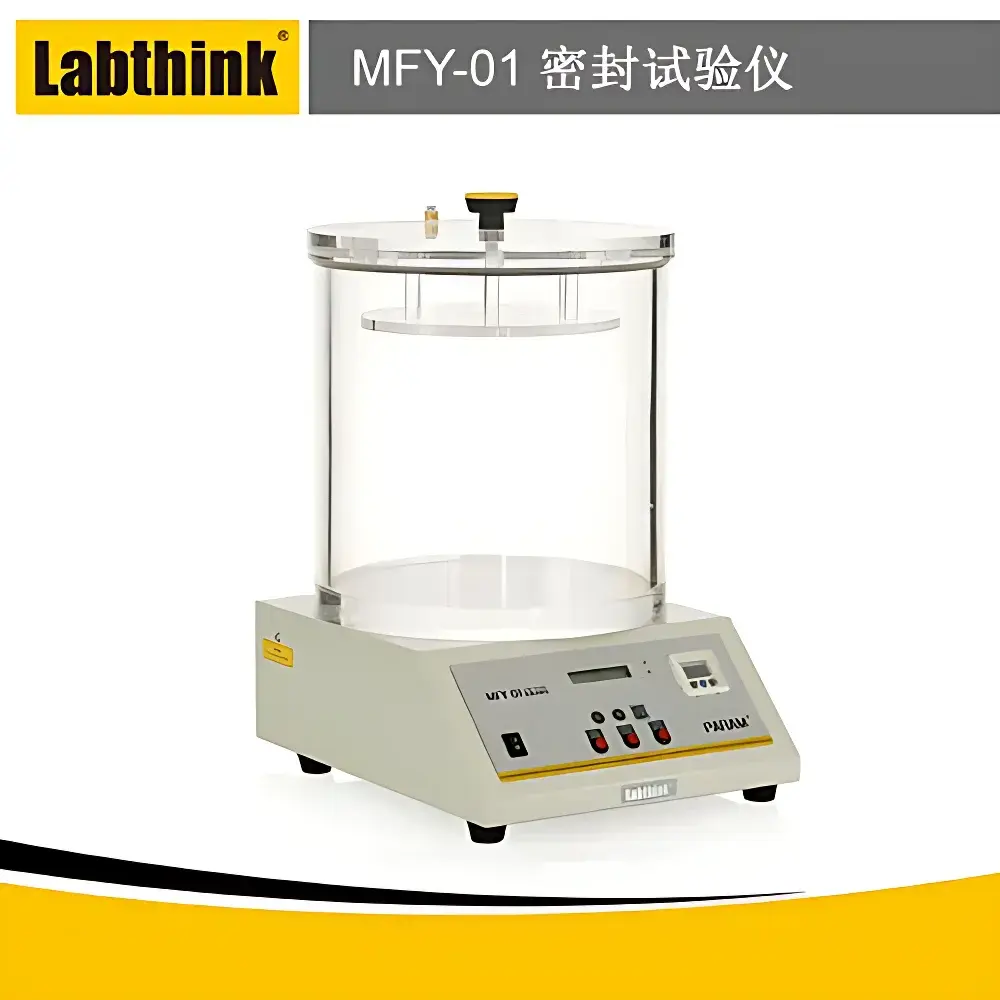
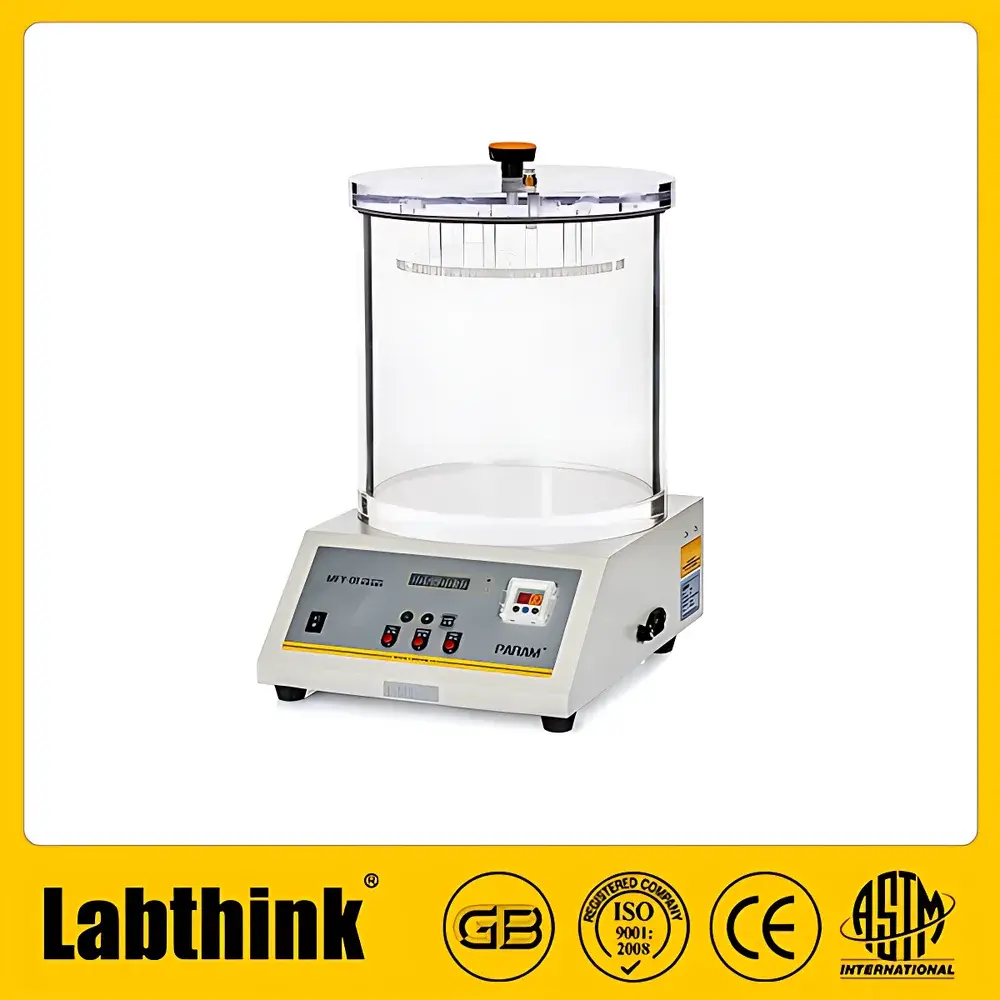
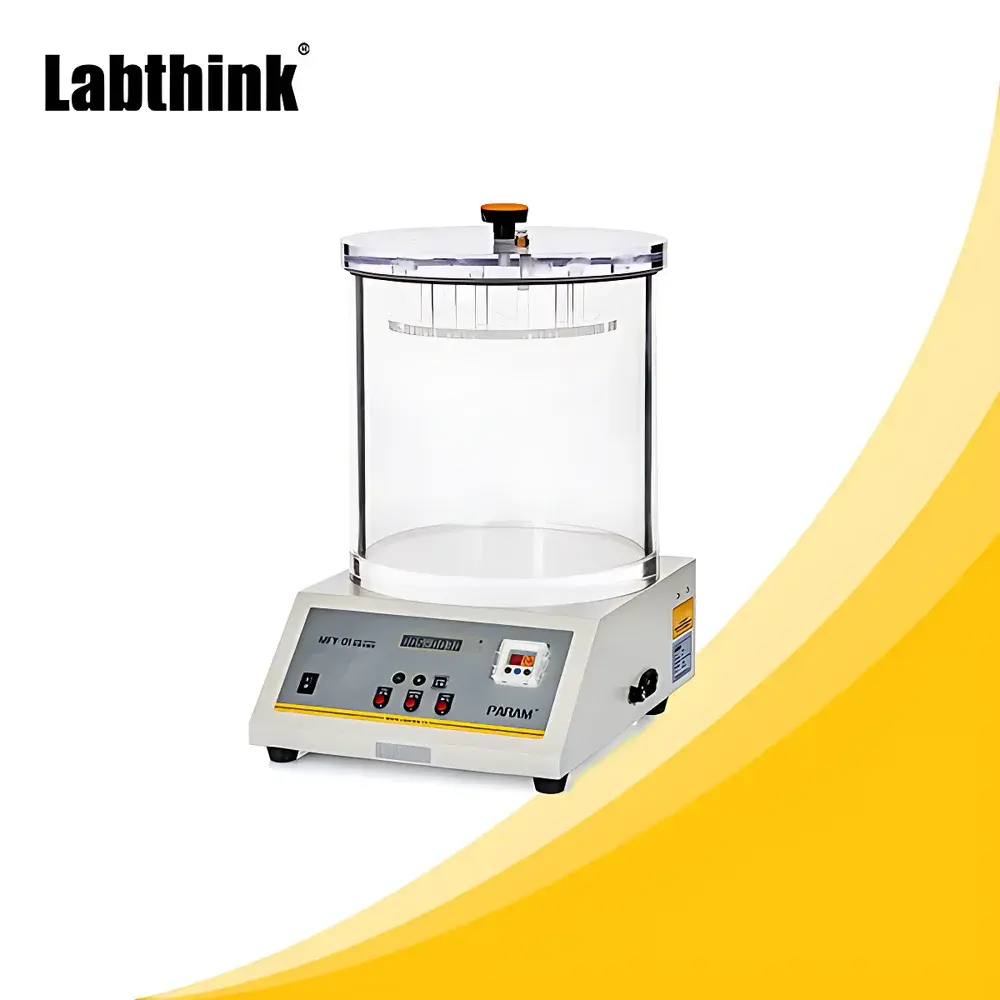
Labthink MFY-01 Vacuum Decay Seal Integrity Tester
| Brand | Labthink |
|---|---|
| Model | MFY-01 |
| Origin | Shandong, China |
| Manufacturer Type | Direct Manufacturer |
| Product Category | Domestic (China-made) |
| Price Range | USD 1,400 – 4,200 (FOB Qingdao) |
| Vacuum Range | 0 to –90 kPa |
| Accuracy Class | Class 1 |
| Standard Chamber Dimensions | Φ270 mm × 210 mm (H) (standard) |
| optional chambers | Φ360 mm × 585 mm (H), Φ460 mm × 330 mm (H) |
| Air Supply Requirement | 0.7 MPa, Φ6 mm polyurethane tubing interface |
| Power Supply | AC 220 V, 50 Hz |
| Net Weight | 12 kg |
| Compliance | GB/T 15171, ASTM D3078 |
Overview
The Labthink MFY-01 Vacuum Decay Seal Integrity Tester is an engineered solution for non-destructive, qualitative assessment of package seal integrity across regulated and industrial sectors. It operates on the principle of vacuum decay testing—applying controlled negative pressure within a sealed test chamber to induce differential pressure across the package wall. The instrument evaluates seal performance by monitoring two distinct physical responses: (1) visible gas leakage from submerged specimens (bubble emission test), and (2) reversible deformation behavior under vacuum followed by shape recovery upon pressure release (distension-recovery test). This dual-mode methodology enables robust pass/fail determination for flexible and semi-rigid packaging—including pouches, blister cards, sachets, bottles, tubes, and trays—without requiring tracer gases or destructive sampling. Designed for routine QC laboratories and packaging development environments, the MFY-01 delivers repeatable, operator-independent results aligned with standardized test protocols.
Key Features
- Microprocessor-controlled operation with backlit LCD interface and intuitive PVC membrane keypad for precise parameter entry
- Digital presetting of target vacuum level (0 to –90 kPa) and vacuum hold duration, ensuring method consistency across operators and shifts
- Integrated pneumatic system with imported solenoid valves and pressure regulators for stable vacuum generation and automatic pressure maintenance
- Auto-compensation function maintains set vacuum level during extended hold periods via real-time pressure feedback and controlled air injection
- Automated test termination and reverse-air purge cycle eliminates manual venting, reducing operator intervention and improving throughput
- Modular vacuum chamber design supports three standard configurations (Φ270×210 mm, Φ360×585 mm, Φ460×330 mm H), with custom dimensions available upon request
- Class 1 vacuum accuracy per JJG 520–2019 (Chinese national metrological verification regulation), traceable to national standards
Sample Compatibility & Compliance
The MFY-01 accommodates a broad spectrum of primary and secondary packaging formats used in food, pharmaceuticals, medical devices, cosmetics, electronics, and consumer goods manufacturing. Compatible specimen types include laminated plastic pouches, aluminum foil wrappers, thermoformed trays, HDPE/PP bottles, collapsible tubes, and rigid PET containers. The system supports post-stress evaluation—e.g., seal integrity verification after simulated distribution hazards such as drop impact, compression, or vibration per ISTA or ASTM D4169 protocols. Regulatory alignment includes compliance with GB/T 15171–1994 “Method for Determination of Seal Integrity of Flexible Package” and ASTM D3078–22 “Standard Test Method for Determination of Leaks in Flexible Packaging by Bubble Emission.” While not inherently 21 CFR Part 11 compliant, audit trails and user access logs can be implemented externally via integrated LIMS or laboratory SOP documentation.
Software & Data Management
The MFY-01 operates as a standalone hardware platform without embedded PC-based software. All test parameters and outcomes are recorded manually or via external lab notebooks. For GMP-aligned environments, users may integrate the device into validated electronic record systems using time-stamped operator entries, printed test reports (via optional thermal printer), and version-controlled SOPs. Raw data—vacuum setpoint, actual achieved vacuum, hold time, observed failure mode (e.g., “continuous bubble stream at seal edge”), and pass/fail designation—are retained per batch or lot for traceability. Calibration records, preventive maintenance logs, and chamber dimension verification must be maintained separately in accordance with ISO/IEC 17025 or internal quality management requirements.
Applications
- Final packaging release testing for sterile barrier systems in pharmaceutical and medical device manufacturing
- Process validation support for heat-sealing, RF sealing, and adhesive bonding operations
- Root cause analysis of seal failures during packaging line troubleshooting
- Comparative evaluation of new packaging materials or sealant formulations
- Stability study packaging qualification per ICH Q5C guidelines
- Supplier qualification audits for contract packaging organizations (CPOs)
- Regulatory submission evidence for FDA IND/ANDA/NDA or EMA marketing authorization applications
FAQ
What vacuum accuracy class does the MFY-01 meet?
The instrument meets Class 1 vacuum accuracy per JJG 520–2019, with full-scale error ≤ ±1% of reading across its operational range (0 to –90 kPa).
Is compressed air supply included with the system?
No. A clean, dry, oil-free compressed air source delivering 0.7 MPa is required and must be provided by the user. The unit accepts Φ6 mm polyurethane tubing via standard push-to-connect fittings.
Can the MFY-01 detect micro-leaks smaller than 50 µm?
The MFY-01 is a qualitative, macro-leak detection tool based on visual observation. It is not designed for quantifying leak rates or detecting sub-50 µm channels; for such sensitivity, helium mass spectrometry or laser-based tracer gas methods are recommended.
Does the system support GLP-compliant data archiving?
As a stand-alone instrument, it does not generate electronic audit trails. GLP compliance requires procedural controls—e.g., dual-operator sign-off, bound logbooks, and documented calibration history—as defined in OECD Principles of GLP.
Are chamber replacement options certified for use with the base unit?
Yes. Optional chambers undergo functional verification against the same vacuum stability and sealing integrity criteria as the standard chamber and are supplied with dimensional certification reports.





