
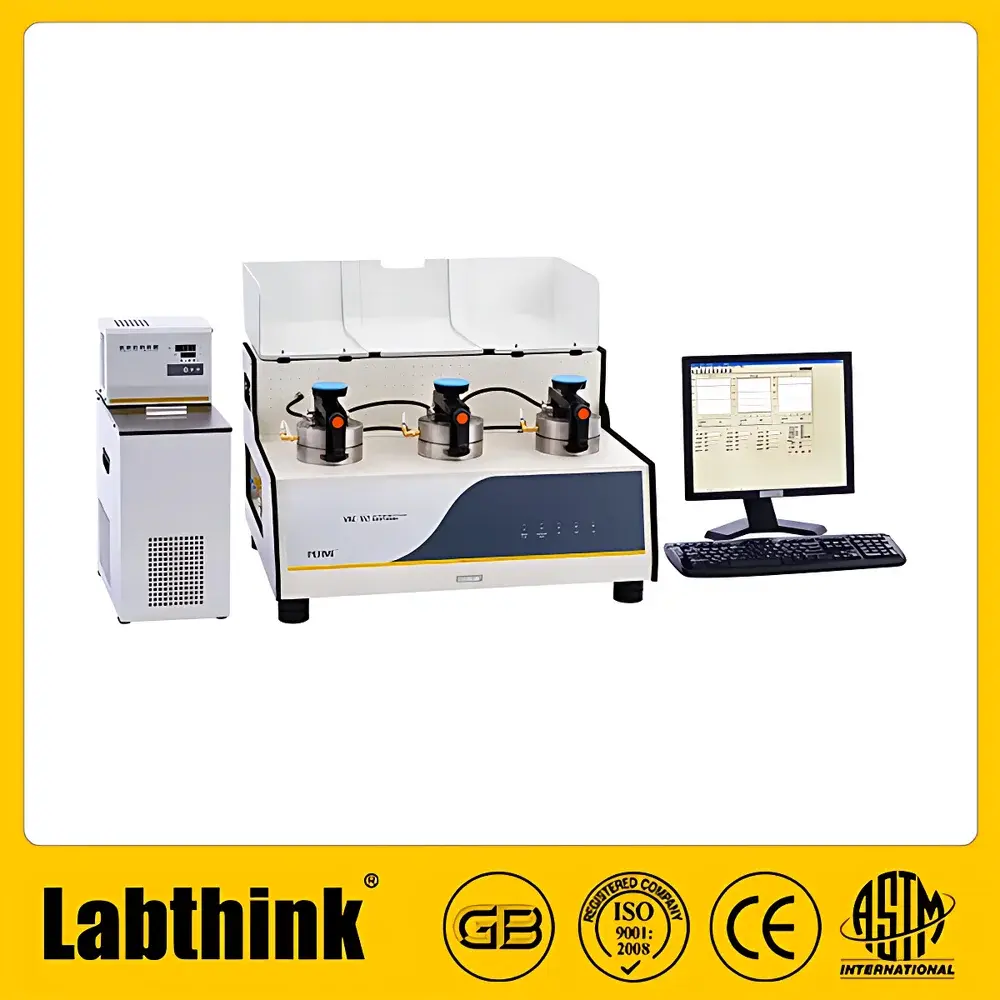
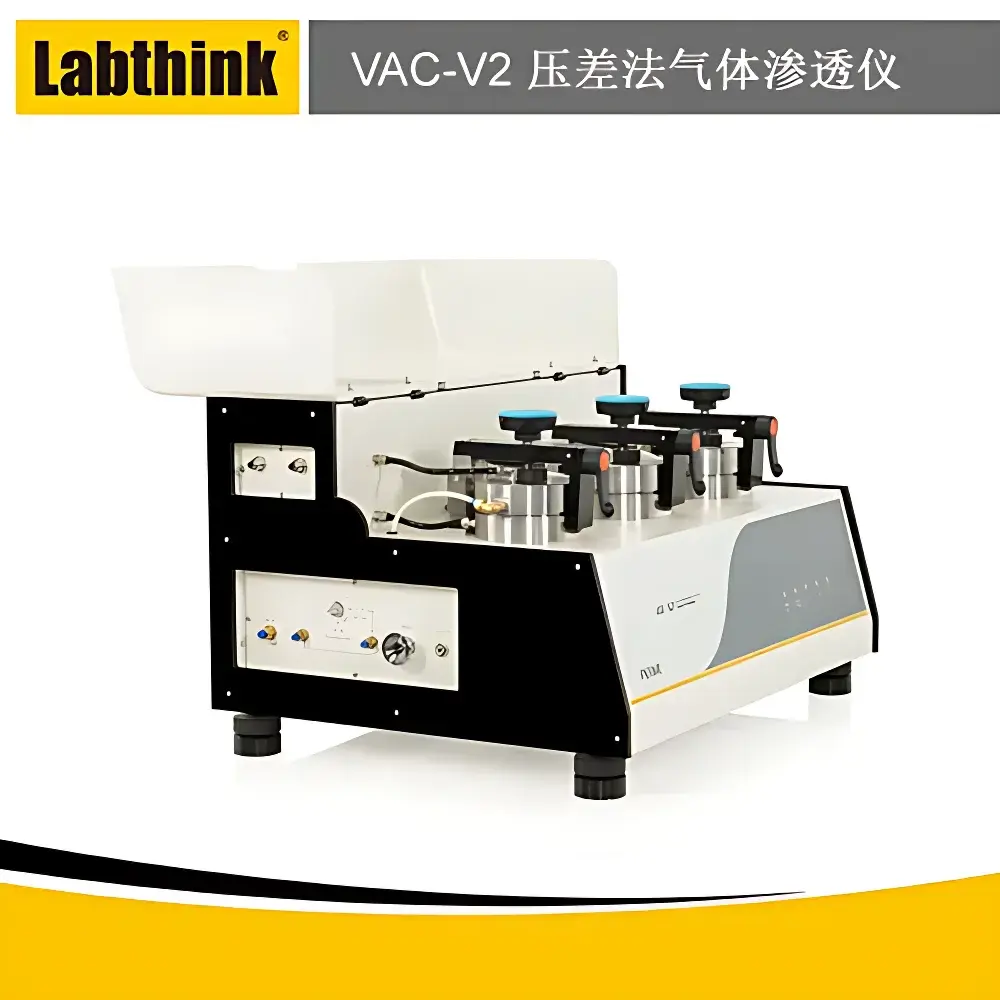
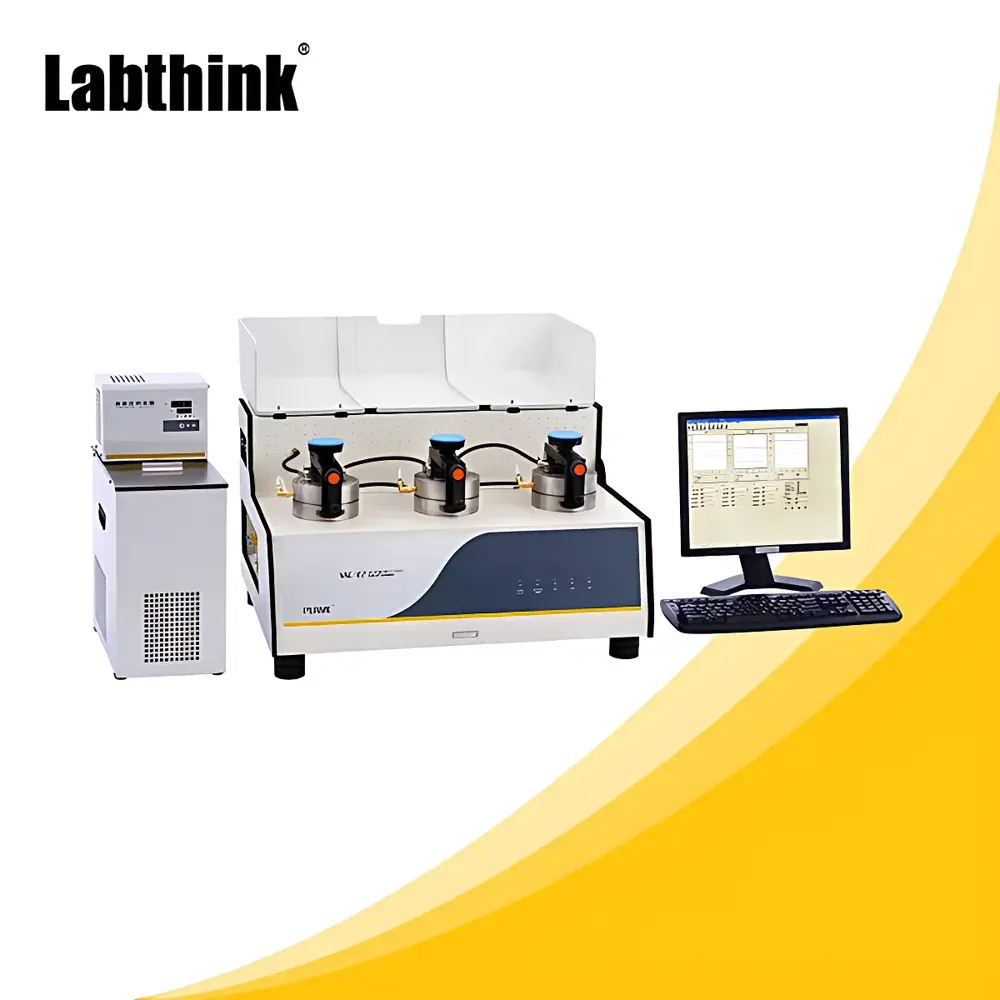
Labthink VAC-V2 Differential Pressure Gas Permeability Analyzer
| Brand | Labthink |
|---|---|
| Model | VAC-V2 |
| Measurement Principle | Differential Pressure (Manometric) Method |
| Test Gases | O₂, N₂, CO₂, Air, He, etc. |
| Test Range | 0.05–50,000 cm³/m²·24h·0.1 MPa (standard) |
| Specimen Count | 3 independent test cells |
| Vacuum Resolution | 0.1 Pa |
| Chamber Vacuum Level | <20 Pa |
| Temperature Control Range | 5–95 °C |
| Temp. Stability | ±0.1 °C |
| Humidity Control Range | 0% RH, 2–98.5% RH, 100% RH (humidification module optional) |
| Humidity Accuracy | ±1% RH |
| Specimen Diameter | Φ97 mm |
| Effective Test Area | 38.48 cm² |
| Test Pressure Differential | –0.1 to +0.1 MPa |
| Supply Gas Pressure | 0.4–0.6 MPa |
| Interface | Ø6 mm polyurethane tubing |
| Dimensions (L×W×H) | 760 × 575 × 450 mm |
| Weight | 88 kg |
| Power | 220 VAC 50 Hz / 120 VAC 60 Hz |
| Compliance | ISO 15105-1, ISO 2556, ASTM D1434, GB/T 1038–2000, JIS K7126-1, YBB 00082003 |
Overview
The Labthink VAC-V2 Differential Pressure Gas Permeability Analyzer is a precision-engineered instrument designed for the quantitative determination of gas transmission rates (GTR), permeability coefficients (P), diffusion coefficients (D), and solubility coefficients (S) in polymeric films, laminates, foils, and rigid sheet materials. It operates on the well-established differential pressure (manometric) method—defined in ISO 15105-1 and ASTM D1434—where a controlled pressure gradient is maintained across a sealed specimen, and the time-dependent accumulation of permeant gas in the low-pressure (vacuum) chamber is measured via high-resolution pressure transduction. This principle enables trace-level detection of gas flux under thermodynamically stable conditions, supporting rigorous structure–property analysis of barrier materials used in pharmaceutical packaging, food preservation, aerospace encapsulation, and sustainable packaging development—including biodegradable films and multilayer coextrusions.
Key Features
- Triple independent test chambers: Enables concurrent, statistically independent measurement of three specimens—identical or dissimilar—under identical environmental conditions, improving throughput and inter-sample comparability.
- High-fidelity environmental control: Integrated Peltier-based temperature regulation (5–95 °C, ±0.1 °C stability) and optional humidity generation (2–98.5% RH, ±1% RH accuracy) allow simulation of real-world storage and transit conditions per ISO 2556 Annex A and USP .
- Dual-mode test logic: Supports both proportional control and fuzzy logic algorithms for dynamic adjustment of vacuum ramping and pressure equilibration, minimizing overshoot and ensuring optimal signal-to-noise ratio during low-flux measurements.
- Extended-range capability: Standard configuration covers 0.05–50,000 cm³/m²·24h·0.1 MPa; optional large-volume expansion kits extend upper limit to ≥500,000 cm³/m²·24h·0.1 MPa—suitable for evaluating non-barrier substrates such as PE liners or uncoated paperboard.
- Hazardous gas adaptability: With factory-modified gas handling pathways (e.g., explosion-proof solenoids, stainless-steel wetted parts, inert purge sequences), the system supports safe testing with flammable (e.g., H₂, CH₄) or toxic gases (e.g., SO₂, Cl₂) under user-defined safety protocols.
- Automated calibration & traceability: Includes certified reference films traceable to NIST-equivalent standards; software-guided calibration routines ensure metrological consistency across laboratories and audit cycles.
Sample Compatibility & Compliance
The VAC-V2 accommodates flat, non-porous specimens up to Φ97 mm (38.48 cm² effective area), including monolayer plastics (PET, PP, PA), metallized films (AlOx, SiOx, Al foil), polymer-coated papers, rubber sheets (EPDM, butyl), fiber-reinforced composites (PTFE-coated fiberglass), and emerging biopolymers (PLA, starch-based blends). All test methodologies conform to internationally recognized standards: ISO 15105-1 (determination of oxygen transmission rate), ISO 2556 (general gas permeability), ASTM D1434 (O₂, N₂, CO₂), JIS K7126-1 (Japanese industrial standard), and YBB 00082003 (Chinese pharmaceutical packaging regulation). Data acquisition complies with ALCOA+ principles—attributable, legible, contemporaneous, original, accurate—and supports 21 CFR Part 11–compliant electronic signatures when integrated with validated Lystem™ Laboratory Data Management System (LDMS).
Software & Data Management
Control and analysis are executed via Labthink’s proprietary PermeationMaster™ software, a Windows-based application featuring real-time pressure curve visualization, automatic endpoint detection, Arrhenius-based temperature extrapolation (for prediction at non-tested temperatures), and multi-parameter regression (P = D × S). Raw pressure vs. time datasets are stored in encrypted .lpm binary format with full metadata tagging (operator ID, calibration status, environmental logs, audit trail timestamps). Export options include CSV, PDF reports (ISO/IEC 17025–compatible templates), and direct integration into Lystem™ LDMS for cross-instrument data harmonization, trend analysis, and automated certificate generation. All software modules undergo annual IQ/OQ validation per GAMP 5 guidelines.
Applications
Beyond routine QC of packaging films (e.g., blister lidding, pouch laminates, medical device pouches), the VAC-V2 supports advanced R&D applications: accelerated aging studies via elevated-temperature permeation kinetics; formulation screening of nanocomposite barriers (e.g., graphene oxide–PE hybrids); helium leak rate modeling for inflatable aerospace components; CO₂ permeability profiling of carbonated beverage bottle preforms; water vapor–gas coupling effects in humidified barrier testing; and regulatory submission packages for FDA 510(k) or EMA CTD Module 3 dossiers. Its capacity to resolve ultra-low transmission rates (<0.1 cm³/m²·24h·0.1 MPa) makes it suitable for evaluating next-generation high-barrier coatings used in flexible OLED encapsulation.
FAQ
What gases can be tested with the VAC-V2?
Standard configurations support O₂, N₂, CO₂, air, and He. Custom modifications enable safe operation with H₂, CH₄, SO₂, and other reactive or hazardous gases—subject to risk assessment and installation of approved gas-handling hardware.
Is humidity control built-in?
Relative humidity control is available as an optional module (not included in base configuration); it delivers precise RH setpoints from 2% to 98.5% using gravimetric vapor generation and feedback-controlled saturation.
How is system calibration verified?
Certified standard membranes with NIST-traceable permeability values are supplied for periodic verification; software includes automated calibration report generation with uncertainty budgets per ISO/IEC 17025 Clause 6.5.
Can test data be exported to LIMS?
Yes—via RS232 serial interface or TCP/IP Ethernet connection, raw and processed data integrate directly with major LIMS platforms using ASTM E1384-compliant messaging or custom API endpoints.
What maintenance is required for long-term accuracy?
Annual vacuum pump oil replacement, quarterly recalibration of pressure transducers, and biannual inspection of O-rings and sealing surfaces are recommended; full service documentation and OEM spare parts kits are provided with each instrument.




