
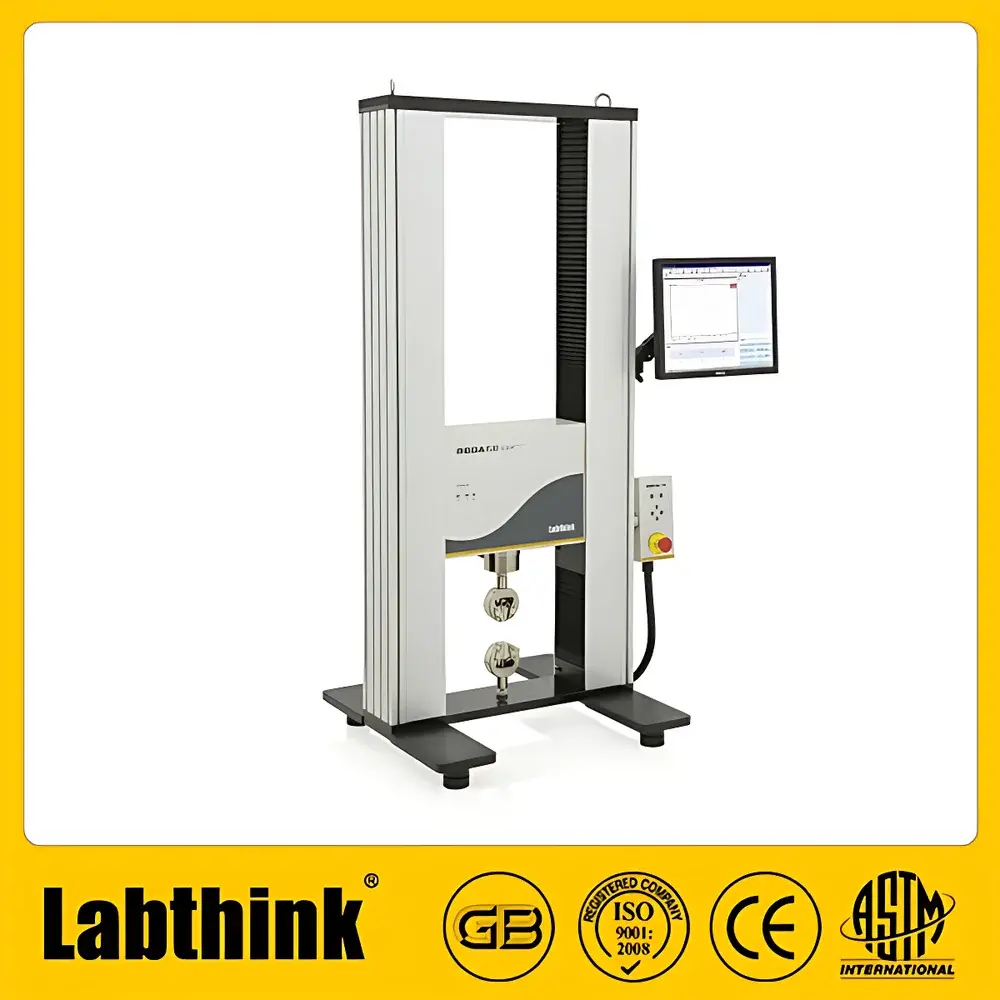
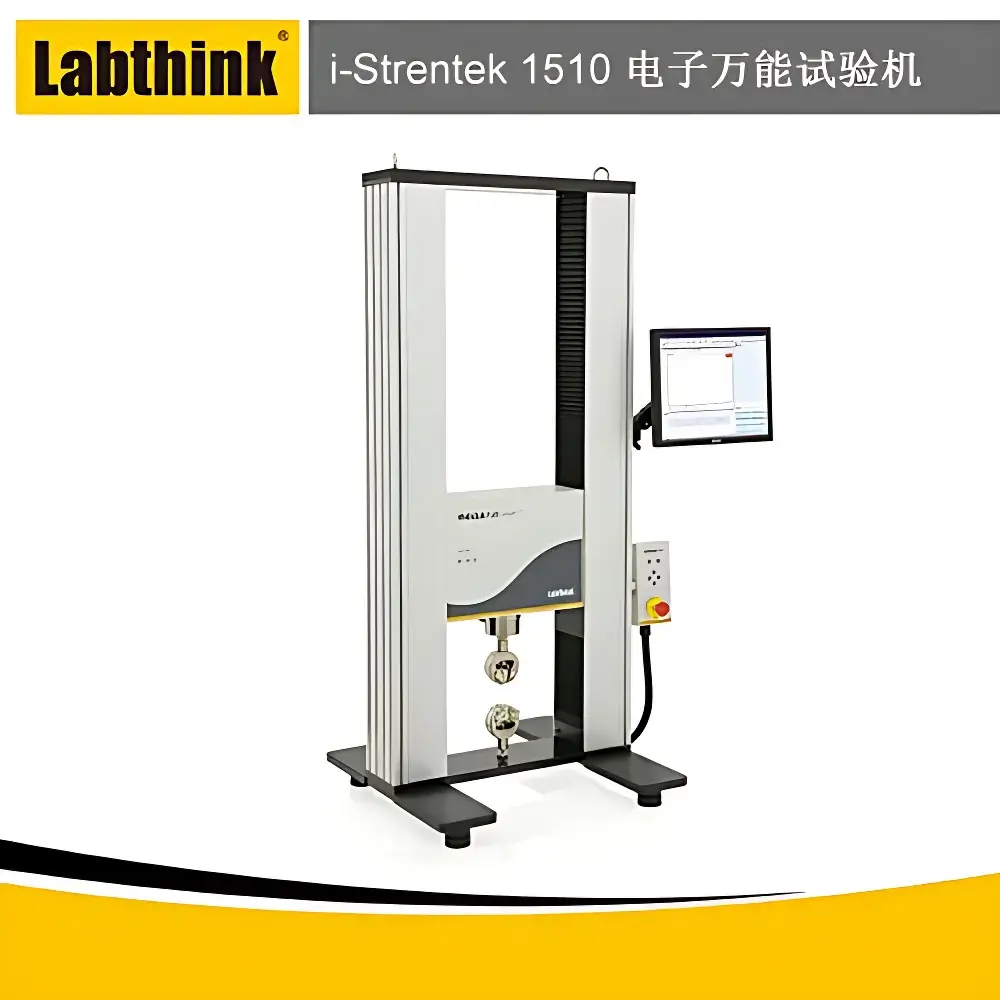
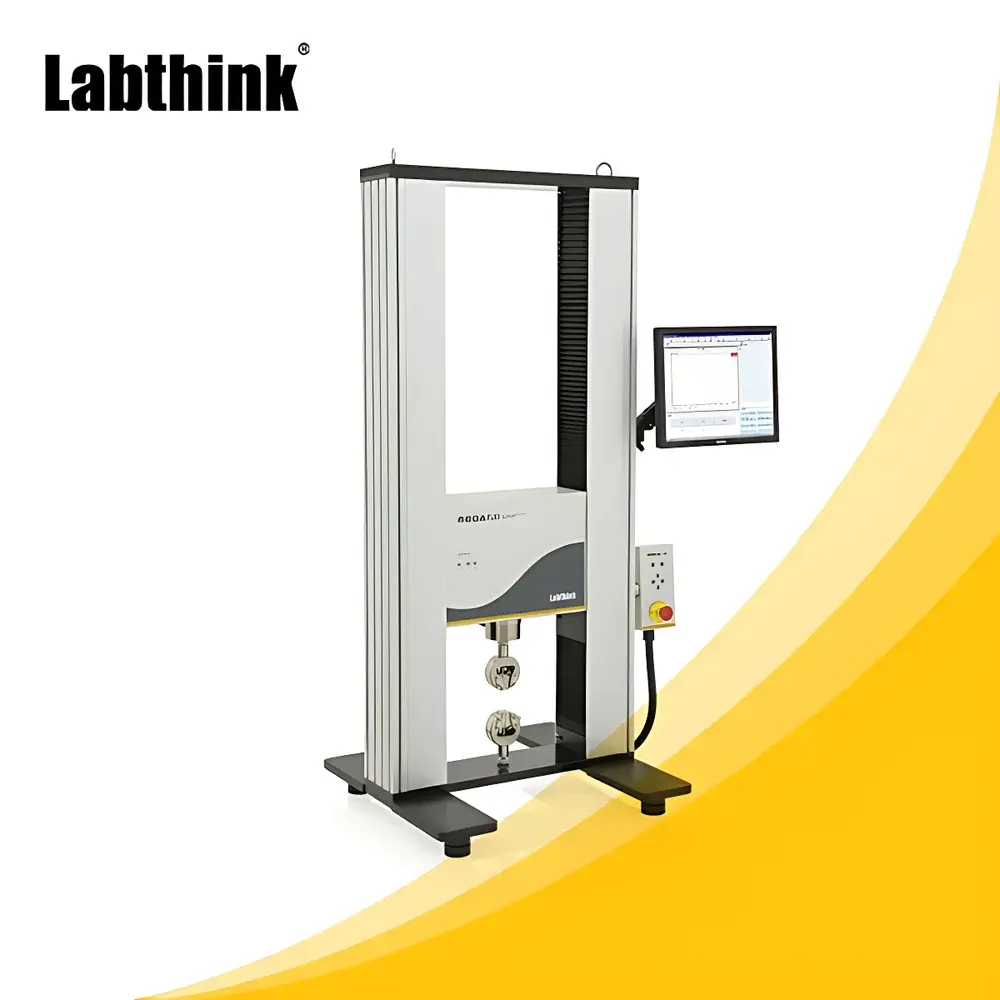
Labthink i-Strentek 1510 Servo-Controlled Universal Testing Machine with LCD Display
| Brand | Labthink |
|---|---|
| Origin | Shandong, China |
| Manufacturer Type | Direct Manufacturer |
| Instrument Type | Electromechanical Universal Testing Machine |
| Model | i-Strentek 1510 |
| Force Capacity Options | 50 N, 100 N, 250 N, 500 N (standard), 1000 N, 2000 N, 5000 N, 10000 N |
| Accuracy Class | ISO 7500-1 / ASTM E4 Class 1 |
| Test Speed Range | 1–500 mm/min (infinitely variable) |
| Maximum Travel | 800 mm |
| Test Station | Single |
| Clamping Method | Pneumatic or Manual |
| Air Supply Requirement | 0.5–0.7 MPa (Ø6 mm polyurethane tubing) |
| Dimensions (L×W×H) | 850 × 700 × 1630 mm |
| Weight | 150 kg |
| Power Supply | 220 VAC 50 Hz / 120 VAC 60 Hz |
| Interface Ports | 4 × USB, 2 × Ethernet |
Overview
The Labthink i-Strentek 1510 is a high-precision, servo-controlled electromechanical universal testing machine engineered for static mechanical property evaluation of flexible and semi-rigid materials across R&D, QC, and regulatory compliance laboratories. It operates on the fundamental principle of uniaxial tensile/compressive force application: a motor-driven crosshead moves relative to a fixed base, while integrated load cells (mounted on the moving crosshead) and high-resolution displacement transducers continuously record force and extension data in real time. This architecture enables accurate derivation of key mechanical parameters—including tensile strength, elongation at break, Young’s modulus, yield stress, peel strength, tear resistance, seal integrity, and compressive stiffness—under controlled displacement or speed modes. Designed for adherence to international mechanical testing standards, the system supports full traceability and reproducibility required in GLP, GMP, and ISO/IEC 17025 environments.
Key Features
- Servo-motor-driven dual-column frame with preloaded ball-screw transmission ensures minimal backlash, high positional repeatability (< ±0.02 mm), and smooth motion across the full 1–500 mm/min speed range.
- Modular force sensor architecture: Standard 500 N capacity with optional upgrades up to 10 kN; all sensors conform to ISO 7500-1 Class 1 accuracy and are factory-calibrated with NIST-traceable certificates.
- Integrated pneumatic clamping system (0.5–0.7 MPa supply) delivers consistent gripping pressure across film, foil, paperboard, and elastomeric specimens—reducing slippage and edge damage during high-speed or low-force tests.
- Embedded Linux-based control system with 7-inch TFT-LCD touchscreen interface, tactile membrane keys, and footswitch support enables standalone operation without external PC dependency.
- Multi-level hardware safety: Mechanical end-stop limit switches, software-defined overload cutoff (configurable threshold), automatic rapid return upon test completion, and real-time fault diagnostics with on-screen error codes.
- Expandable I/O architecture: Four USB 2.0 ports for peripheral devices (e.g., barcode scanners, external storage) and dual Gigabit Ethernet interfaces for networked data export, remote monitoring, and integration into LIMS or MES platforms.
Sample Compatibility & Compliance
The i-Strentek 1510 accommodates an extensive portfolio of specimen geometries and material classes—from sub-millimeter-thick polymer films (e.g., PET, PE, BOPP) and laminated pouches to rigid containers (IBC totes, corrugated boxes, plastic drums) and biomedical components (IV bag seals, syringe plungers, catheter hubs). Over 100 specialized fixtures—including 90°/180° peel jaws, trouser-tear clamps, compression platens, eccentric grips, and custom angular pull adapters—are available to meet application-specific alignment and loading requirements. The instrument is validated against more than 40 national and international standards, including ASTM D882 (tensile properties of thin plastics), ASTM F88 (seal strength of flexible barrier materials), ISO 37 (vulcanized rubber tensile testing), GB/T 1040 series (plastics tensile methods), GB/T 12914 (paper tensile), and YBB pharmaceutical packaging standards. Optional DataShield™ configuration provides audit-ready electronic records compliant with FDA 21 CFR Part 11 requirements, including user authentication, electronic signatures, and immutable change logs.
Software & Data Management
The embedded TestMaster™ software offers intuitive test method setup, real-time curve visualization (force vs. displacement, stress vs. strain), and automated calculation of over 30 mechanical indices per test cycle. Batch testing supports up to 99 specimens per group, with statistical post-processing including mean, standard deviation, coefficient of variation, min/max, and confidence intervals. Curve overlay functionality enables comparative analysis across materials, batches, or aging conditions. Raw data exports as CSV or XML files include full metadata (operator ID, timestamp, environmental conditions if linked to optional climate chamber), calibration history, and test parameter logs. When equipped with DataShield™, all data transactions are cryptographically signed, version-controlled, and stored in tamper-evident repositories—with role-based access control, retention policies, and automated backup to NAS or cloud infrastructure.
Applications
Primary applications span packaging integrity validation (heat seal strength, peel adhesion of laminates, puncture resistance of blister foils), polymer characterization (modulus profiling of thermoplastic elastomers, creep behavior of hydrogels), and container performance assessment (compressive load-to-failure of fiber drums, buckling resistance of collapsible tubes). Secondary use cases include medical device component testing (syringe barrel rigidity, IV connector pull-off force, wound dressing adhesion), consumer product evaluation (toothbrush bristle fatigue, cosmetic applicator torque, snack bag reseal strength), and academic research on bio-based films, nanocomposites, and recycled polymers. Custom fixture development services enable adaptation to non-standard geometries—such as tapered vials, multi-layer pouch corners, or orthopedic foam samples—without compromising measurement fidelity.
FAQ
What standards does the i-Strentek 1510 support out-of-the-box?
It natively implements test protocols aligned with ASTM D882, ASTM F88, ISO 37, GB/T 1040.1–1040.5, GB/T 12914, and YBB pharmaceutical packaging standards. Custom method templates can be imported via XML for proprietary or internal specifications.
Is the system compatible with third-party LIMS or ELN platforms?
Yes—via its dual Ethernet ports and RESTful API support (available under Labthink’s OpenLink™ SDK), enabling bidirectional data exchange with major laboratory informatics systems.
Can the force range be changed during routine operation?
Force transducers are hardware-configured; switching between capacities (e.g., from 500 N to 10 kN) requires physical sensor replacement and recalibration—performed by certified Labthink service engineers.
Does the embedded software support multi-language UI?
The interface supports English, Simplified Chinese, and Spanish; additional languages may be enabled upon request for enterprise deployments.
What maintenance is required to sustain ISO 17025 compliance?
Annual verification against reference load standards (±0.5% tolerance), biannual ball-screw lubrication, and quarterly validation of displacement encoder linearity using calibrated step gauges are recommended—and fully documented in the included Maintenance Logbook module.



