
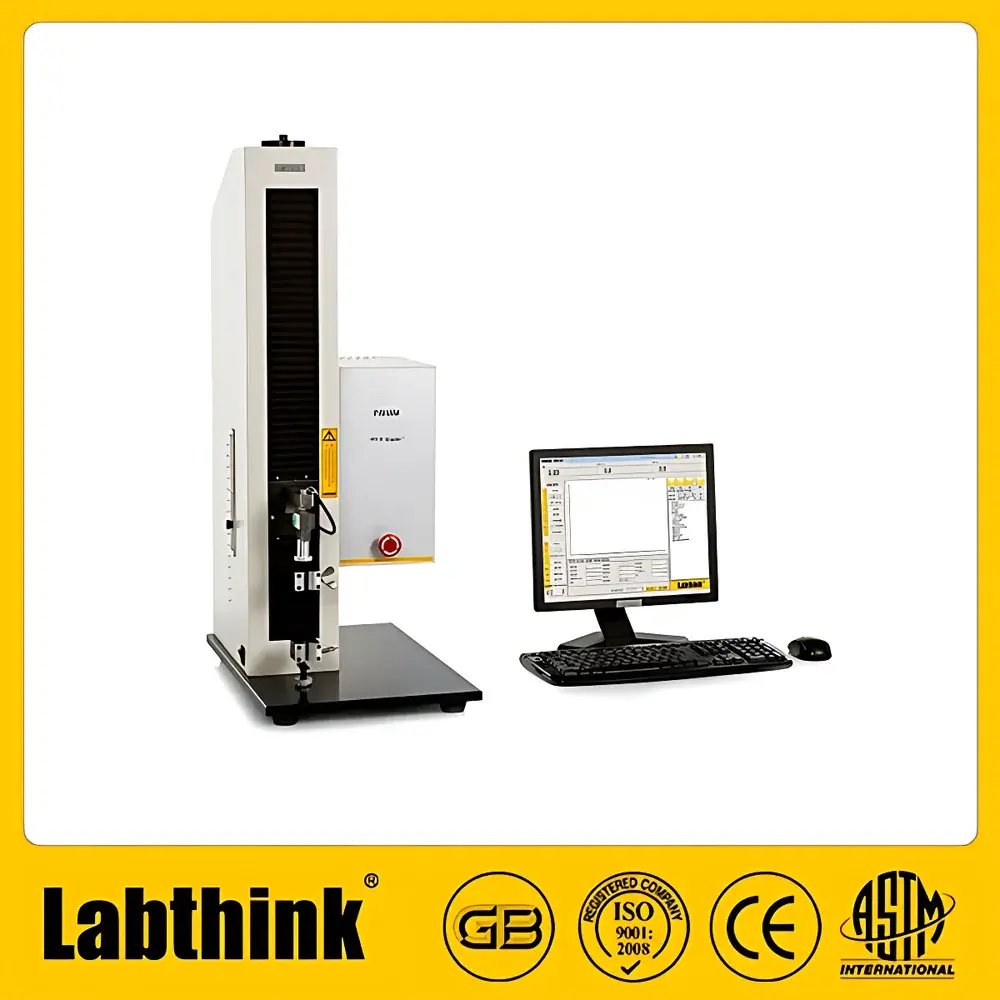
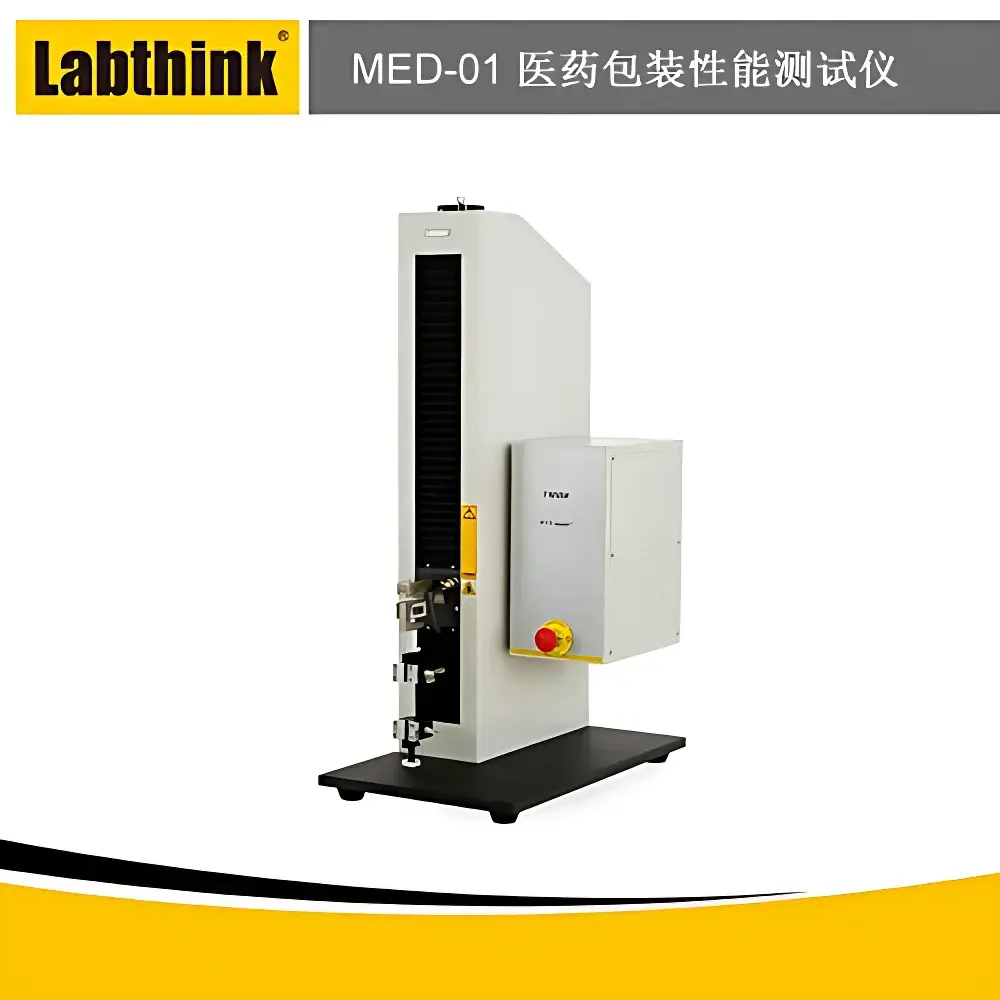
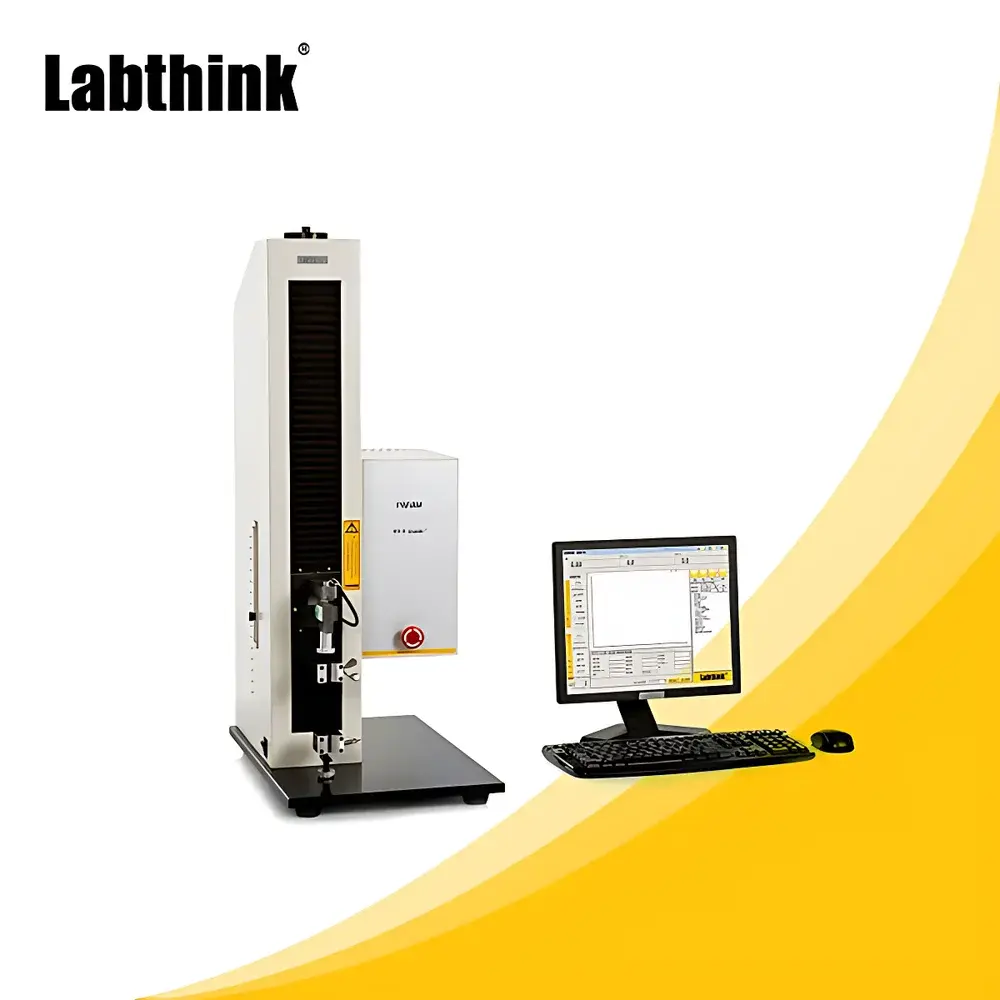
Labthink MED-01 Medical Protective Clothing Tensile Tester for Breaking Force and Elongation at Break
| Brand | Labthink |
|---|---|
| Model | MED-01 |
| Origin | Shandong, China |
| Manufacturer Type | Original Equipment Manufacturer (OEM/ODM) |
| Compliance | GB 19082-2009, YY/T 1498-2016, ASTM D882, ISO 37, GB/T 1040.2-2006 |
| Force Range | 250 N (standard), optional 50–1000 N sensors |
| Accuracy | Better than Class 0.5 per ISO 7500-1 |
| Test Speed | 10–300 mm/min (bidirectional, programmable) |
| Gauge Length | 30 mm (standard), 50 mm (optional) |
| Crosshead Travel | 600 mm |
| Dimensions | 851 × 500 × 940 mm (L×W×H) |
| Weight | 68 kg |
| Power | 220 VAC 50 Hz / 120 VAC 60 Hz |
Overview
The Labthink MED-01 Medical Protective Clothing Tensile Tester is a precision universal testing instrument engineered for the quantitative mechanical characterization of single-layer and multilayer medical barrier materials—specifically designed to meet regulatory requirements for disposable medical protective clothing as defined in GB 19082-2009 and YY/T 1498-2016. It operates on the fundamental principle of uniaxial tensile testing: a standardized specimen is clamped between two parallel grips, and the moving crosshead applies controlled, linear displacement while high-fidelity load cells (traceable to national metrological standards) continuously record force response. Simultaneously, an integrated high-resolution encoder captures real-time displacement data. From this synchronized force–displacement curve, the instrument computes critical parameters including breaking force (in newtons), elongation at break (%), tensile strength (MPa), modulus at specified strain offsets, and yield point—enabling full compliance verification against minimum thresholds (e.g., ≥45 N breaking force and ≥15% elongation for critical zones of protective gowns).
Key Features
- Class 0.5 accuracy certified per ISO 7500-1, ensuring traceable, repeatable results across laboratories and audit cycles.
- Dual-mode actuation architecture supporting both tension and compression testing—essential for evaluating seal integrity, puncture resistance, and compression-set behavior in composite medical packaging systems.
- Sixteen preconfigured test methods compliant with ISO, ASTM, GB, YY, and JIS standards—including tensile, peel (90° and 180°), tear (trouser, Elmendorf), puncture, and push-pull configurations.
- Modular sensor platform with interchangeable load cells (50 N to 1000 N), allowing users to optimize signal-to-noise ratio for low-force applications (e.g., film seal strength) or high-load validation (e.g., reinforced gown seams).
- Embedded Linux-based control system with intuitive touchscreen interface, eliminating external PC dependency while supporting GLP-compliant user access control and electronic signature workflows.
- Full bidirectional speed control (10–300 mm/min) with programmable acceleration/deceleration profiles—critical for simulating realistic donning/doffing stresses and avoiding inertial artifacts during high-speed rupture events.
Sample Compatibility & Compliance
The MED-01 accommodates specimens up to 30 mm wide (standard) or 50 mm (optional), with manual wedge-action grips ensuring uniform stress distribution and minimal slippage for low-modulus nonwovens, laminated films, and coated textiles. Over 100 specialized fixtures—including ASTM D1938 trouser-tear jigs, ISO 11607 peel anvils, and YY 0613-2007 syringe plunger adapters—are available to extend applicability beyond protective clothing into sterile barrier systems, infusion bags, blister lidding, and drug-device combination products. All test protocols align with FDA-recommended validation frameworks and support 21 CFR Part 11-compliant audit trails when integrated with Lystem™ Laboratory Data Management System (LDMS)—including timestamped operator logs, method versioning, raw data immutability, and electronic report generation.
Software & Data Management
The embedded MED-OS software provides real-time graphing of force–displacement curves, automatic peak detection, and configurable pass/fail limits based on regulatory thresholds. Raw data exports in CSV and XML formats preserve full metadata (test date, operator ID, calibration certificate ID, environmental conditions). When networked, the instrument interfaces natively with Lystem™ LDMS—a validated, server-based platform enabling centralized storage, cross-instrument trending, statistical process control (SPC) charting, and automated PDF report generation with digital signatures. All software modules undergo periodic revalidation per ICH Q9 and ISO/IEC 17025 requirements.
Applications
Beyond primary use in GB 19082-2009-compliant protective gown qualification, the MED-01 serves as a core mechanical testing platform across regulated healthcare manufacturing: tensile evaluation of surgical drapes and gowns; peel strength validation of peel-open pouches (ASTM F88); puncture resistance of IV bag ports (ISO 8536-4); needle-shield retention force (ISO 11348); syringe barrel–plunger friction (ISO 11040-4); and compression deformation of foam wound dressings (ISO 13485 Annex A). Its modularity supports R&D investigations into fiber orientation effects, hydroentanglement strength loss after sterilization, and accelerated aging impacts on polypropylene melt-blown layers.
FAQ
Does the MED-01 comply with FDA 21 CFR Part 11 for electronic records?
Yes—when operated with Lystem™ LDMS under configured audit-trail and electronic signature settings, it meets all technical and procedural requirements for electronic records and signatures.
Can the instrument validate both dry and wet-state mechanical properties?
Yes—optional environmental chambers (−20 °C to +80 °C) and humidity-controlled enclosures enable conditioning per ISO 291 prior to testing, critical for assessing hydrophilic nonwoven performance after simulated exposure.
Is calibration traceable to national standards?
All load cells are calibrated using NIST-traceable deadweight standards, with certificates issued per ISO/IEC 17025 by an ILAC-accredited lab; recalibration intervals are configurable within the software.
What maintenance is required for long-term accuracy?
Annual verification of crosshead alignment, grip parallelism, and encoder resolution is recommended; Labthink provides on-site service contracts with ISO 13485-certified technicians.
How does the MED-01 handle anisotropic materials like spunbond-meltblown-spunbond (SMS) laminates?
Directional testing modes allow independent evaluation of machine-direction (MD) and transverse-direction (TD) tensile properties, with automatic calculation of isotropy ratios per ASTM D882 Annex A.



