

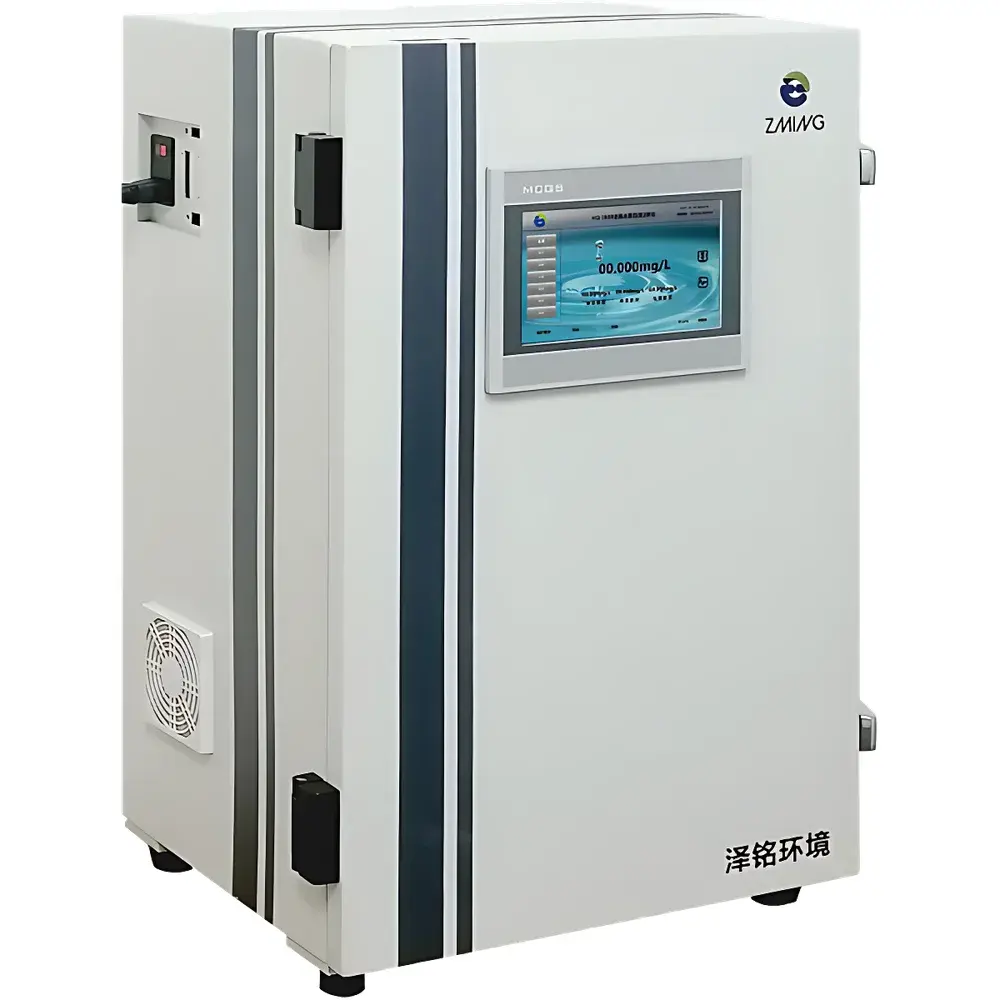
Zming Environmental HQ-3600(NO₂) Online Nitrite-Nitrogen Analyzer
| Brand | Zming Environmental Technology Co., Ltd. |
|---|---|
| Origin | Jiangsu, China |
| Manufacturer Type | Authorized Distributor |
| Country of Origin | China |
| Model | HQ-3600(NO₂) |
| Instrument Type | Online Analyzer |
| Measurement Range | 0–1 mg/L (expandable) |
| Accuracy | ±10% |
| Detection Limit | 0.01 mg/L |
| Resolution | 0.001 mg/L |
Overview
The Zming Environmental HQ-3600(NO₂) Online Nitrite-Nitrogen Analyzer is a dedicated photometric instrument engineered for continuous, unattended quantification of nitrite nitrogen (NO₂⁻–N) in natural and anthropogenic aqueous matrices. It operates on the principle of diazotization-coupling spectrophotometry: nitrite ions react with sulfanilamide under acidic conditions to form a diazonium salt, which subsequently couples with N-(1-naphthyl)ethylenediamine dihydrochloride (NEDD) to yield a stable pink azo dye. Absorbance is measured at 540 nm using a dual-beam optical system, enabling real-time correction for lamp drift, power supply fluctuations, and ambient light interference. Designed for deployment in fixed-site monitoring stations and distributed sensor networks, the HQ-3600(NO₂) delivers trace-level detection (LOD = 0.01 mg/L NO₂–N) with high reproducibility across variable water quality conditions—including seawater, riverine systems, drinking water intakes, and industrial effluents.
Key Features
- Dual-beam optical architecture with matched reference and sample paths, minimizing signal drift caused by voltage instability or LED aging.
- Capacitive fluid metering system ensuring precise, pulse-free delivery of sample and reagents—critical for maintaining stoichiometric reaction integrity and inter-run repeatability (RSD < 3% at 0.5 mg/L).
- Integrated color and turbidity compensation algorithm: concurrent measurement at 700 nm corrects for non-specific absorbance from suspended solids and dissolved humics, extending operational validity in waters with turbidity up to 500 NTU.
- Stabilized reagent formulation with enhanced shelf life: proprietary preservative matrix extends unrefrigerated reagent stability to 90 days without performance degradation—reducing maintenance frequency and field logistics burden.
- Modular design supporting hot-swappable consumables (cartridge-based reagent packs, flow cells, and waste containers), enabling <5-minute service interventions during routine calibration or replacement cycles.
Sample Compatibility & Compliance
The HQ-3600(NO₂) accommodates raw, filtered, or pre-treated water samples without mandatory pretreatment—provided particulate load remains within ISO 7027-compliant turbidity limits. It meets core functional requirements outlined in EPA Method 354.1 (Nitrite by Diazotization) and aligns with ISO 15681-2:2015 (Water quality — Determination of orthophosphate and total phosphorus — Part 2: Spectrometric method after digestion), adapted for nitrite-specific validation protocols. Data output conforms to SDI-12 and Modbus RTU communication standards, facilitating integration into SCADA platforms compliant with IEC 62443-3-3 for industrial cybersecurity. The analyzer supports audit-trail-enabled operation per GLP principles, with timestamped event logging (calibration, error, maintenance) stored locally and exportable via RS-485 or optional Ethernet module.
Software & Data Management
Embedded firmware provides configurable measurement intervals (15 min to 24 h), programmable auto-zero and multi-point calibration routines (up to 5 standards), and dynamic range extension via dilution logic. All operational parameters, raw absorbance values, and diagnostic logs are stored in non-volatile memory with 30-day local retention. Remote access is enabled through a secure web interface (HTTPS/TLS 1.2) supporting user role-based permissions (operator, technician, administrator). Export formats include CSV and XML, compatible with LIMS environments requiring 21 CFR Part 11–compliant electronic records when paired with external digital signature modules. Firmware updates are delivered via signed OTA packages with SHA-256 verification.
Applications
- Real-time monitoring of nitrite breakthrough in drinking water distribution systems following chloramination or nitrification control events.
- Tracking seasonal nitrite accumulation in eutrophic reservoirs and estuarine mixing zones—particularly at river mouths where nitrification-denitrification transitions occur.
- Regulatory compliance reporting for industrial discharge permits (e.g., textile, food processing, semiconductor wastewater) where NO₂⁻–N is a listed parameter under local environmental statutes.
- Performance evaluation of constructed wetlands and denitrifying bioreactors by quantifying nitrite accumulation as an indicator of incomplete denitrification.
- Early-warning detection in aquaculture recirculating systems, where sub-ppm nitrite concentrations pose acute toxicity risks to fish gill function.
FAQ
What sample pretreatment is required prior to analysis?
No filtration or acidification is required for most surface and wastewater applications; however, samples exceeding 500 NTU turbidity should be gravity-filtered (0.45 µm) to prevent flow cell fouling.
Can the instrument operate in seawater without salinity compensation?
Yes—the optical and fluidic design inherently mitigates chloride interference; validation data confirms <±5% bias across salinities from 0 to 35 ppt.
How often must calibration standards be replaced?
Certified nitrite-N stock solutions (100 mg/L) remain stable for 6 months refrigerated; working standards (0.1–1.0 mg/L) should be prepared fresh weekly to ensure metrological traceability.
Is remote diagnostics supported?
Yes—built-in self-test diagnostics monitor pump pressure, LED intensity, photodiode response, and reagent level; alerts are transmitted via SNMP traps or SMS gateways upon threshold violation.
Does the system support automatic dilution for out-of-range samples?
Yes—optional integrated dilutor module enables programmable 2× to 10× dilution with post-dilution reanalysis, extending effective upper limit to 10 mg/L while preserving stated accuracy specifications.







