
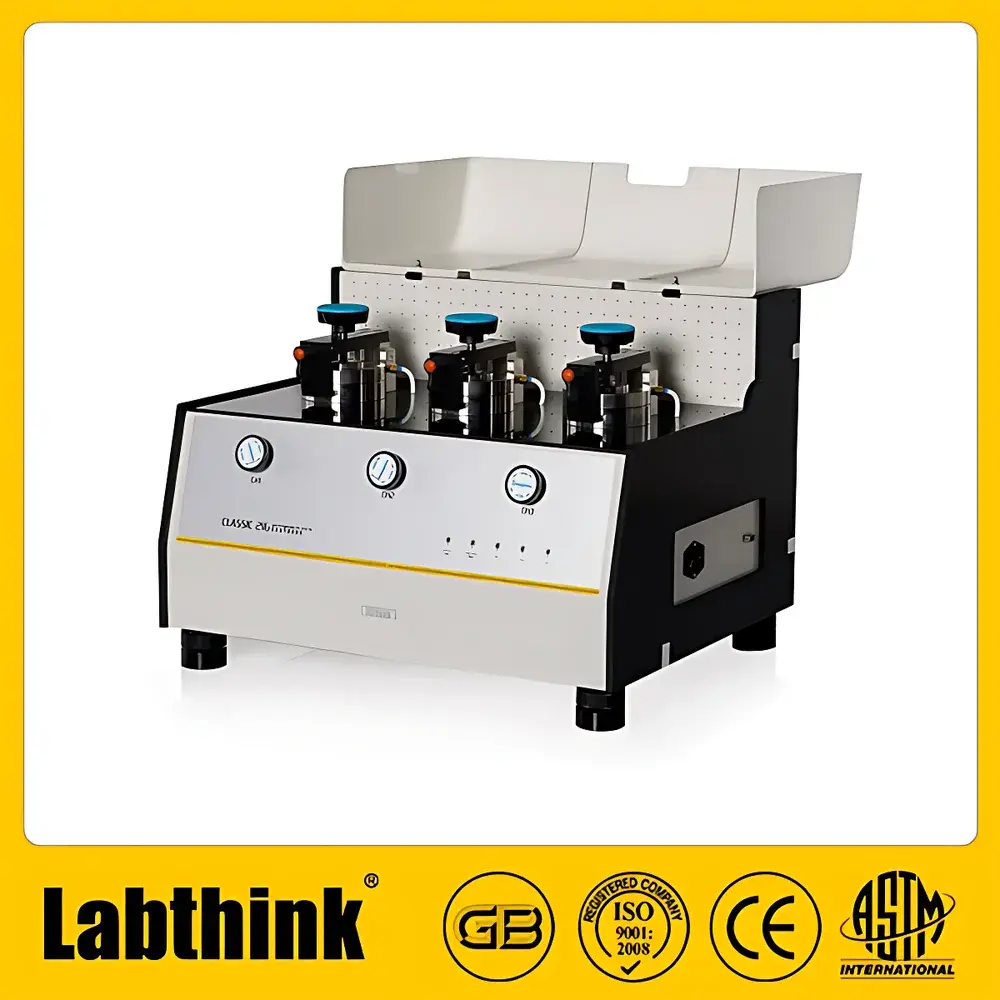
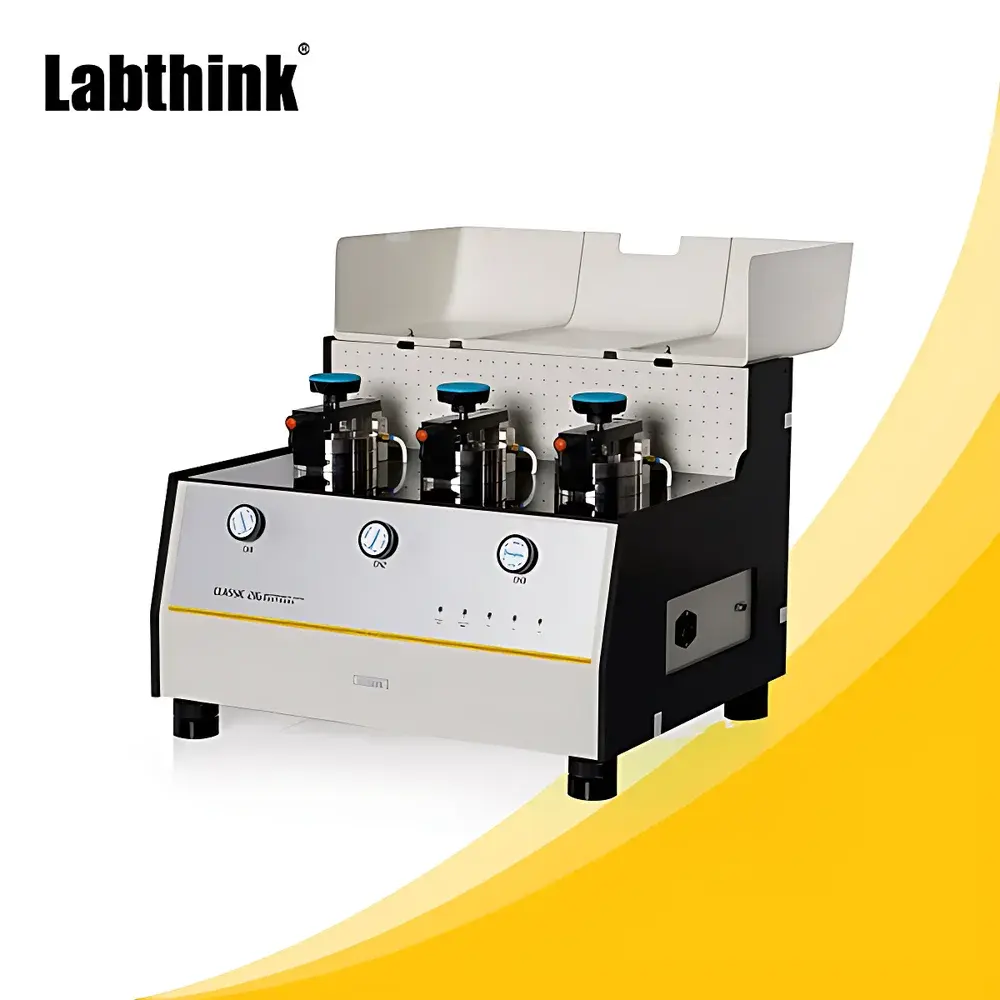
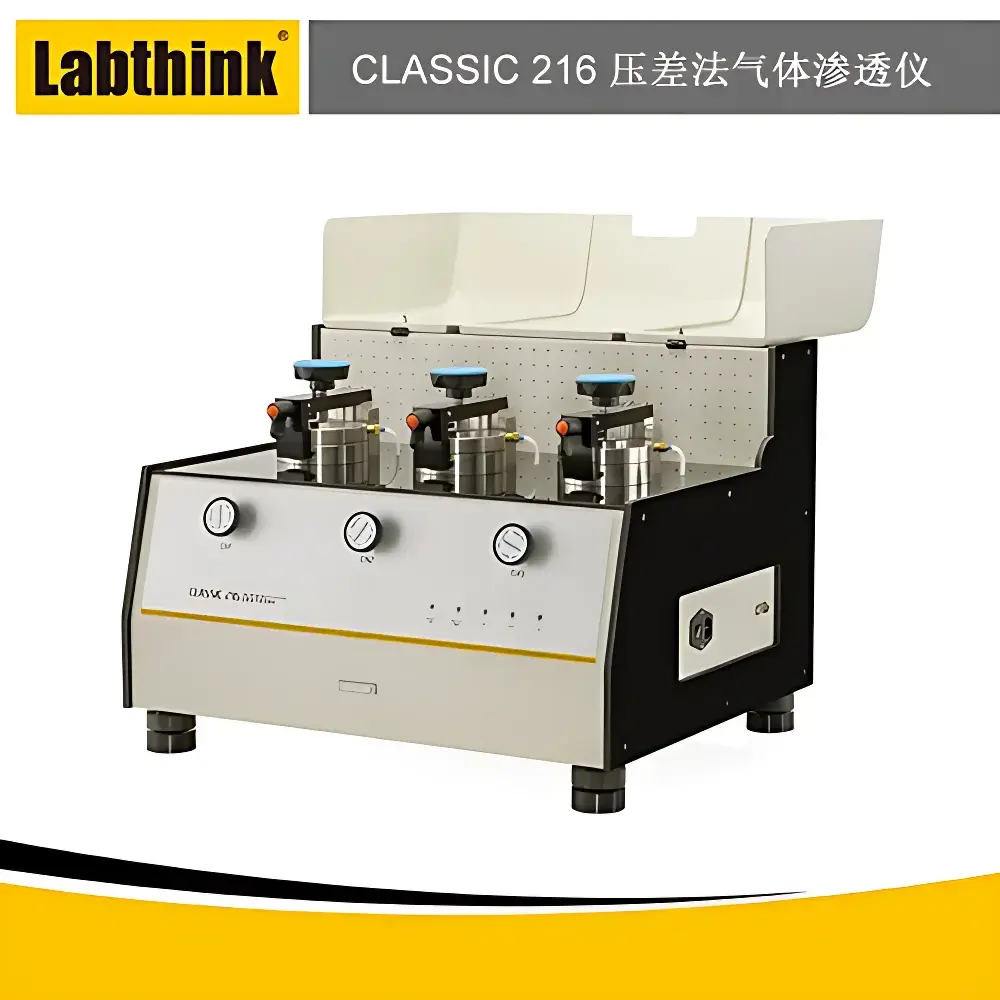
Labthink CLASSIC 216 Differential Pressure Gas Permeability Analyzer
| Brand | Labthink |
|---|---|
| Model | CLASSIC 216 |
| Measurement Principle | Differential Pressure (Manometric) Method |
| Test Gases | O₂, N₂, CO₂, Air, He |
| Test Range | 0.1–50,000 cm³/m²·24h·0.1 MPa (standard) |
| Number of Independent Test Cells | 3 |
| Vacuum Resolution | 0.1 Pa |
| Minimum Test Chamber Vacuum | <20 Pa |
| Temperature Control Range | 15–55 °C (external chiller/heater required for precise isothermal operation) |
| Humidity Control Options | 0% RH, 100% RH, or intermediate levels per ASTM E104 (humidification system optional) |
| Specimen Area | 38.48 cm² (Ø97 mm) |
| Pressure Differential Range | –0.1 to +0.1 MPa |
| Supply Gas Pressure | 0.4–0.6 MPa |
| Power Supply | AC 220 V / 50 Hz or AC 120 V / 60 Hz |
| Dimensions (L×W×H) | 670 × 540 × 430 mm |
| Net Weight | 75 kg |
| Compliance | ISO 15105-1, ISO 2556, ASTM D1434, JIS K7126-1, GB/T 1038–2000, YBB 00082003–2015 |
Overview
The Labthink CLASSIC 216 Differential Pressure Gas Permeability Analyzer is a precision-engineered instrument designed for quantitative determination of gas transmission rates (GTR), permeability coefficients (P), diffusion coefficients (D), and solubility coefficients (S) in polymeric films, laminates, foils, and rigid sheet materials. It operates on the manometric differential pressure principle—widely recognized as the gravimetric reference method for high-accuracy barrier property assessment. In this configuration, a conditioned specimen is sealed between two isolated chambers: the upstream (high-pressure) side is pressurized with the test gas, while the downstream (low-pressure) side is maintained under high vacuum. The transient rise in downstream pressure—monitored via ultra-stable capacitance manometers—is mathematically integrated to derive time-dependent permeation flux, enabling full kinetic modeling of gas transport behavior in accordance with Fickian and non-Fickian diffusion frameworks.
Key Features
- Three fully independent test cells enable concurrent, statistically robust evaluation of identical or dissimilar specimens under identical environmental conditions—critical for quality control batch verification and comparative material screening.
- High-resolution vacuum measurement (0.1 Pa) and stable sub-20 Pa base vacuum ensure reliable detection of low-permeability materials such as PVDC-coated films, metallized PET, and SiOx-coated substrates.
- Dual-mode process logic—proportional control and fuzzy logic algorithms—optimizes chamber equilibration and data acquisition timing across wide permeability ranges (0.1 to >500,000 cm³/m²·24h·0.1 MPa), minimizing operator intervention and improving inter-laboratory reproducibility.
- Modular thermal and humidity conditioning support: temperature range spans 15–55 °C; optional external chiller/heater units provide ±0.1 °C stability; humidity generation follows ASTM E104 protocols, supporting standardized testing at defined RH levels (0%, 100%, or intermediate points).
- Computer-controlled architecture with embedded real-time data logging, automatic zero-point correction, and built-in calibration routines using certified reference membranes traceable to NIST standards.
- Comprehensive safety design includes overpressure relief valves, gas leak detection circuitry, and fail-safe vacuum interlocks compliant with IEC 61000-6-2/6-4 electromagnetic compatibility requirements.
Sample Compatibility & Compliance
The CLASSIC 216 accommodates circular specimens of Ø97 mm (38.48 cm² effective area), suitable for flexible packaging films (e.g., BOPP, PE, PET, PVDC, AlOx/SiOx coatings), semi-rigid sheets (PP, PVC, ABS), pharmaceutical blister lidding, and emerging biodegradable matrices (PLA, PHA, starch-based composites). Its mechanical clamping system ensures uniform sealing pressure without edge deformation—a prerequisite for valid ISO 15105-1 and ASTM D1434 compliance. All reported results adhere to internationally accepted definitions of permeability (P = D × S), where diffusion is derived from time-lag analysis and solubility is inferred from steady-state flux normalization. Instrument validation documentation supports GLP/GMP audit readiness, including full traceability of calibration gases, pressure transducers, and temperature sensors.
Software & Data Management
Operated via Labthink’s proprietary PermeData™ software (Windows OS), the system delivers ISO/IEC 17025-aligned reporting with electronic signatures, audit trails, and 21 CFR Part 11-compliant user access controls. Raw pressure-vs.-time datasets are stored in HDF5 format with metadata tagging (operator ID, ambient conditions, calibration history). Statistical modules compute confidence intervals for replicate measurements, perform Arrhenius-based temperature extrapolation (enabling prediction of shelf-life limiting O₂ ingress at accelerated storage conditions), and generate comparative bar charts across material families. Export options include CSV, PDF, and XML formats compatible with LIMS integration and enterprise QA databases.
Applications
- Pharmaceutical Packaging: Quantitative O₂ and H₂O vapor transmission rate (WVTR) assessment of cold-form blister lidding, sachet films, and child-resistant pouches per USP & YBB pharmacopoeial standards.
- Food Packaging R&D: Barrier optimization of retortable pouches, modified atmosphere packaging (MAP) films, and vacuum-sealed trays—correlating CO₂/N₂ permeability with product shelf-life models.
- Automotive & Electronics: Evaluation of encapsulation films for battery separators and moisture-sensitive OLED display barriers.
- Sustainable Materials: Performance benchmarking of compostable films against conventional polymers under controlled humidity and elevated temperature profiles.
- Regulatory Submissions: Generation of validated permeability dossiers for FDA 510(k), EU MDR Annex I, and China NMPA registration dossiers.
FAQ
What gases can be tested with the CLASSIC 216?
O₂, N₂, CO₂, air, He, and other non-corrosive gases—provided appropriate gas handling components (stainless steel regulators, inert tubing) are used.
Is temperature and humidity control included in the base configuration?
The CLASSIC 216 provides ambient temperature operation (15–55 °C) but requires externally connected chiller/heater and humidity generator units for precise isothermal or hygrothermal control.
How is instrument calibration verified?
Certified standard membranes (e.g., polyethylene film with known O₂ transmission rate) are supplied for daily performance qualification; annual third-party calibration of pressure and temperature sensors is recommended.
Can the system comply with 21 CFR Part 11 requirements?
Yes—PermeData™ software includes role-based access control, electronic signatures, and immutable audit logs meeting FDA electronic records regulations.
What sample preparation tools are included?
Standard configuration includes manual die cutter, vacuum grease, quantitative filter paper, and dual-stage vacuum pump; optional accessories include automated sampling station and humidity-controlled conditioning chamber.






