
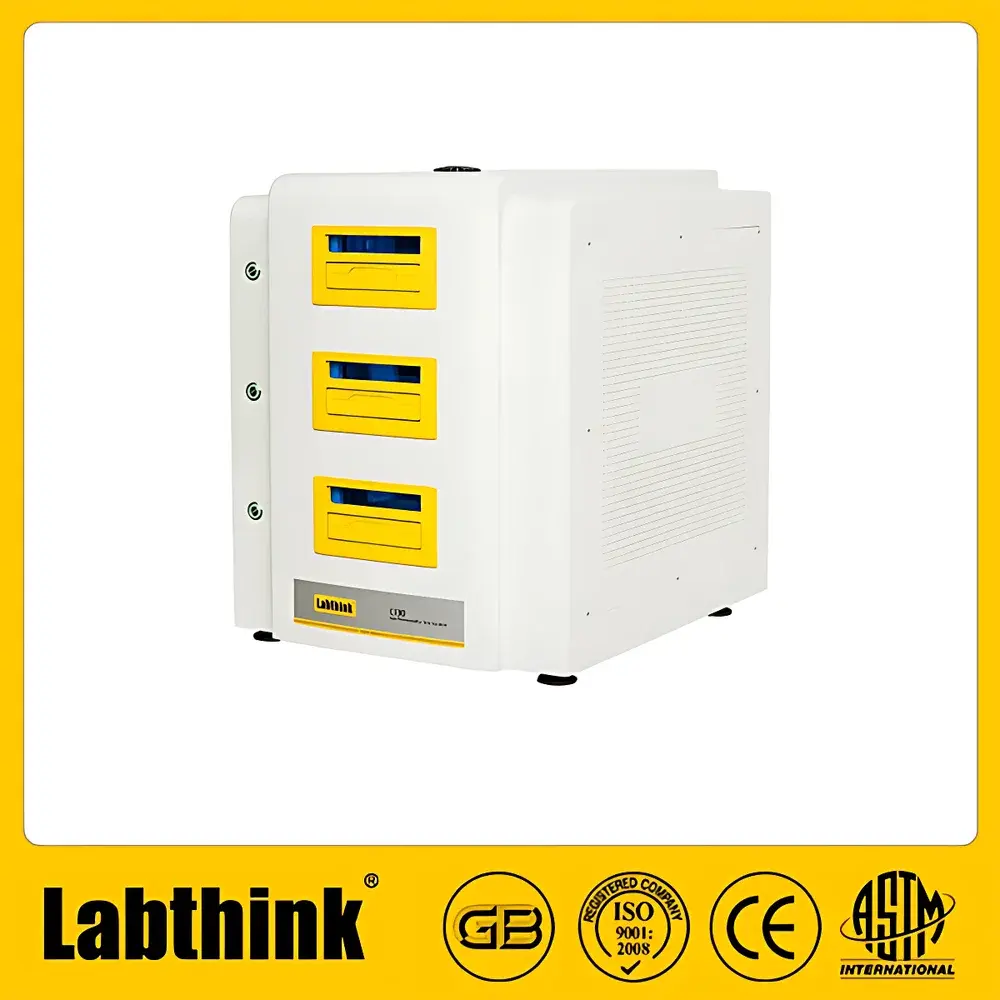
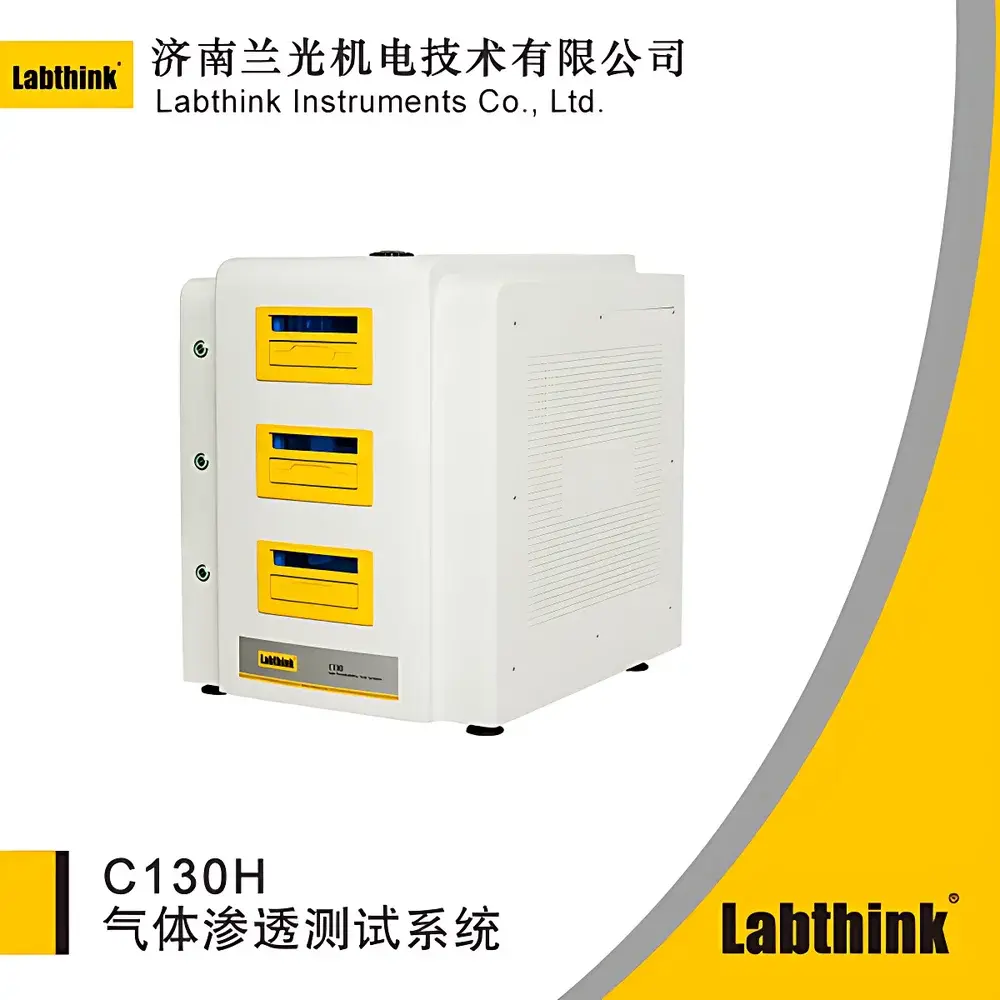
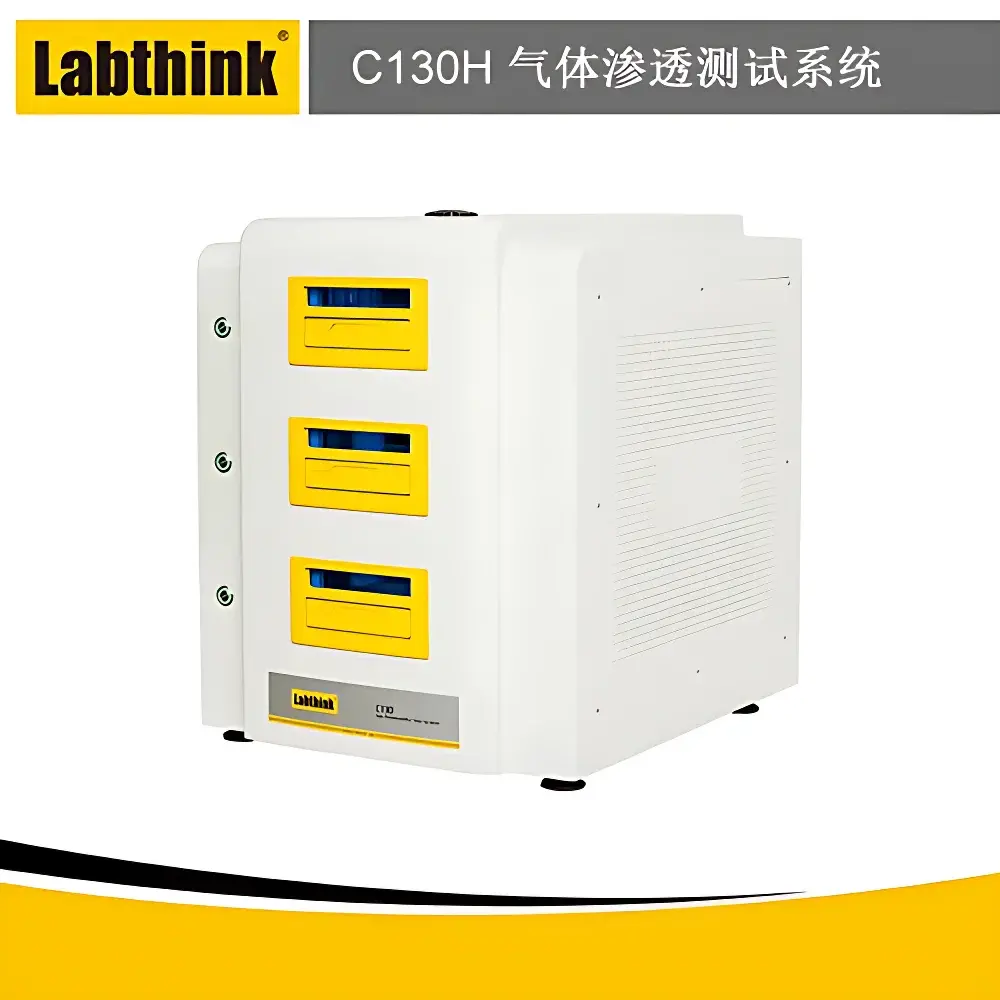
Labthink C130H Differential-Pressure Method Gas Permeability Analyzer
| Brand | Labthink |
|---|---|
| Origin | Shandong, China |
| Manufacturer Type | Direct Manufacturer |
| Country of Origin | China |
| Model | C130H |
| Price Range | USD 14,000 – 85,000 |
| Test Principle | Differential-Pressure (Manometric) Method |
| Standards Compliance | ISO 15105-1, ISO 2556, ASTM D1434, GB/T 1038-2000, JIS K7126-1, YBB 00082003 |
| Measurement Range | 0.01–50,000 cm³/(m²·24h·0.1MPa) |
| Resolution | 0.001 cm³/(m²·24h·0.1MPa) |
| Temperature Range | 10–50 °C (ambient reference 23 °C) |
| Temp. Stability | ±0.05 °C |
| Temp. Accuracy | ±0.3 °C (at calibration port) |
| Vacuum Resolution | 0.01 Pa |
| Vacuum Accuracy | ±0.2% of reading (1–100% of sensor span) |
| Chamber Vacuum Level | <10 Pa |
| Specimen Quantity | 3 independent test chambers |
| Specimen Diameter | Φ97 mm |
| Effective Test Area | 38.48 cm² |
| Test Gases | O₂, N₂, CO₂, air, He (custom configurations available for flammable, explosive or toxic gases) |
| Test Pressure Range | 10–210 kPa (adjustable) |
| Gas Supply Pressure | 0.5–0.6 MPa |
| Power Supply | 220 VAC ±10%, 50 Hz OR 120 VAC ±10%, 60 Hz |
| Dimensions (L×W×H) | 710 × 350 × 630 mm |
| Net Weight | ~100 kg |
Overview
The Labthink C130H Differential-Pressure Method Gas Permeability Analyzer is an engineered solution for precise, reproducible determination of gas transmission rates (GTR), permeability coefficients (P), diffusion coefficients (D), and solubility coefficients (S) in polymeric films, laminates, foils, and rigid sheet materials. It operates on the fundamental principle of differential-pressure (manometric) gas permeation: a conditioned specimen is sealed between two isolated chambers; the low-pressure side is evacuated to high vacuum (<10 Pa), while the high-pressure side is charged with test gas at a precisely controlled pressure (10–210 kPa). The resulting transmembrane partial pressure gradient drives molecular diffusion, and real-time monitoring of pressure rise in the low-pressure chamber enables quantitative calculation of gas flux using Fick’s first law and the ideal gas law. This method is intrinsically traceable, fully compliant with ISO 15105-1 and ASTM D1434, and suitable for both routine QC and advanced barrier research.
Key Features
- Triple independent test chambers with fully autonomous operation—enabling concurrent testing of three specimens under identical or divergent conditions, with no cross-talk or shared pneumatic interference.
- Automated drawer-type test chamber with motorized clamping: ensures uniform sealing force (±1.5% repeatability), eliminates operator-induced variability, and reduces setup time by >60% versus manual systems.
- High-stability thermal control system: 360° circumferential air circulation maintains temperature deviation ≤ ±0.05 °C across the entire test area, validated per ISO 15105-1 Annex B requirements for thermal homogeneity.
- Ultra-high-resolution vacuum sensing: imported capacitive vacuum transducers (0.01 Pa resolution) coupled with a dual-stage oil-free vacuum pump (ultimate vacuum ≤0.2 Pa) enable reliable quantification of ultra-high-barrier materials down to 0.01 cm³/(m²·24h·0.1MPa).
- Intelligent test mode architecture: supports both one-touch standard testing (predefined per ISO/GB/ASTM protocols) and full-parameter research mode—allowing independent adjustment of dwell time, pressure ramp rate, data acquisition interval, and curve-fitting algorithms for D, S, and P derivation.
- Modular gas handling: configurable for single-gas, binary mixtures, or custom gas blends; optional integrated humidification module (ISO 15105-2 compliant) enables controlled RH exposure during permeation testing.
Sample Compatibility & Compliance
The C130H accommodates flat, non-porous, and semi-crystalline barrier materials up to 3 mm thickness, including biaxially oriented polypropylene (BOPP), ethylene-vinyl alcohol (EVOH) coextrusions, SiOx/AlOx-coated PET, aluminum foil laminates, PVDC-coated paperboard, fluoropolymer membranes, and aerospace-grade polyimide films. It meets the mechanical and metrological requirements of ISO 2556 (plastic films), ASTM D1434 (gas transmission rate), and YBB 00082003 (pharmaceutical packaging). For regulated environments—including pharmaceutical primary packaging validation—the system optionally integrates DataShield™ audit-trail functionality and supports 21 CFR Part 11-compliant electronic records when deployed with GMP-certified software modules.
Software & Data Management
The embedded Windows-based control platform eliminates external PC dependency, mitigating cybersecurity risks and OS-level instability. Real-time visualization includes synchronized pressure-vs.-time, transmission rate-vs.-time, and temperature-vs.-time plots—all exportable in CSV and PDF formats. Raw data are stored with immutable timestamps, operator ID, instrument calibration status, and environmental metadata. Optional DataShield™ integration enables centralized database synchronization via SQL or REST API, supporting enterprise LIMS and MES connectivity. Calibration verification ports for temperature and pressure allow on-site NIST-traceable validation without disassembly.
Applications
- Primary packaging development: oxygen transmission rate (OTR) screening of blister lidding foils, sachet laminates, and cold-form foil for moisture-sensitive APIs.
- Food packaging R&D: CO2 permeability mapping of modified atmosphere packaging (MAP) films used in meat, cheese, and baked goods.
- Advanced material qualification: helium leak rate assessment of inflatable space habitat membranes and fuel cell proton exchange membranes (PEMs).
- Sustainable packaging validation: comparative permeability profiling of compostable starch-based films versus conventional PE under standardized humidity gradients.
- Automotive component testing: air permeation analysis of rubber diaphragms, tire innerliners (butyl rubber), and EV battery pouch film integrity.
- Regulatory submission support: generation of GLP-compliant reports for FDA IND/NDA dossiers and EMA scientific advice packages.
FAQ
What gases can be tested on the C130H?
Standard configurations support O₂, N₂, CO₂, air, and He. Custom variants with explosion-proof solenoids, inert purge sequences, and dual-stage gas filtration are available for H₂, CH₄, NH₃, and other hazardous gases.
Is humidity control integrated?
Humidity-controlled testing is supported via optional inline saturator modules meeting ISO 15105-2 specifications; relative humidity is stabilized ±2% RH across 10–90% RH ranges.
How is system accuracy verified?
Each unit ships with certified reference films (e.g., NIST-traceable PET and AlOx/PET standards); onboard calibration ports allow field verification of temperature (±0.3 °C) and vacuum (±0.2% of reading) sensors without third-party intervention.
Can test data be exported to LIMS?
Yes—via DataShield™, raw datasets and audit logs are exportable in ASTM E1384-compliant XML format or directly ingested into SQL Server, Oracle, or cloud-based LIMS platforms using secure TLS 1.2 endpoints.
What maintenance is required?
Scheduled maintenance includes quarterly vacuum pump oil replacement (if oil-lubricated variant selected), annual sensor recalibration, and biannual seal inspection. Mean time between failures (MTBF) exceeds 12,000 hours for critical pneumatic subsystems.




