
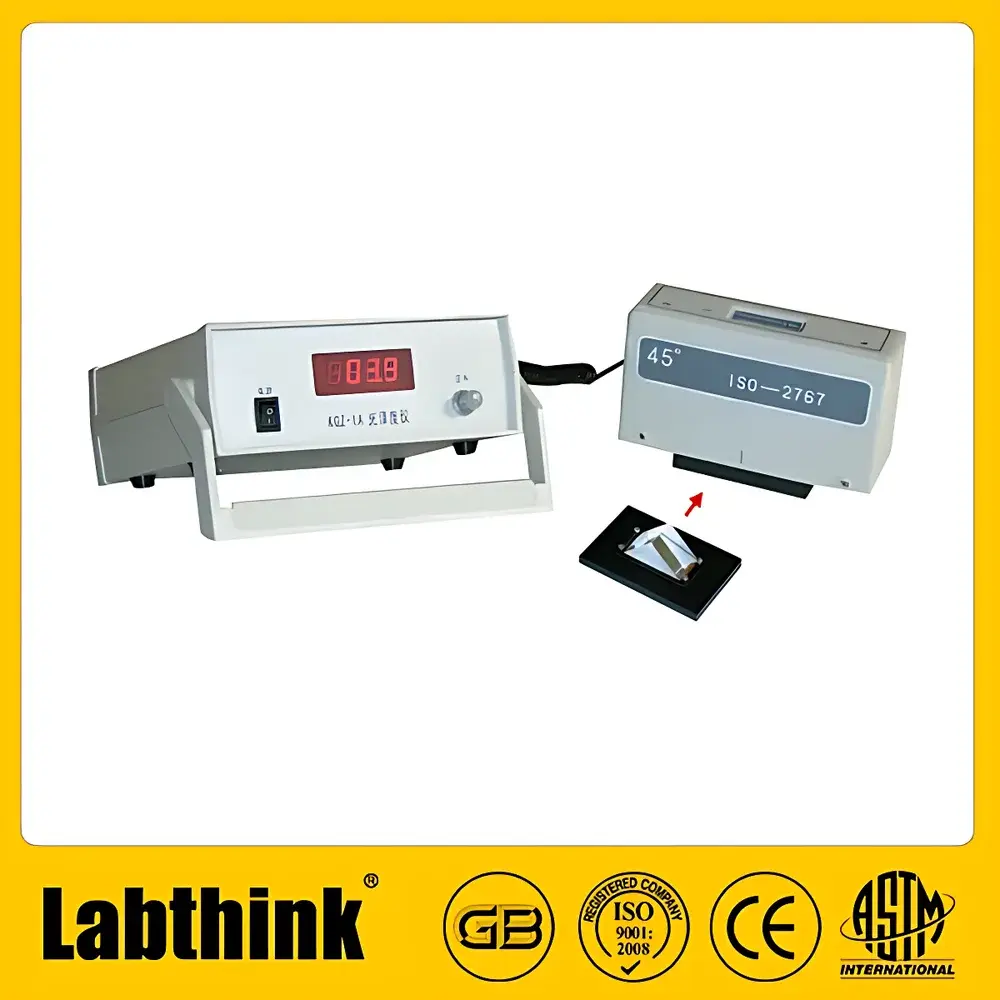
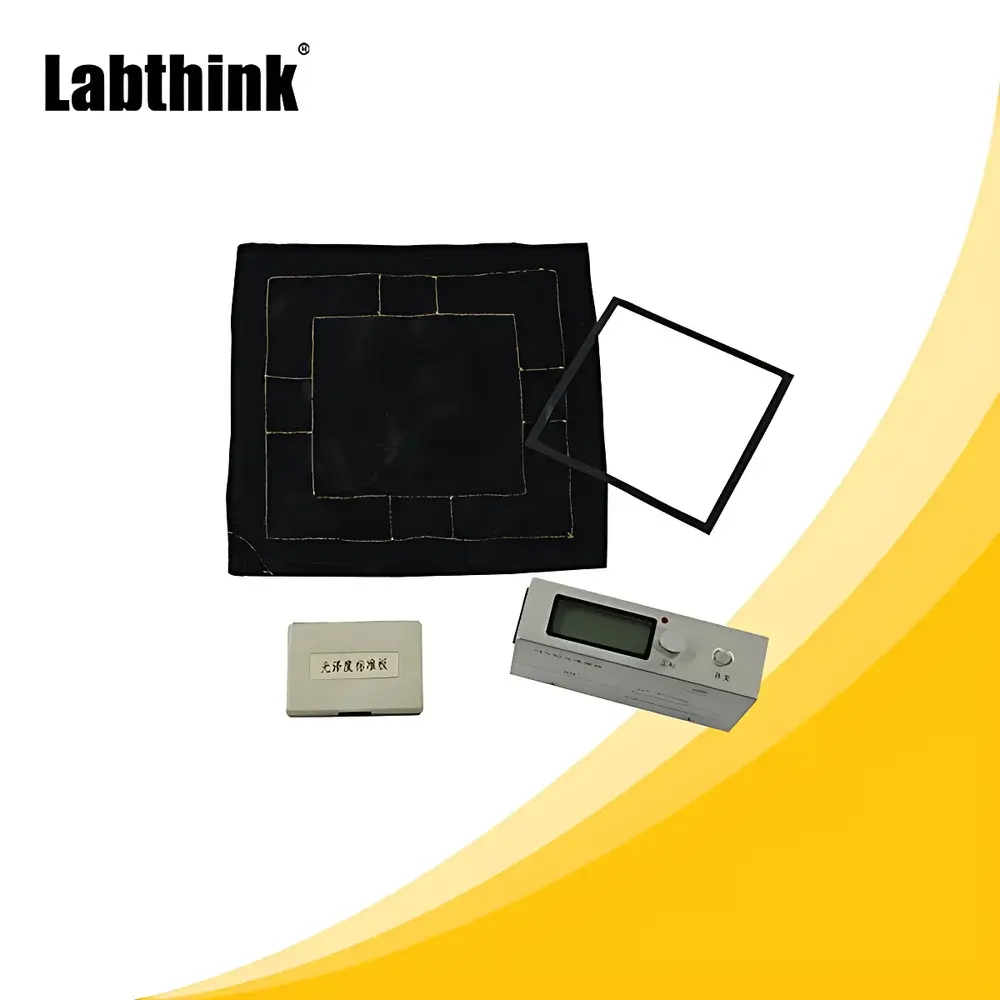
Labthink IG-200 Portable Gloss Meter
| Brand | Labthink |
|---|---|
| Model | IG-200 |
| Measurement Geometry | 20° / 60° / 85° (Standard Single-Angle Configuration) |
| Measurement Range | 0–199.9 GU |
| Resolution | 0.1 GU |
| Repeatability | ±1 GU |
| Zero Drift | ≤0.5 GU / 30 min |
| Accuracy | ±1 GU |
| Light Source | Tungsten-Halogen Lamp (10,000 h lifetime) |
| Calibration Standard | Fused Quartz Reference Tile (Annual Drift < 0.3%) |
| Power Supply | 4×AA Ni-MH Rechargeable Batteries (9 V DC, 100 mAh) |
| AC Adapter Input | 220 V, 50 Hz |
| Operating Temperature | −25 °C to +40 °C |
| Battery Life | Up to 10 h continuous operation |
| Auto-Zero Compensation | Yes |
| Data Hold & USB Export | Yes |
| Compliance | JJG 696–2015 (China National Verification Regulation for Gloss Meters), ISO 2813, ASTM D523, GB/T 9754 |
Overview
The Labthink IG-200 Portable Gloss Meter is a precision optical instrument engineered for rapid, repeatable measurement of specular gloss on non-metallic planar surfaces. Based on the principle of specular reflectance—defined as the ratio of reflected luminous flux at the specular angle to that of a reference black glass standard under controlled illumination—the IG-200 delivers traceable, metrologically validated results in accordance with ISO 2813 and ASTM D523. Its compact, handheld architecture integrates a stabilized tungsten-halogen light source, high-precision photodetector array, and temperature-compensated analog-to-digital conversion circuitry to ensure consistent performance across ambient conditions ranging from −25 °C to +40 °C. Certified per China’s JJG 696–2015 national verification regulation and validated through international interlaboratory comparison, the IG-200 serves as a primary field tool for quality assurance teams requiring on-site, real-time gloss evaluation without laboratory dependency.
Key Features
- True portable design: Weighing under 350 g with integrated ergonomic grip and one-handed operation; no warm-up required—stable readings achieved within 3–5 seconds after power-on.
- High-stability calibration reference: Fused quartz standard tile with annual drift < 0.3%, certified against NIM (National Institute of Metrology, China) traceable standards.
- Long-life illumination system: Tungsten-halogen lamp rated for ≥10,000 hours of operational life, minimizing maintenance intervals and photometric drift.
- Intelligent power management: Built-in Ni-MH rechargeable battery pack (4×AA, 100 mAh) supports up to 10 hours of continuous use; low-voltage warning and real-time charging status indicator included.
- Auto-zero compensation circuitry: Eliminates manual zero adjustment; automatic baseline correction performed at startup and during idle periods.
- Dual-mode power operation: Simultaneous charging and measurement enabled via external AC adapter (220 V, 50 Hz), functioning as both charger and AC/DC converter.
- Data integrity safeguards: Hold function for transient reading capture; non-volatile memory retains last 20 measurements; optional USB interface supports CSV export for traceability documentation.
Sample Compatibility & Compliance
The IG-200 is optimized for non-scattering, smooth-surfaced materials including solvent- and water-based coatings, UV-cured inks, laminated films, coated papers, thermoplastics (e.g., ABS, PP, PET), and anodized aluminum substrates. It is not suitable for textured, matte, or highly diffusive surfaces where diffuse reflectance dominates. All measurement protocols conform to ISO 2813 (specular gloss at 20°, 60°, and 85°), ASTM D523 (standard test method for specular gloss), and GB/T 9754 (Chinese national standard for non-metallic coating gloss). Instrument verification follows JJG 696–2015, ensuring compliance with metrological requirements for factory calibration, internal QA audits, and third-party inspection reports. While not FDA 21 CFR Part 11–certified out-of-box, raw data logs exported via USB may be integrated into validated LIMS or ELN environments supporting GLP/GMP workflows.
Software & Data Management
The IG-200 operates autonomously without proprietary software; however, its USB interface enables direct connection to Windows/Linux systems for batch data retrieval. Exported files are plain-text CSV format containing timestamp, measurement value (GU), instrument ID, and operator tag (if manually entered). No cloud synchronization or remote firmware updates are supported—firmware revisions require local reprogramming via Labthink-certified service centers. Audit trail functionality is limited to on-device time/date stamping; full electronic record integrity (e.g., user authentication, change history) must be implemented externally via laboratory information management systems (LIMS) or validated Excel templates compliant with ISO/IEC 17025 Clause 7.7.
Applications
- QC release testing of automotive clear coats and OEM body paints
- In-line gloss verification during gravure and flexographic printing processes
- Batch-to-batch consistency assessment of architectural latex paints and industrial enamels
- Surface finish evaluation of extruded plastic profiles and injection-molded housings
- Regulatory submission support for medical device packaging (ISO 11607–2 surface characterization)
- Research-grade correlation studies between gloss values and surface roughness (Ra) measured via profilometry
FAQ
What gloss angles does the IG-200 support?
The standard IG-200 model is configured for 60° geometry, per ISO 2813 default. Optional variants include 20° (for high-gloss surfaces >70 GU) and 85° (for low-gloss/matte finishes <10 GU); multi-angle versions require factory configuration.
Is the quartz reference tile user-replaceable?
Yes—the fused quartz standard tile is field-serviceable and supplied with NIM-traceable calibration certificate; replacement tiles are available through Labthink authorized distributors with recalibration services.
Can the IG-200 be used in humid or dusty industrial environments?
The instrument meets IP52 ingress protection rating (drip-resistant, dust-protected); prolonged exposure to condensation or abrasive particulates is not recommended without protective housing.
Does the IG-200 support statistical process control (SPC) output?
No native SPC functions are embedded; however, exported CSV data can be imported into Minitab, JMP, or custom Python scripts for X̄–R chart generation and Cp/Cpk analysis.
How often should the instrument be recalibrated?
Annual recalibration against accredited standards is recommended; more frequent verification (e.g., daily using the onboard zero and reference tile) is required in regulated manufacturing environments per ISO 9001 Clause 7.1.5.2.



