
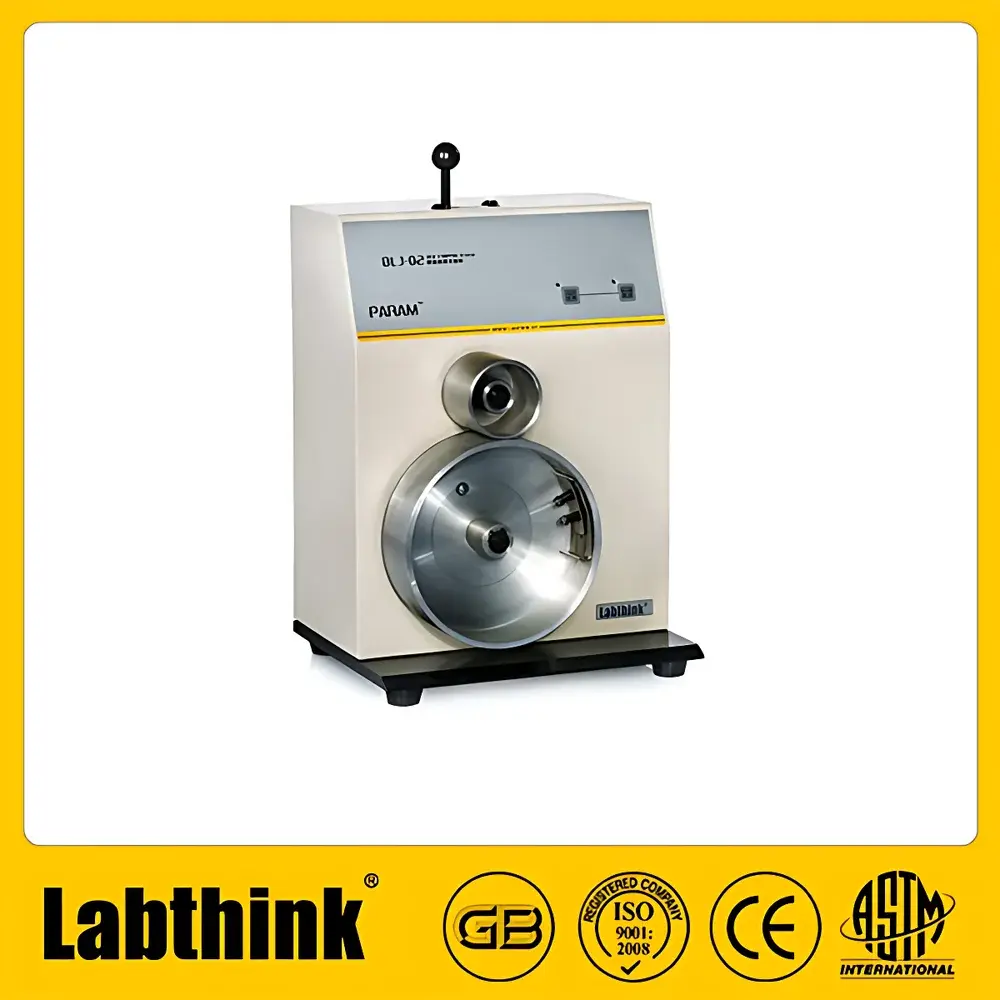
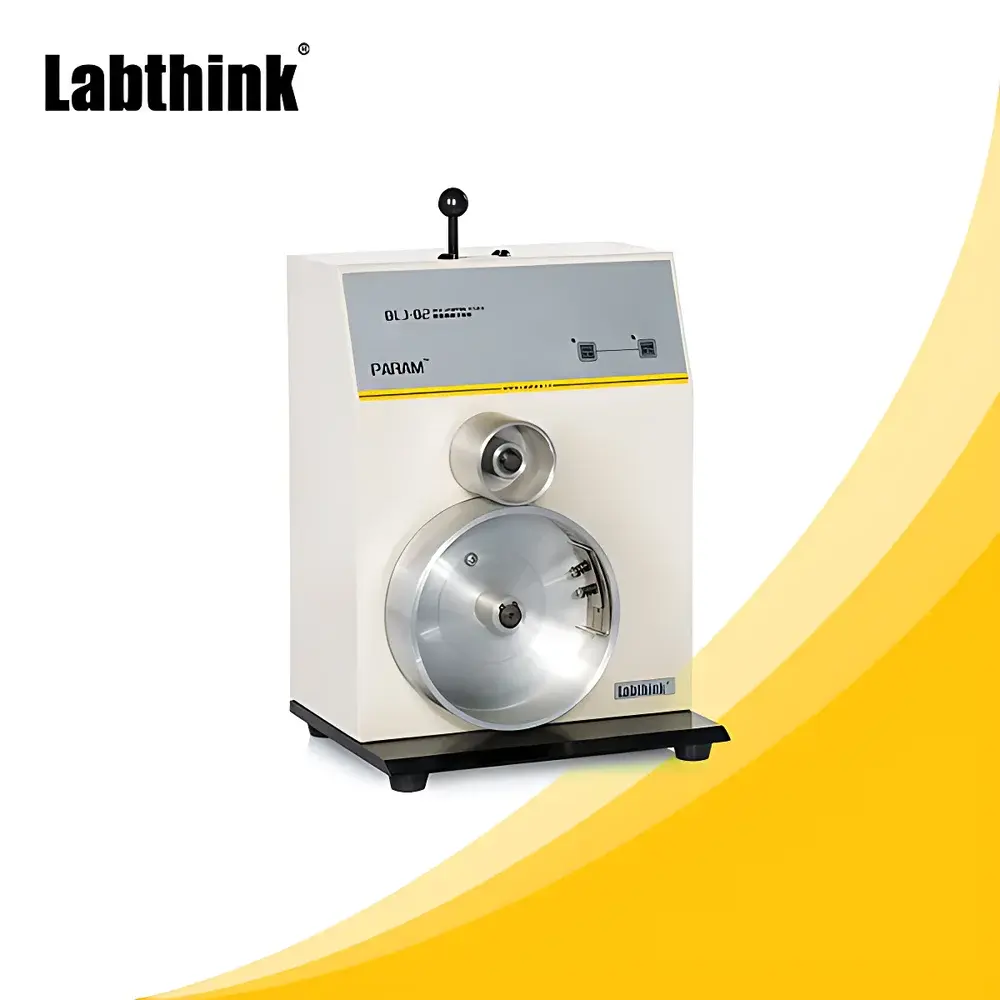
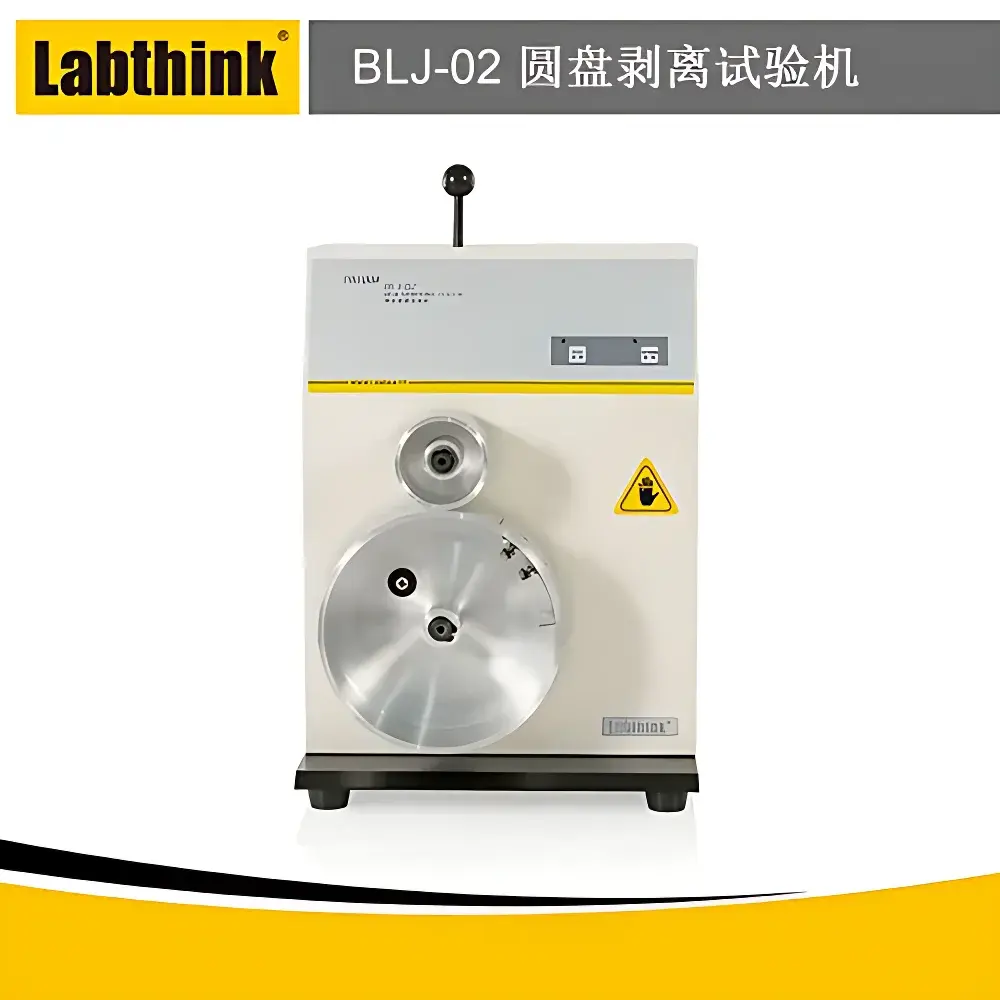
Labthink BLJ-02 Disc Peel Tester for Ink Adhesion Strength
| Brand | Labthink |
|---|---|
| Origin | Shandong, China |
| Manufacturer Type | Direct Manufacturer |
| Region of Origin | Domestic (China) |
| Model | BLJ-02 |
| Quotation | Upon Request |
| Disc Pressure | 100 N |
| Peel Speed | 0.8 m/s |
| Dimensions (L×W×H) | 280 mm × 230 mm × 380 mm |
| Power Supply | AC 220 V, 50 Hz |
| Net Weight | 21 kg |
Overview
The Labthink BLJ-02 Disc Peel Tester is an engineered instrumentation system designed to quantitatively assess the adhesion strength of printed ink layers on flexible packaging substrates—particularly those produced via gravure printing processes. It operates on the standardized disc peel principle, wherein a defined area of pressure-sensitive adhesive tape (typically specified glass-backed or acrylic-based tape per GB/T 7707 and JIS Z0237) is applied under controlled load and rolling conditions to the printed surface, followed by mechanical peeling at a fixed angle and velocity. This method replicates real-world delamination stresses encountered during packaging handling, filling, and storage. The instrument implements a rigid, torque-stabilized disc drive mechanism to maintain constant peel speed (0.8 m/s) and consistent normal force (100 N), ensuring high repeatability across operator shifts and laboratories. Its design aligns with fundamental tribological and interfacial adhesion measurement theory, where bond failure mode—cohesive within ink, adhesive at ink–substrate interface, or mixed—is visually and semi-quantitatively evaluated per standardized pass/fail criteria.
Key Features
- Microprocessor-controlled operation with dedicated PVC membrane keypad and backlit LCD display for intuitive parameter input and real-time status monitoring
- Automated end-of-test audible alarm to enhance laboratory safety and prevent operator oversight during unattended cycles
- Precision-machined stainless steel test disc assembly with calibrated spring-loaded loading mechanism to deliver exact 100 N contact pressure across full disc diameter
- Fixed-angle peel geometry compliant with ISO/IEC 17025-aligned test setup requirements, minimizing angular deviation during tape separation
- Robust aluminum alloy chassis with vibration-dampening base, supporting stable operation in shared QC lab environments
- No consumable calibration artifacts required; system performance verified via traceable mechanical load cell verification and speed encoder validation
Sample Compatibility & Compliance
The BLJ-02 accommodates standard specimen strips measuring 15 mm × 150 mm, compatible with single-layer and multilayer flexible films—including BOPP, PET, CPP, PE, metallized polyester, and coated cellophane—as well as laminated structures used in food, pharmaceutical, and consumer goods packaging. It supports testing of both solvent-based and water-based gravure inks, UV-curable inks, and electron-beam cured coatings. Regulatory compliance includes full alignment with GB/T 7707–2008 “Gravure Printing Ink Adhesion Test Method”, JIS C 2107 “Test Methods for Adhesion of Printed Inks on Plastic Films”, and JIS Z 0237 “Methods of Test for Pressure Sensitive Adhesive Tapes”. While not inherently 21 CFR Part 11 compliant, its deterministic mechanical architecture enables integration into GLP/GMP workflows when paired with documented SOPs and manual audit trails.
Software & Data Management
The BLJ-02 operates as a standalone hardware platform without embedded data logging or PC connectivity. All operational parameters—including test count, elapsed time, and pass/fail designation—are displayed and retained locally on the LCD screen for up to 99 cycles. Users are expected to record outcomes manually in laboratory notebooks or LIMS-integrated spreadsheets. For enterprises requiring electronic records, Labthink offers optional external USB digital cameras (sold separately) for time-stamped image capture of peeled specimens, facilitating visual archiving aligned with ISO/IEC 17025 clause 7.5.2 on result reporting integrity.
Applications
- Quality control of gravure-printed flexible packaging prior to lamination or filling
- Comparative evaluation of ink formulation batches across pigment dispersion, resin selection, and curing efficiency
- Validation of substrate surface treatment efficacy (e.g., corona or plasma activation) on polyolefins
- Assessment of interlayer adhesion in metallized or barrier-coated films
- Root cause analysis of print mottling, scuffing, or rub-off defects in production troubleshooting
- Supporting technical documentation for packaging validation protocols under ICH Q5C and ASTM D3330
FAQ
What tape specifications are recommended for use with the BLJ-02?
Standardized glass-backed pressure-sensitive tape meeting JIS Z 0237 Type A or ASTM D3330 Type I is required. Tape width must be ≥15 mm; nominal adhesion energy should fall between 2.5–4.0 N/25 mm.
Is the BLJ-02 suitable for testing digital inkjet prints?
No. Its test methodology and normative references are specific to gravure and flexographic ink systems. Inkjet inks require alternative assessment methods such as cross-hatch adhesion (ASTM D3359) or Taber abrasion (ASTM D4060).
Can test results be exported directly to Excel or LIMS?
Not natively. The device lacks USB, Ethernet, or Bluetooth interfaces. Data export requires manual transcription or integration with third-party imaging systems.
Does the instrument require annual recalibration?
Yes. Annual verification of disc pressure (±2% tolerance) and peel speed (±1% tolerance) using NIST-traceable force and tachometric standards is recommended per ISO/IEC 17025 Clause 6.5.
What environmental conditions are required for valid testing?
Specimens must be conditioned at 23 ± 2 °C and 50 ± 5% RH for ≥4 hours prior to testing, per GB/T 2918 and ISO 291 general conditioning requirements.



