
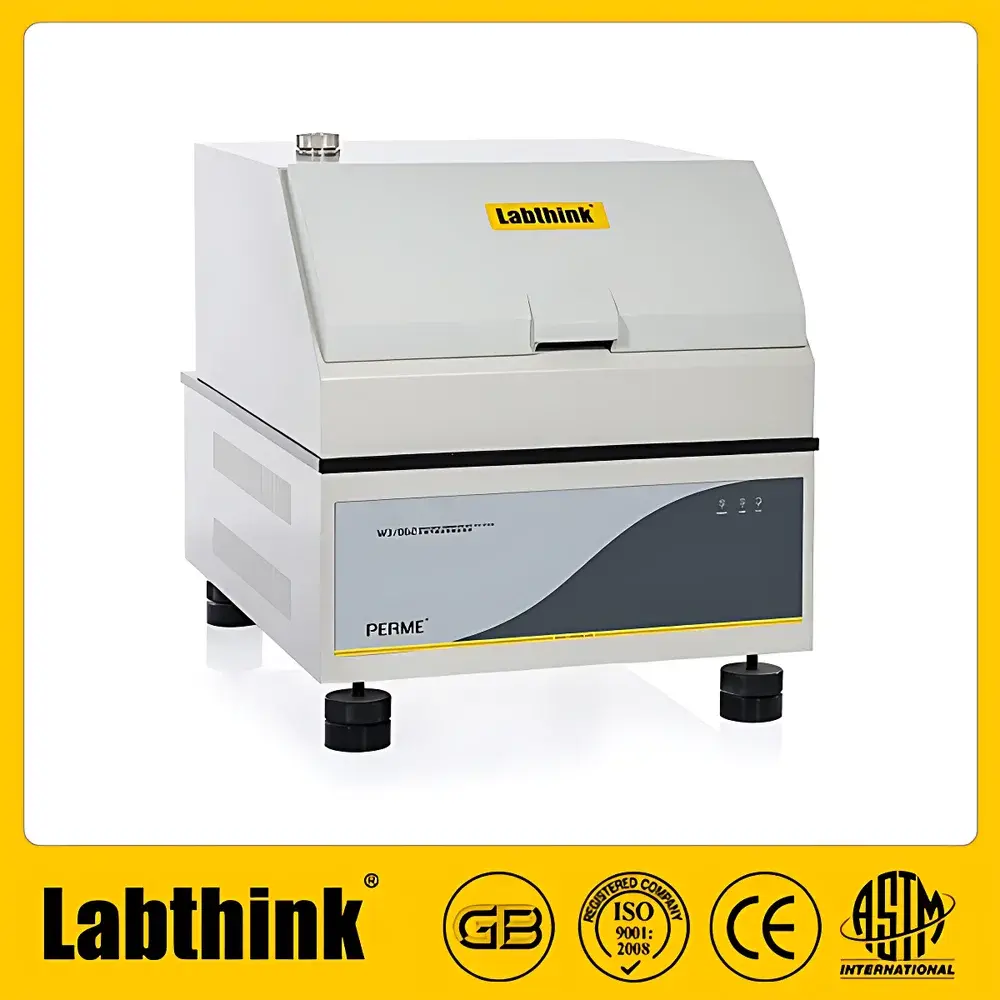
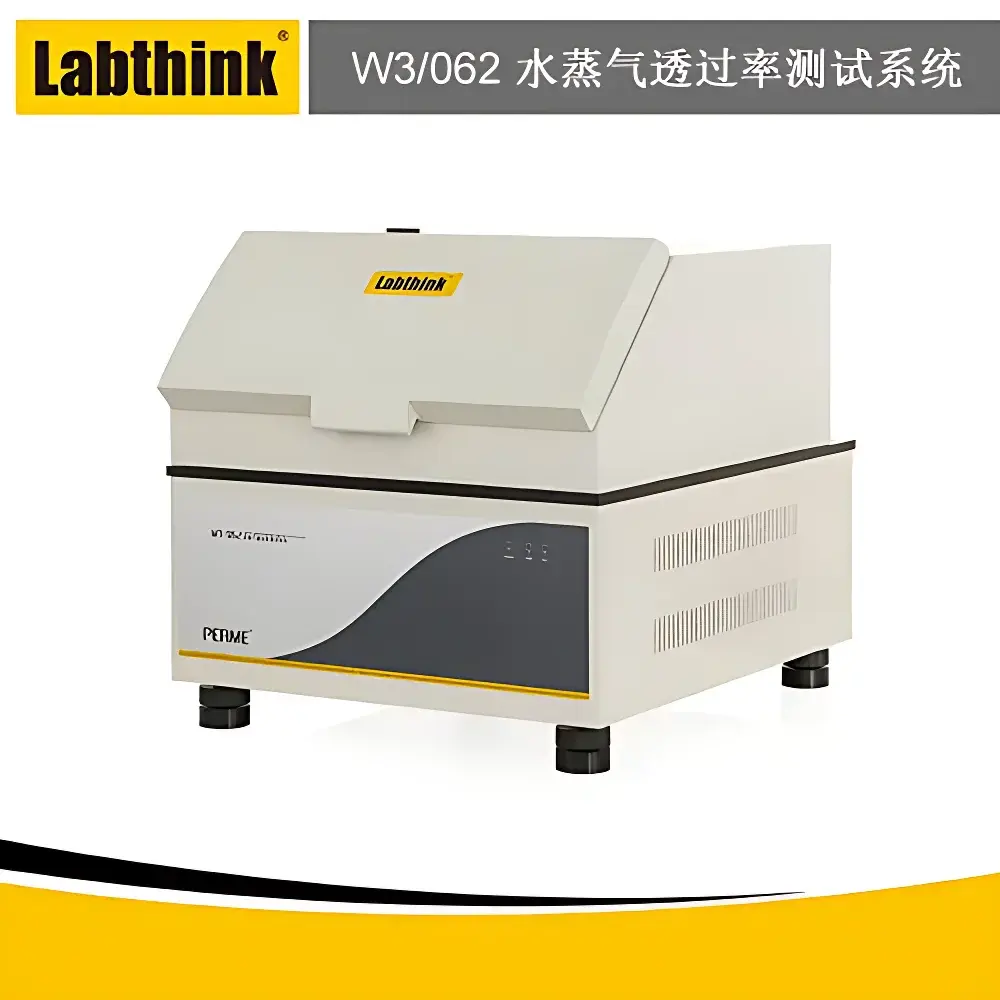
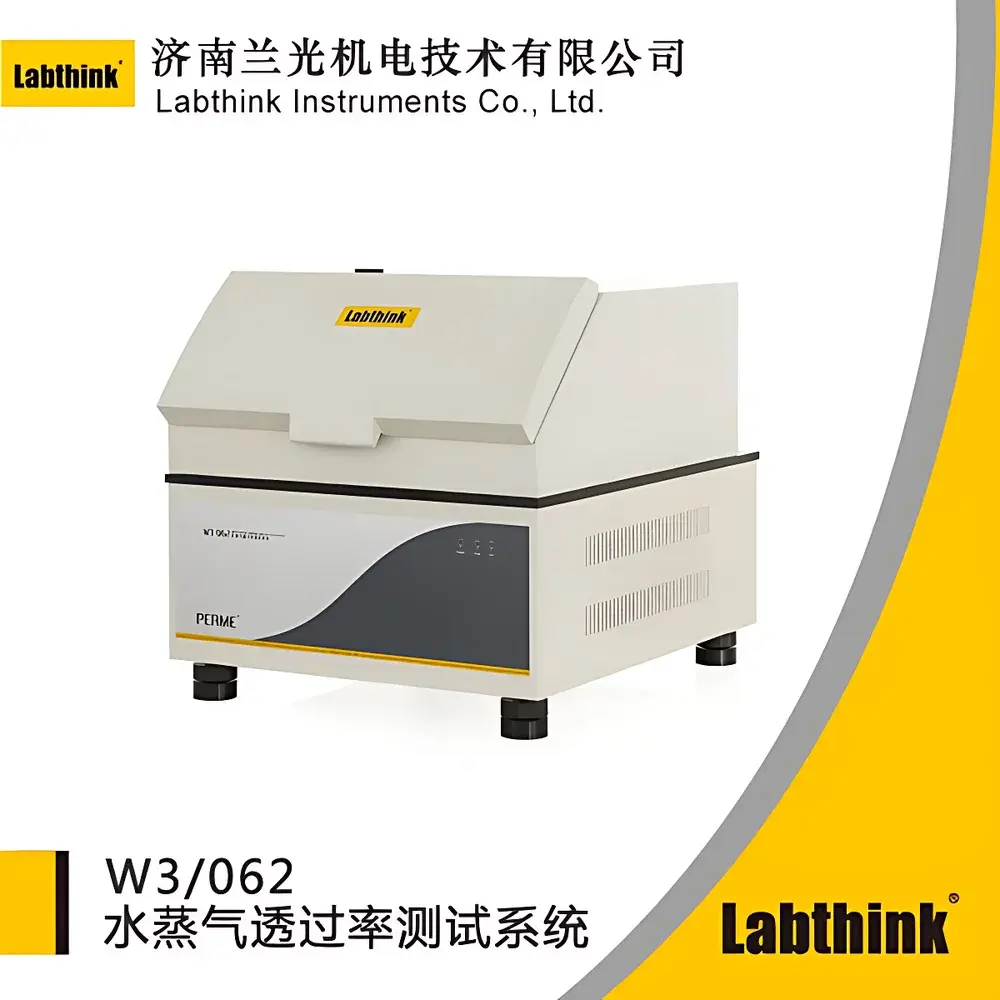
Labthink W3/062 Gravimetric Cup Method Water Vapor Transmission Rate (WVTR) Tester
| Brand | Labthink |
|---|---|
| Origin | Shandong, China |
| Manufacturer Type | Direct Manufacturer |
| Model | W3/062 |
| Test Principle | Gravimetric Cup Method (Weight Loss/Gain) |
| Measurement Range | 0.1–10,000 g/m²·24h (weight loss mode) |
| Sample Capacity | 1–6 independent specimens per test cycle |
| Temperature Control | 15–55 °C (±0.1 °C accuracy) |
| Humidity Control | 10–98% RH (±1% RH accuracy) |
| Test Area | 33 cm² |
| Specimen Thickness Limit | ≤3 mm |
| Chamber Volume | 45 L |
| Power Supply | 220 VAC 50 Hz / 120 VAC 60 Hz |
| Net Weight | 80 kg |
| Compliance Standards | GB 1037, GB/T 16928, ASTM E96, ASTM D1653, ISO 2528, TAPPI T464, DIN 53122-1, JIS Z0208, YBB00092003 |
Overview
The Labthink W3/062 Gravimetric Cup Method Water Vapor Transmission Rate (WVTR) Tester is a precision-engineered instrument designed for the quantitative determination of water vapor permeation through flexible barrier materials. It operates on the gravimetric cup method—a standardized, physically traceable technique in which a conditioned specimen separates two controlled environmental chambers: one saturated with water vapor and the other maintained at a defined low-humidity condition. As water vapor migrates across the sample under a fixed vapor pressure gradient, mass change of the sealed test cup is monitored continuously via a high-resolution analytical balance (0.001 g resolution). The resulting time-dependent weight data are processed to calculate WVTR in g/m²·24h, providing direct, absolute measurement without reliance on calibration films or indirect sensor responses. This principle ensures metrological integrity and full alignment with regulatory testing requirements across packaging, medical device, and pharmaceutical primary packaging development.
Key Features
- High-precision dual-mode operation: supports both weight-loss (dry-side chamber) and weight-gain (humid-side chamber) configurations, enabling accurate WVTR quantification across ultra-low (2,500 g/m²·24h) material classes.
- Parallel multi-specimen capability: integrated 6-position rotating carousel accommodates six independent test cups simultaneously, each with dedicated environmental control and real-time mass monitoring—eliminating sequential testing bottlenecks.
- Scalable architecture: single host controller can be extended to manage up to nine satellite units (totaling 60 concurrent test stations), supporting high-throughput QC labs and accelerated stability studies.
- Thermo-hygrometric precision: temperature regulated within ±0.1 °C from 15–55 °C; relative humidity controlled from 10–98% RH with ±1% RH accuracy—critical for reproducible compliance with ASTM E96 desiccant and inverted cup protocols.
- Robust mechanical design: stainless-steel test chamber (45 L volume), sealed gas pathways, and corrosion-resistant internal components ensure long-term stability under continuous humid/dry cycling conditions.
Sample Compatibility & Compliance
The W3/062 is validated for use with polymeric films, laminates, coated papers, aluminum foils, blister foil composites, and medical-grade nonwovens—materials routinely evaluated for shelf-life prediction and barrier specification validation. Its 33 cm² test area (Φ74 mm specimen) and ≤3 mm thickness limit accommodate standard packaging substrates while permitting optional customization for thicker or rigid formats. All operational parameters adhere strictly to internationally recognized standards including ASTM E96 (Procedure A & B), ISO 2528, GB 1037, and YBB00092003 for pharmaceutical packaging. Data acquisition and reporting workflows support GLP-compliant documentation, including audit-trail-enabled user authentication, electronic signatures, and timestamped raw mass logs—fully compatible with FDA 21 CFR Part 11 requirements when deployed with Lystem™ Laboratory Data Management System.
Software & Data Management
The system runs Labthink’s proprietary WinWVTR software, featuring an intuitive graphical interface with real-time mass trend visualization, automatic endpoint detection, and built-in statistical analysis (mean, SD, CV%, confidence intervals). All raw weight vs. time datasets are stored in encrypted binary format with metadata tagging (operator ID, environmental setpoints, calibration history). When connected to a local network, the W3/062 integrates seamlessly with Lystem™—a centralized platform enabling cross-instrument data aggregation, customizable report templates (PDF/Excel), role-based access control, and automated backup to NAS or cloud repositories. Software updates are delivered via secure HTTPS channels, and version history is retained for full traceability during regulatory inspections.
Applications
- Development and qualification of food packaging films (e.g., PET/PE laminates, metallized CPP) to meet shelf-life moisture ingress targets.
- Validation of sterile barrier systems (SBS) per ISO 11607–1, including Tyvek® pouches and peelable lids used in Class II/III medical devices.
- Accelerated aging studies under controlled RH/temperature profiles to model long-term barrier degradation.
- Comparative evaluation of coating formulations (e.g., SiOx, AlOx) applied to flexible substrates for OLED encapsulation or pharmaceutical blister protection.
- QC release testing of incoming raw materials against supplier specifications and internal SOPs.
FAQ
What is the difference between weight-loss and weight-gain modes?
Weight-loss mode places the desiccant inside the test cup (dry side), with ambient humidity outside—ideal for low-permeability films. Weight-gain mode reverses this: distilled water resides in the cup (humid side), and dry air flows externally—better suited for highly permeable materials where signal-to-noise ratio improves with mass increase.
Can the W3/062 comply with FDA 21 CFR Part 11?
Yes—when operated with Lystem™ LMS and configured with electronic signature enforcement, audit trail logging, and user permission tiers, the system satisfies electronic record and signature requirements for regulated environments.
Is calibration traceable to national standards?
All mass measurements are traceable to NIST-certified weights; temperature and RH sensors are calibrated using ISO/IEC 17025-accredited reference equipment, with full calibration certificates provided upon request.
What maintenance is required for long-term reliability?
Routine tasks include monthly verification of balance linearity, quarterly replacement of desiccant and humidity-saturated salt solutions, biannual inspection of sealing gaskets, and annual recalibration of environmental sensors by authorized service engineers.
Does the system support custom test protocols beyond standard methods?
Yes—the software allows user-defined ramp profiles for temperature/humidity, variable test durations, and programmable pause/resume sequences—enabling research-grade permeation kinetics studies.






